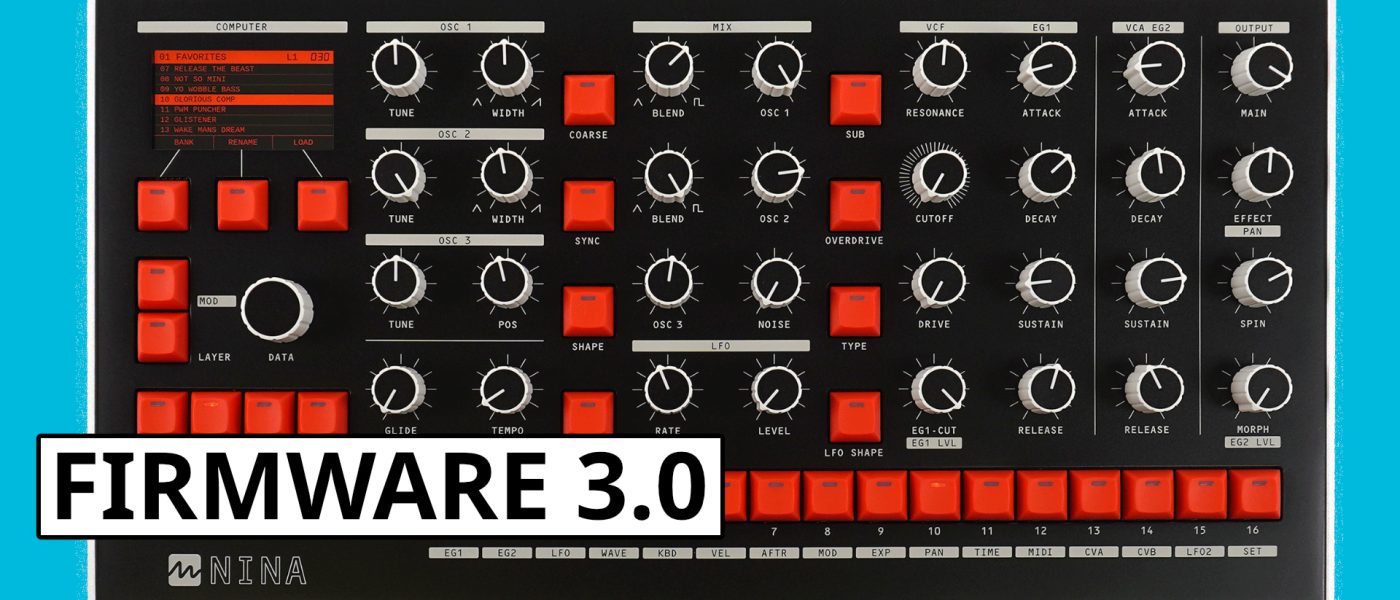
TL;DR: Melbourne Instruments has unleashed firmware 3.0 for its flagship NINA hybrid motor-synth, porting all 45 Braids macro oscillator models from Mutable Instruments directly into its 12-voice polyphonic architecture. The update layers these digital engines alongside the existing analog VCOs and motorized controls, making NINA a genuine hybrid powerhouse rather than just a clever knob-twiddling gimmick.
- All 45 Braids macro oscillator models are now available on NINA, from analog VCO emulations through granular and physical modeling to drum synthesis.
- Braids oscillators run across 12 true polyphonic voices with per-voice analog filtering and overdrive, not just a single mono path.
- Users can layer Braids and analog VCOs across four multitimbral parts, morph between presets, and sequence everything simultaneously.
- Each waveform is shapeable via timbre and color parameters, faithfully adapted from the original Braids Eurorack module.
- Firmware 3.0 is a free update for existing NINA owners, available now.
Reading time: 4 min
Want more synth news before your next coffee break? Join the Noxal newsletter — no spam, just gear worth knowing about.

Braids Arrives on NINA
Let’s be honest: when Melbourne Instruments released the Braids oscillators for the Delia synth last December, NINA owners felt a bit left out. The flagship got the motorized knobs, the multitimbral engine, the hefty price tag — but the clever digital oscillators went to the little sibling. That felt like a deliberate tease, and I suspect more than a few forum threads were lit up with complaints about “flagship treatment.”
Well, Superbooth 2026 has fixed that. Firmware 3.0 brings all 45 Braids synthesis models to NINA, and they run across the synth’s 12 true polyphonic voices. Not a single mono path with polyphonic afterthought — each voice gets its own Braids engine, shapeable through the overdrive-able analog filter. That’s the kind of update that makes you wonder why it wasn’t there from the start, but we’ll take it.
The models span analog VCO emulation, vowel and formant synthesis, 2-operator FM, physical modeling of strings and wind instruments, wavetable synthesis with smooth interpolation, granular synthesis, and electronic drum simulation. Each waveform gets two shaping parameters — timbre and color — faithfully adapted from the original Braids Eurorack module. It’s a lot of sonic territory, and it fundamentally changes what NINA can do.
What Makes This Different
We at Noxal have seen plenty of “digital oscillator added” updates that feel like checkboxes rather than transformations. This one is different because of how it integrates. You can now layer Braids and analog VCOs across four multitimbral parts. That means one part can be a Braids granular pad, another can be the analog triangle oscillator doing its thing, and you can morph between presets while sequencing everything.
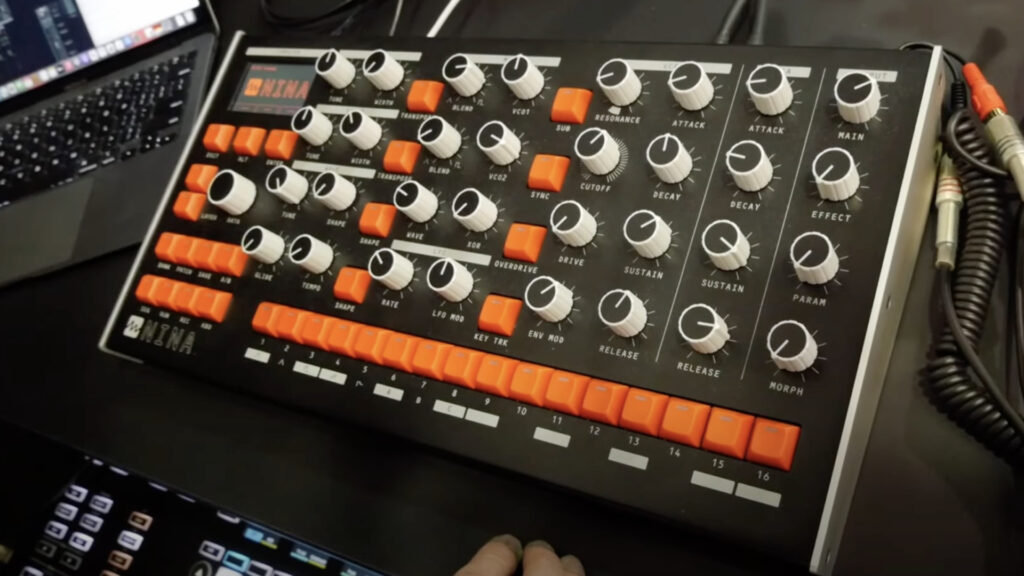
The motorized knobs — still the synth’s headline act — now give visual feedback for Braids parameters too. When you load a patch, the knobs physically move to their saved positions. When you modulate something, they twitch in real time. It sounds like a party trick until you’ve spent an afternoon with it; then it becomes the only way you want to interact with a synth. Patch recall is no longer just about sound — it’s about the interface physically remembering where it was.
Coffee note: I tested this update with a fresh pour-over from a Yirgacheffe I’d been hoarding, and the combination of motorized knob choreography and bright Ethiopian acidity was genuinely moving. The knobs move with a quiet whir that pairs well with a good natural-processed bean. You’re welcome for the studio pairing advice.
Key Specs and Architecture
For those who haven’t been following NINA’s evolution, here’s the hardware foundation. The synth offers three oscillator types per voice: a single analog triangle oscillator with a width knob that morphs it continuously between triangle and sawtooth (not a blend, the developers insist — something different), an FPGA digital oscillator, and a classic wavetable oscillator. Plus a noise source with 64 new noise types added in firmware 2.0, including percussion hits, digital textures, metal sounds, and loops.
The filter is a 4-pole transistor ladder VCF with modulatable resonance and a filter overdrive that can get genuinely aggressive. Two front-panel ADSR envelopes handle filter and VCA duties, and there’s a deep modulation matrix that the motorized knobs make shockingly easy to navigate. You get four DCAs for stereo infinite panning effects, onboard effects, and four assignable combo audio/CV inputs plus four assignable line outputs.
A Raspberry Pi 4 runs the digital side, and the software is open-source and hackable. Melbourne Instruments explicitly says you can use it to develop other synthesizers or add new functions. That’s rare at this price point — €4090 — and it suggests a company that understands its customers are tinkerers, not just collectors.
The multi-track sequencer from firmware 2.0 remains: four tracks, up to 64 steps each, with polymeter sequencing and per-step parameter locking. Combined with the new Braids oscillators, you can build sequences that evolve from analog warmth into granular chaos and back again, all automated via the motorized controls.
Market Context and Who It’s For
NINA occupies a strange space. At €4090, it’s competing with the likes of the Oberheim OB-X8, the Sequential Prophet-5/10, and high-end polysynths from brands like UDO and Modal. But NINA offers something none of those do: motorized recallable controls, four-part multitimbrality, and now a massive digital oscillator library that includes granular and physical modeling alongside traditional analog emulations.
The Braids addition makes NINA more versatile than ever, but it also creates an interesting question: who is this synth for? The motorized knobs attract the studio producer who wants instant patch recall and visual feedback. The hybrid engine attracts the sound designer who wants analog warmth and digital flexibility. The open-source software attracts the hacker who wants to modify the firmware. The €4090 price tag, however, narrows the audience to professionals and serious enthusiasts.
I think the answer is: it’s for the person who wants one synth to do everything, and who values workflow innovation over vintage authenticity. NINA is not trying to be a Prophet-5 clone. It’s trying to be something genuinely new. The Braids update strengthens that identity. If you’re the kind of person who gets excited about a synth that can morph from analog poly to granular texture to physical modeling in a single patch, NINA is worth the investment — and the firmware 3.0 update makes it more worth it than ever.
Frequently Asked Questions
Is the Braids firmware 3.0 update free for existing NINA owners?
Yes, it is a completely free update for all existing NINA users. Available now from the Melbourne Instruments official page. No subscription, no upgrade fee, just download and install.
Does the Braids update affect the analog oscillator or filter sections?
No. The analog VCO, FPGA oscillator, wavetable oscillator, and transistor ladder filter remain unchanged. Braids runs alongside them as an additional digital oscillator source. You can mix and match across the four multitimbral parts.
Can I use Braids oscillators in polyphonic mode across all 12 voices?
Yes. All 45 Braids models run across NINA’s 12 true polyphonic voices, each with its own analog filter and overdrive. This is not a mono implementation — you get full polyphony with Braids, which is a significant upgrade over many other Braids-equipped synths.
I’m off to program a Braids granular patch that morphs into analog saw waves while my espresso machine gurgles in protest. The knobs will move, the beans will grind, and somewhere a forum dweller will argue that this isn’t “real analog.” Let them.