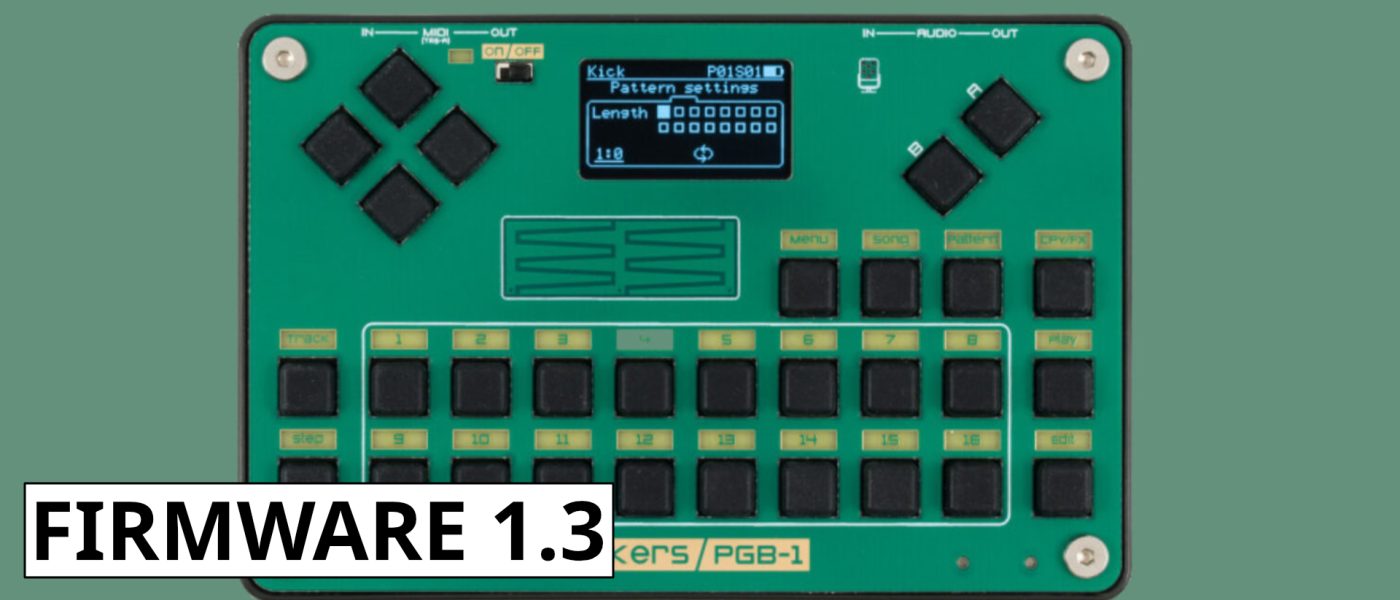
TL;DR: Wee Noise Makers has released firmware 1.3 for its PGB-1 pocket-sized groovebox, adding new hi-hat engines, an overhauled LFO system, a revamped project mixer, and a web-based sample manager. The update is free for all users, and a second production batch is now available with minor hardware tweaks.
- Firmware 1.3 introduces eight new hi-hat engines (808, 505, LM2, CR78, MRK2, acoustic) with LP/BP/HP filter variants.
- LFO system gets additive, subtractive, and bipolar modes plus a new random shape and real-time visual feedback.
- Project mixer now shows levels across tracks, effects, and master output with clipping indicators.
- Autofill feature is no longer limited; can be applied to any track with adjustable probability.
- Second production batch includes a black screen and improved battery door; web-based sample manager (beta) now available.
Reading time: 4 min
Want more synth news before your next coffee break? Join the Noxal newsletter — no spam, just gear worth knowing about.

A Pocket That Punches Above Its Weight

When Fabien Chouteau first showed the PGB-1 at SynthFest France two years ago, we at Noxal raised an eyebrow. A pocket-sized groovebox with open-source firmware? It sounded either brilliant or a recipe for endless tinkering. Turns out, it’s both. The PGB-1 has been shipping since October 2025 at 279€ (plastic) or 309€ (aluminum), and it’s already carved a niche among travelers, bedroom producers, and anyone who’s ever cursed a laptop on a train.
Firmware 1.3, released just before SynthFest France 2026, is the kind of update that makes you wonder why bigger companies can’t be bothered. It’s free, it’s substantial, and it addresses real workflow complaints. I’ve spent a few days with it, and I can confirm: this isn’t a point-release patch. It’s a rethink of several core systems.
New Hi-Hat Engines and Sampler Tricks
The PGB-1 already had a ridiculous number of drum engines — 707 and 909 samples, plus a bunch of synthesis-based ones. Firmware 1.3 adds eight more hi-hat engines: 808, 505, LM2, CR78, MRK2, and acoustic. Each comes in low-pass, band-pass, and high-pass variants. That’s not just padding a spec sheet; it means you can dial in everything from a crisp 808 sizzle to a gritty LM2 wash without leaving the box.
The sampler engines also got love. Glide is now available for smooth pitch transitions, with fast and slow options. There are also new pitch-shifter engines that bump samples up or down by one or two octaves. If you’ve ever wanted to turn a vocal snippet into a bass drone or a kick into a sub rumble, this is your ticket. It’s not revolutionary, but it’s the kind of thoughtful addition that makes the PGB-1 feel less like a toy and more like a tool.
LFO Overhaul and Project Mixer Facelift
The LFO system in firmware 1.3 is a proper overhaul. New operation modes — additive, subtractive, and bipolar — give you more control over how modulation affects parameters. There’s also a new random shape, which I’ve already used to create some pleasantly chaotic filter sweeps. The controls have been reorganized to make sync and looping more intuitive, and there’s now real-time visual feedback showing exactly how modulation is moving things around. It’s not a full modular system, but for a groovebox that fits in a jacket pocket, it’s impressive.
The project mixer has also been given a facelift. You can now monitor and adjust levels across tracks, effects, and the final output, with visual indicators that warn you about clipping. There are dedicated pages for volume and stereo panning across all tracks at once, plus a page to assign or review which effects are on each track. It’s a small UI win, but it saves time when you’re deep in a live set and don’t want to dig through menus.
Autofill, Live FX, and Web Sample Manager
The autofill feature — previously limited to certain tracks — can now be applied to any track. You can also adjust probability settings to make fills hit more or less often. It’s a small change, but it opens up the PGB-1 for more improvisational use. The filter and stutter effects are now fully tweakable, too. You can create your own rhythm patterns in the stutter FX, step by step, with custom fades in and out. That’s the kind of detail that makes a groovebox feel alive during a performance.
And then there’s the web-based sample manager (beta). It lets you preview sounds, edit start and end points, apply effects, drag and drop audio files, and back up your samples. It’s browser-based, so no install hassle. I’ve used it to quickly swap out a few drum hits, and it works well enough for beta software. Wee Noise Makers has also released a proper user manual — deeper than the quick-start guide — which is a godsend given the feature depth.
Who Is This For?
The PGB-1 is for the person who wants a groovebox that doesn’t demand a backpack. It’s for the live performer who needs instant access to 16 tracks of sequencing, arpeggiation, and chord modes. It’s for the tinkerer who appreciates open-source firmware and the promise of ongoing updates. It’s not for the person who wants a polished, all-in-one workstation with a massive touchscreen. The PGB-1 is small, plastic (or aluminum if you spring for it), and its UI is menu-divey. But if you can get past that, the sound engines are genuinely excellent, and the sequencer is deeper than many desktop units.
It’s also for the person who likes supporting independent developers. Fabien Chouteau is clearly invested in this box — firmware 1.3 is proof of that. The second production batch includes a black screen and a better battery door, which suggests he’s listening to feedback. That’s rare in hardware-land.
Market Context and Availability
At 279€, the PGB-1 competes with the Korg Volca series, the Teenage Engineering PO line, and the Roland Aira Compact series. It’s more expensive than most of those, but it also offers far more under the hood. The open-source approach means you’re not locked into a manufacturer’s roadmap. If the community decides the PGB-1 needs a granular engine, it might get one. That’s a powerful selling point.
The second production batch is available now directly from Wee Noise Makers and retailers. The plastic version is 279€, the aluminum version is 309€. Firmware 1.3 is a free download for all existing users. If you’ve been on the fence, now is a good time to jump in.
Frequently Asked Questions
Is the PGB-1 firmware 1.3 update free?
Yes, it is completely free for all existing PGB-1 users. You can download it from the Wee Noise Makers website.
What new hi-hat engines are added in firmware 1.3?
Eight new hi-hat engines: 808, 505, LM2, CR78, MRK2, and acoustic. Each is available in low-pass, band-pass, and high-pass filter variants, giving you 24 new hi-hat options total.
Does the second production batch have any hardware changes?
Yes, the second batch includes a black screen and a redesigned battery door. These are minor improvements based on user feedback. The price remains the same.
I’ll be honest — I updated the firmware while my espresso machine was warming up, and by the time my cup was ready, I’d already sequenced a beat using the new 808 hats. That’s efficiency. Now if only my coffee maker had open-source firmware…