TL;DR: Swedish synth designer Albert Nyström returns with the HUM 2, a multi-timbral digital synthesizer that layers three independent voices with generative sequencing and six built-in physical sensors. It’s not just another groovebox — the sensors let you modulate parameters using light, tilt, distance, and touch, promising a genuinely tactile performance experience. Pricing and availability remain unannounced, but we’re already clearing space on our desks.
- Three independent voices, each with its own synthesis engine (subtractive, FM, wavetable, organ, and experimental) plus per-layer generative sequencers up to 64 steps with 17 quantize scales.
- Six onboard sensors (distance, light, tilt X/Y, touch 1/2) that can be mapped to any parameter for real-time, expressive modulation.
- Modulation engine with four mappable LFOs and a multi-FX processor with independent sends for delay, reverb, and overdrive.
- Connectivity includes L/R line output, headphone jack, three CV outputs, two CV inputs, and MIDI + audio over USB-C.
- Evolution of the original HUM released in 2024, with a deeper sensory component and expanded generative capabilities.
Reading time: 4 min
Want more synth news before your next coffee break? Join the Noxal newsletter — no spam, just gear worth knowing about.

What is the Nyström HUM 2?

Albert Nyström has a knack for making small, weird, and affordable instruments that feel like they were born in a basement lab fueled by curiosity and cheap coffee. The original HUM, released in 2024, was a compact digital synth with generative leanings. It was charming but left us wanting more — more voices, more modulation, more ways to poke and prod the sound.
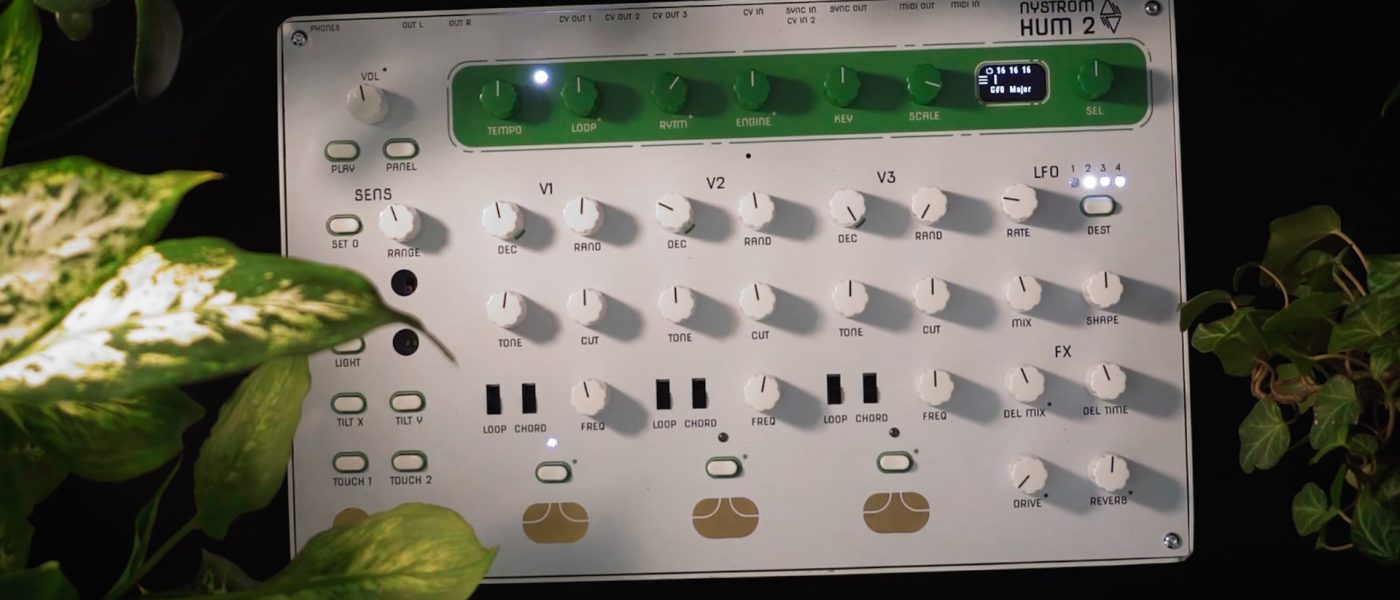
The HUM 2 answers that call, and then some. It’s a multi-timbral digital synthesizer with three independent voices, each sporting its own assignable synthesis engine. You get classics like subtractive, FM, and wavetable, plus organ and “more experimental engines.” Nyström doesn’t elaborate on how deep each engine goes, but the front panel shows five parameters and two switches per layer — enough to shape a sound without drowning in menus. Each voice also gets its own generative sequencer, capable of creating patterns on the fly or fixed loops up to 64 steps. Quantization is handled by 17 scale options, so your sequences stay musical even when the generative algorithm gets a little too enthusiastic.
On the back, you’ll find L/R line outputs, a headphone jack, three CV outputs, two CV inputs, and MIDI plus audio over USB-C. That’s a solid I/O suite for a desktop unit, and the CV connectivity means it can play nice with your modular system or sequence external gear. It’s a self-contained ecosystem that doesn’t demand a computer, but won’t shun one either.
Sensory Synthesis: The Real News
Let’s be honest: generative sequencers are everywhere these days. Every other synth and plugin promises to spit out endless patterns while you sip your latte and pretend you’re composing. What separates the HUM 2 from the pack is its six built-in sensors: distance, light, tilt X/Y, and touch 1/2. These aren’t gimmicks — they’re mappable modulation sources that let you physically interact with your sequences in real time.
Imagine waving your hand over the distance sensor to swell the reverb, or tilting the entire synth to bend the filter cutoff. The light sensor could trigger a new pattern when you dim the studio lights (ideal for dramatic performance art or just when your cat walks past). The touch sensors offer two points for direct, capacitive control — think of them as touch strips that can be assigned to any parameter. This isn’t just about making sounds; it’s about making sounds with your whole body, not just your fingertips on a keyboard.
This sensory layer transforms the HUM 2 from a desktop sequencer into an expressive instrument. Few synths at this price point (whatever it ends up being) offer this level of tactile engagement. It’s the difference between pressing play and actually playing.
Three Voices, Three Worlds
Three independent voices might sound modest in a world of 16-voice polyphonic workstations, but the HUM 2 isn’t about playing chords. Each voice is a complete sound engine with its own sequencer, parameters, and modulation routing. You could have one voice running a generative FM pattern, another doing a slow wavetable pad, and a third triggering percussive organ stabs — all modulated by the sensors simultaneously. The modulation engine adds four mappable LFOs, and the multi-FX processor provides delay, reverb, and overdrive with independent sends per voice.
This architecture encourages layering and interplay rather than traditional note-by-note composition. The generative sequencers on each voice can interact, creating evolving polyrhythms and unexpected harmonic shifts. The 17 scale options keep things musical, but you can also go off-script if you’re feeling adventurous. The CV inputs and outputs further extend the possibilities, letting you sync with modular gear or control external parameters.
We at Noxal appreciate a synth that understands that limitation breeds creativity. Three voices force you to make choices. The sensors force you to engage physically. The generative engines force you to relinquish total control. It’s a recipe for happy accidents, and in my experience, happy accidents are where the best patches are born.
Market Context and Who This Is For
Nyström operates in a space occupied by other boutique builders like Critter & Guitari, Folktek, and SOMA Laboratory. These are instruments that prioritize experimentation and tactile feedback over traditional keyboard-based workflows. The HUM 2 fits squarely in that tradition, but with a more refined feature set and a clearer focus on generative sequencing as a performance tool.
Who is this for? If you’re a modular user looking for a self-contained generative brain with CV connectivity, the HUM 2 could be your new best friend. If you’re a keyboard player who wants to break out of scale-based thinking, the sensors and generative engines offer a new way to interact with sound. If you’re a sound designer who loves happy accidents, you’ll find plenty here. It’s also ideal for live performers who want something more expressive than a laptop running Ableton — no clicking, just waving, tilting, and touching.
The original HUM was a cool experiment. The HUM 2 feels like a serious instrument. We just need to know the price. Given Nyström’s history of affordable DIY kits (remember the $70 DIY synth?), we’re hoping the HUM 2 remains accessible without sacrificing quality. Until pricing drops, we’ll be here, refreshing our RSS feeds and grinding our coffee beans a little finer in anticipation.
Frequently Asked Questions
What synthesis engines are included in the Nyström HUM 2?
The HUM 2 offers classic subtractive, FM, wavetable, organ, and additional experimental engines across three independent voices. Each engine is controlled by five parameters and two switches per layer, though Nyström has not detailed the depth of each engine beyond basic controls.
How do the built-in sensors work on the HUM 2?
The six sensors (distance, light, tilt X/Y, and touch 1/2) can be mapped to any knob or parameter on the synth. Once assigned, moving your hand, tilting the unit, or touching the capacitive pads modulates the assigned parameter in real time, allowing for expressive, hands-on control over generative sequences and sound shaping.
When will the Nyström HUM 2 be available and how much will it cost?
As of the announcement, availability and pricing are TBA (to be announced). Nyström typically keeps prices reasonable — the original HUM was affordable — but we’re waiting for official details. Expect updates around Superbooth 2025 or shortly after.
I’m already imagining the look on my cat’s face when I start tilting the HUM 2 toward the light sensor and it suddenly drops into a minor key. She’ll judge me, but the generative sequencer won’t. Time to brew another pot and wait for pricing news.