
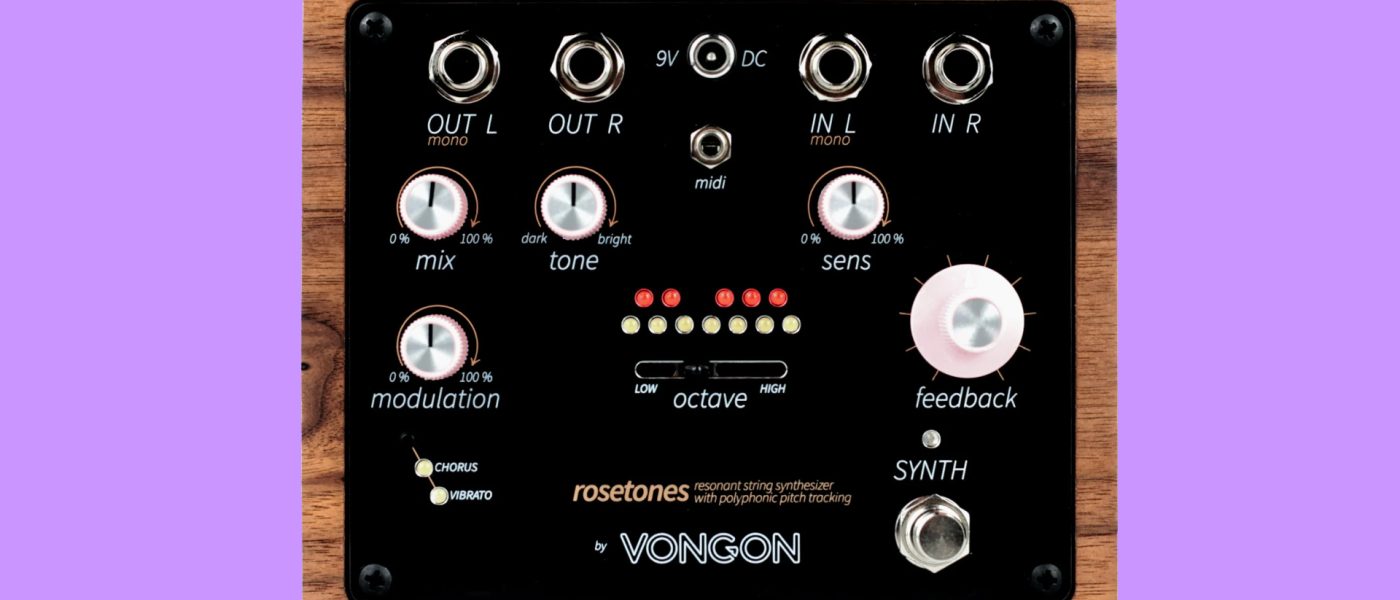
TL;DR: Vongon’s Rosetones is not your typical pedal — it’s a 12-voice polyphonic resonant string synthesizer in a compact stompbox. It tracks your guitar in real time, excites a chromatic resonator bank, and can even be played standalone via MIDI. At $449, it’s a niche but fascinating tool for those who want to turn their instrument into a luscious, evolving string machine.
- 12-voice polyphonic resonator bank that sympathetically responds to incoming audio, creating organic string textures.
- Six knobs control mix, tone, sensitivity, modulation, octave range, and feedback; a slider shifts resonance pitch for harmonies and inversions.
- Built-in chorus and vibrato effects add ensemble width or pitch drift.
- TRS 3.5mm MIDI input enables standalone use as a 12-voice string synth with a MIDI controller (nine hardware presets).
- Available now for $449 — a price that places it between premium pedals and desktop synths.
Reading time: 4 min
Want more synth news before your next coffee break? Join the Noxal newsletter — no spam, just gear worth knowing about.

What Is the Vongon Rosetones?

We at Noxal have seen a lot of pedals claiming to be “more than meets the eye,” but the Vongon Rosetones takes that phrase and drives it through a resonant filter. At first glance, it looks like a sleek, minimalist stompbox — think a compact control panel with six knobs, a slider, and a toggle switch. But beneath that unassuming exterior lies a 12-voice polyphonic resonant string synthesizer. Yes, you read that right: a polyphonic synth in a pedal, and not one that wants you to plug in a keyboard (though you can).
Vongon is a boutique brand known for pushing the boundaries of what a pedal can do. Their previous releases, like the Paragraphs filter pedal, have been weird and wonderful in equal measure. With Rosetones, they’ve created a device that sits somewhere between a string synth, a resonator bank, and a delay unit. It’s not trying to be a faithful recreation of a Mellotron or a Solina — it’s something far more experimental. As the press materials put it, it “envelops the guitar in string-synth textures.” We’d add that it does so with a distinctly organic, almost acoustic quality.
A Resonator Bank That Listens
The beating heart of the Rosetones is a 12-voice chromatic resonator bank. This isn’t your average shimmer reverb or pitch-shifting delay. Instead, the pedal continuously listens to your audio — whether from a guitar, a synth, or even a microphone — and waits for the right note to come along. When it detects a pitch, it excites the corresponding delay line, creating a sympathetic resonance. Imagine the strings of a piano vibrating in response to a singer’s voice, but in a pedal. That’s the vibe here.
This approach yields textures that are both delicate and powerful. Play a single note, and the Rosetones responds with a bloom of resonant harmonics. Strum a chord, and you get a rich, polyphonic wash that can range from a gentle shimmer to a roaring, feedback-laden swell. The sensitivity and feedback knobs let you dial in how aggressively the resonators react and how long they sustain. This means you can go from short, percussive bursts to glacial, never-ending decay trails. It’s a system that rewards exploration — and a bit of patience.
Tweaking the Texture: Knobs, Sliders, and FX
Control-wise, the Rosetones is refreshingly simple. Six knobs handle mix, tone (dark to bright), sensitivity, modulation, low-to-high octave range, and feedback. The slider is where things get interesting: it shifts the resonance voice, letting you create additional harmonies, chord inversions, and other tonal tricks. It’s a subtle but powerful tool for changing the harmonic character of the resonator bank without needing a full keyboard.
On top of that, Vongon baked in two built-in effects: chorus and vibrato. The chorus adds subtle multi-voice detuning, giving you that classic ensemble-style width — think string synth pads but with a pedal-friendly footprint. The vibrato, on the other hand, introduces a pitch-drifting effect that can make the resonators sound unstable or even haunting. Both effects can be blended to taste, and they interact with the modulation knob for additional motion and depth. The result is a sound that can feel lush, wobbly, or even slightly broken — in the best possible way.
There’s also a three-way toggle for the octave range (low, medium, high), which lets you match the resonator bank to the register of your instrument. And with a sustain that can be dialed from short to infinite, you can craft everything from tight, rhythmic plucks to endless, ambient soundscapes.
MIDI and Standalone Use: A Secret Synth
Here’s where the Rosetones reveals its dual personality. If you don’t play guitar — or if you simply want to use it as a standalone instrument — you can plug in a MIDI controller via the TRS 3.5mm MIDI input. This transforms the pedal into a fully fledged 12-voice string synthesizer. No guitar required. You can save up to nine hardware presets, making it usable in live or studio settings without endless knob-twiddling.
We at Noxal are particularly intrigued by this feature. While there are plenty of desktop string synths out there, few offer this level of portability and immediacy. The Rosetones, in standalone mode, becomes a compact, hands-on synth that fits in a pedalboard or a small corner of a desk. The caveat is that there aren’t many demos of it in MIDI mode yet — the company has focused on guitar demos so far. But the potential is clear: a polyphonic resonant string synth for $449 that you can play with any MIDI controller is a compelling proposition, especially if you’re after something more experimental than the usual Juno or Solina emulations.
Market Context and Who It’s For
At $449, the Rosetones sits in a curious price bracket. It’s more expensive than a typical boutique pedal but cheaper than most desktop synthesizers. For guitarists, it offers a unique texture that you won’t find in standard delays or reverbs — it’s more akin to running your signal through a resonant filter bank or a physical modeling synth. For synth enthusiasts, it’s a MIDI-controlled string machine that can also process external audio, making it a versatile tool for sound design.
Who is this for? The adventurous guitarist who wants to escape the pedalboard clichés of distortion and delay. The synth player who craves organic, evolving textures without the menu-diving. The producer who loves the idea of a resonator bank but wants it in a format that can be stomped on mid-set. It’s not for everyone — if you’re looking for a straightforward reverb or a classic synth emulation, you might be better served elsewhere. But if you’re willing to experiment with sympathetic resonance and unpredictable feedback, the Rosetones could become your new secret weapon.
Frequently Asked Questions
Can the Vongon Rosetones be used with instruments other than guitar?
Yes. The Rosetones accepts any audio input via a standard 1/4-inch jack, so you can plug in anything from a bass guitar to a synth to a microphone. The TRS MIDI input also allows it to function as a standalone synth when connected to a MIDI controller.
How many presets does the Rosetones have?
It has nine hardware presets that can be saved and recalled directly on the pedal. This makes it easy to switch between sounds live or in the studio without needing to re-dial knobs.
Does the Rosetones require a specific power supply?
Yes, like most pedals, it requires a standard 9V DC center-negative power supply. It does not run on batteries, so make sure you have a suitable adapter.
We at Noxal have a soft spot for gear that makes us rethink our signal chain. The Rosetones is exactly that — a pedal that turns your guitar into a string machine, and your coffee break into a sound design session. Just don’t blame us if you lose an afternoon to feedback-laced resonance.