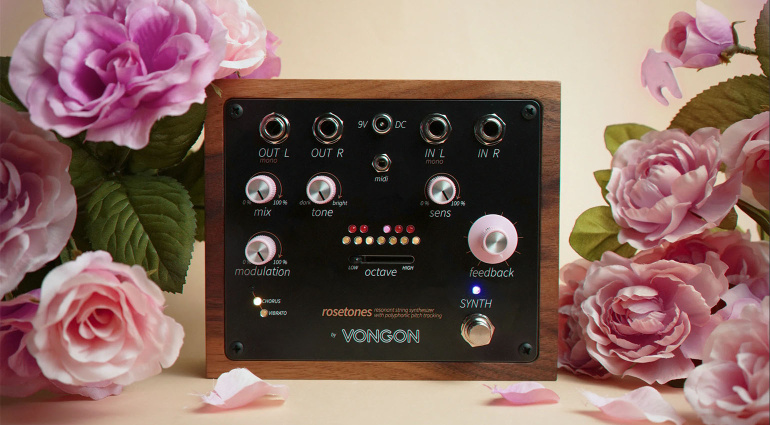
TL;DR: VONGON, the Oakland boutique behind the ultra-minimal Replay synth, has dropped Rosetones – a handmade string synth pedal with a 12-voice chromatic resonator oscillator. It tracks your playing, triggers tuned delay lines, and sounds like a dream for guitar, harp, or even percussion. Available now for $449.
- Rosetones uses a 12-voice chromatic resonator bank instead of a typical oscillator, routing detected pitches into tuned delay lines for string-like harmonics.
- Features feedback, sensitivity, octave slider, waveshaper, tone filter, and modulation section with chorus/vibrato – all controllable via MIDI for chord voicings.
- Handmade in Oakland, California, with a hardwood enclosure; works as an effect pedal or standalone synth.
- Price is $449 direct from VONGON – competitive for boutique, hand-built gear with this level of sonic character.
Reading time: 4 min
Want more synth news before your next coffee break? Join the Noxal newsletter — no spam, just gear worth knowing about.
What Is VONGON Rosetones?

Let’s get this out of the way: VONGON is not your average pedal company. Based in Oakland, California, they’ve been quietly releasing some of the most aesthetically and sonically distinctive gear in the boutique space. If you remember the Replay synth – that ultra-minimalist box that divided opinions like a bad coffee roast – you know they don’t do things by half measures. Rosetones is their latest, and it’s a string synth pedal that does something genuinely different.
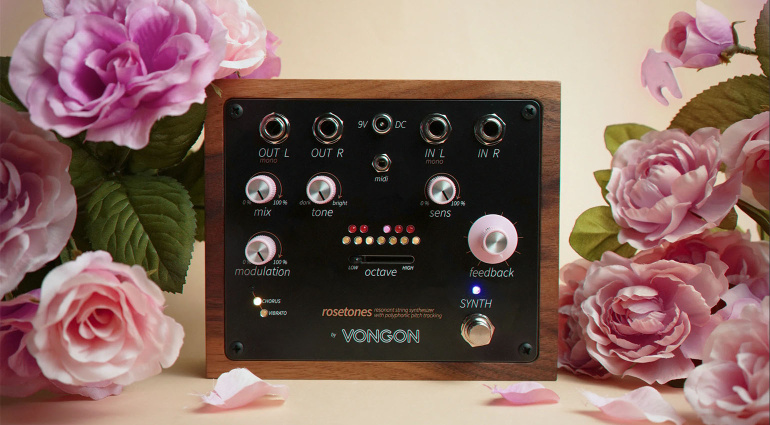
At its core, Rosetones is a 12-note chromatic string synth pedal. But here’s the twist: instead of a standard oscillator, it uses a 12-voice chromatic resonator bank. When you play a note, the pedal tracks your pitch and routes it into tuned delay lines. Think Karplus-Strong synthesis, but with a dedicated resonator for each chromatic pitch class. The result is a sound that’s organic, harmonic, and surprisingly expressive – like a plucked string that never quite dies, but evolves.
We at Noxal have seen a lot of string synth pedals come and go. Most are either digital emulations that feel sterile or analog circuits that eat up your board space. Rosetones sits in a sweet spot: it’s physical, it’s responsive, and it sounds like someone actually cared about the tonality rather than just ticking feature boxes.
What Makes It Interesting?
Let’s talk about that resonator bank. VONGON describes it as “each pitch class exciting a resonator that can sustain, swell, and interact with feedback to create dynamic harmonic movement.” That’s not marketing fluff – it’s a genuine departure from how most synth pedals work. Instead of a simple oscillator that repeats the same waveform, you get a system where each note has its own acoustic character. Play a chord, and each voice behaves slightly differently, creating a texture that feels alive.
The feedback knob acts like a decay envelope, controlling how long the resonator sustains. Crank it up, and you get infinite drones that can morph into chaotic howls. The sensitivity knob lets you control velocity response, so your picking dynamics actually matter. And that octave slider? It can alter chord voicings, giving you harmonic flexibility without needing a secondary controller. Via MIDI, you can set chord voicings externally, which opens up possibilities for sequencers or keyboardists who want to treat Rosetones as a standalone synth voice.
I’ll be honest – I’ve spent too many late nights with a cup of cold coffee watching the demo videos. The one with Emily’s harp is particularly gorgeous. Rosetones seems to love string instruments, but it also handles percussion and even synth inputs with surprising grace. It’s not just a one-trick pony; it’s a textural tool that rewards experimentation.
Key Specs and Features
Here’s the rundown for the spec-sheet crowd:
- Resonator Bank: 12-voice chromatic, one per pitch class, with Karplus-Strong inspired tuned delay lines.
- Controls: Feedback (decay), Sensitivity (velocity), Tone filter (dark to bright), Modulation knob (chorus/vibrato, selectable individually or together).
- Octave Slider: Shifts pitch of the resonator, capable of altering chord voicings.
- MIDI: Full MIDI control for chord voicings via external controller.
- Audio Path: Waveshaper bank before the tone filter and modulation section.
- Connectivity: Audio input (works with guitar, synth, etc.) and standalone synth mode.
- Enclosure: Handmade hardwood – because if you’re paying boutique prices, you want something that looks as good as it sounds.
- Price: $449 direct from VONGON.
It’s not a feature monster by modern standards – there’s no endless menu diving or Bluetooth app. But that’s the point. Rosetones is about immediate, tactile control over a specific, beautiful sound. Sometimes less is more, especially when that “less” is this well-tuned.
Market Context and Competition
We’ve seen a mini-renaissance of Karplus-Strong devices lately. Just this week, we covered the Zlosynth Instruments Arplus, which takes a different approach but lives in a similar sonic neighborhood. Then there’s the Tiptop Audio Resonator, which brings Polymoog-style resonator filters to Eurorack. And let’s not forget the endless parade of pitch shifter pedals that try to do string-like textures.
But Rosetones stands apart because it’s not trying to be a Swiss Army knife. It’s a dedicated, single-purpose tool for generating and manipulating resonator-based string tones. At $449, it’s pricier than a mass-market multi-effects pedal, but it’s also hand-built in the US with a hardwood enclosure. For the boutique buyer who values craftsmanship and sonic character over raw specs, that’s a fair trade.
We at Noxal have a soft spot for gear that commits to a vision. Rosetones commits hard. It’s not for everyone, but for the right player – someone who wants to add organic, evolving string textures to their setup – it’s a gem.
Who Is It For?
If you’re a guitarist who’s tired of the same old overdrive pedals and wants to explore textural, ambient territory, Rosetones is a no-brainer. It pairs beautifully with clean amps and single-coil pickups, turning your guitar into a string machine that can do everything from subtle shimmer to full-on drones.
Synth players will love it as an external processor or standalone voice. Run a drum machine through it, and suddenly your beats have a resonant, harmonic tail that’s more organic than any reverb. Harp players? Apparently, it works wonders there too. The point is, Rosetones rewards curiosity. It’s not a plug-and-play effect for the impatient; it’s a tool for the tinkerer who enjoys finding new sounds in the same box.
That said, if you need pristine digital effects or a massive feature set, look elsewhere. Rosetones is analog-voiced, feedback-friendly, and occasionally unpredictable – which is exactly why we love it.
Frequently Asked Questions
Is the VONGON Rosetones a true stereo pedal?
No, Rosetones is mono in and mono out. The modulation section (chorus/vibrato) adds spaciousness, but it’s not a stereo effect. If you need stereo imaging, you’ll need to pair it with a stereo reverb or delay after it.
Can I use Rosetones with a bass guitar?
Yes, but with caveats. The resonator bank is tuned chromatically, so it will track bass notes, but the character is more mid-range focused. For deep sub-bass, you might want to blend it with a clean signal. That said, it can produce some lovely growly textures on bass.
Does it require external power or batteries?
Rosetones uses a standard 9V DC power supply (center negative, 2.1mm barrel). No battery option, so make sure your pedalboard power supply has an extra slot. Given the hand-built nature, we’d recommend a quality isolated supply to keep noise low.
Now if you’ll excuse me, I need to figure out how to convince my wife that a $449 resonator pedal is a “necessary studio tool” – right after I finish this cold pour-over that’s been sitting on my desk since the demo video started playing.