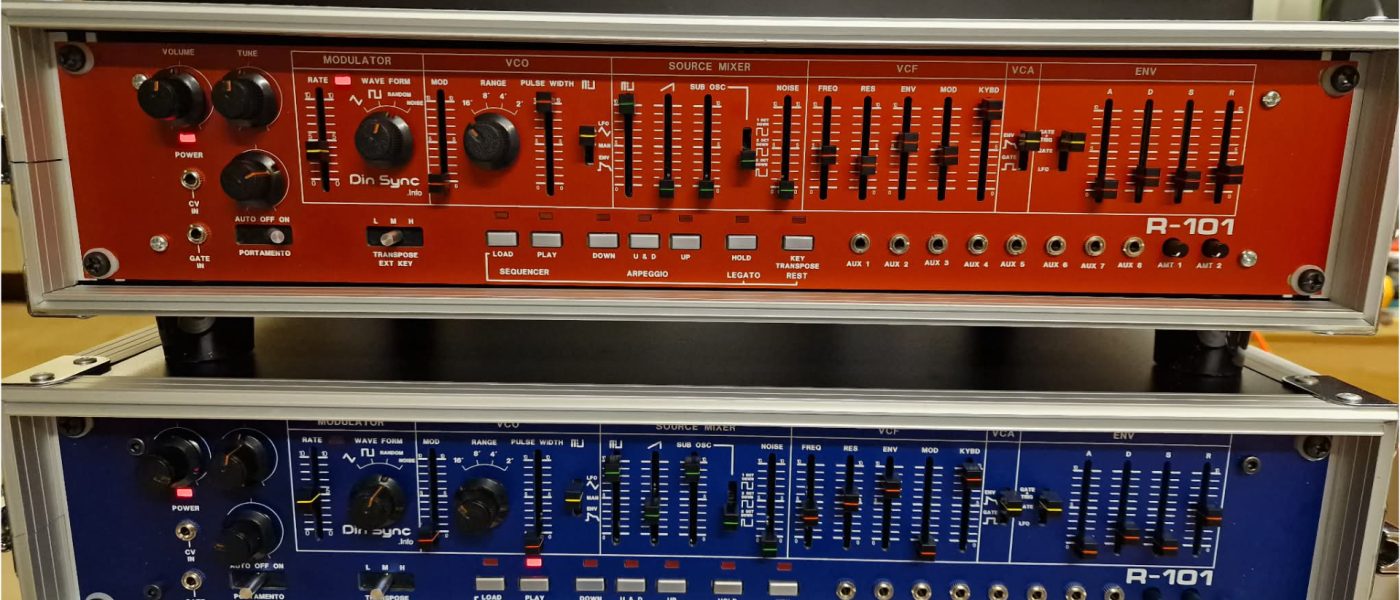
TL;DR: Din Sync’s Paul Barker is bringing the Roland SH-101 to the rackmount world with the R-101, a 2HE replica built from original-spec components. Expect a Curtis CEM 3340 oscillator, an IR 3109-based filter, and a built-in sequencer — all without presets, because why would you need ‘em? It’s the SH-101 you know and love, now with a face that says “I’m serious about my rack.”
- Rackmount format (2HE, 150mm deep) with all front-panel controls — no keyboard, no nonsense.
- Faithful reproduction using original-type CEM 3340 VCO, IR 3109 filter chip replica, and BA662 VCA clone.
- Built-in sequencer and arpeggiator with legato, plus eight AUX CV inputs (currently labeled, likely expandable).
- MIDI in/out, CV/gate input, and no presets — analog purists, rejoice.
- Launching at Superbooth 2026 (May 7–9); price and availability TBA.
Reading time: 3 min
Want more synth news before your next coffee break? Join the Noxal newsletter — no spam, just gear worth knowing about.

The Rackmount Revolution

We at Noxal have a soft spot for the Roland SH-101. It’s a synth that needs no introduction — a monosynth that defined the sound of acid, electro, and a dozen other genres. But let’s be honest: the original’s keyboard is a bit of a diva. It takes up space, it’s plastic, and unless you’re a keyboardist, it’s just dead weight. Enter Paul Barker, the mad scientist behind Din Sync, who’s decided to give the SH-101 a rackmount makeover. The R-101 is a 2HE rackmount clone that strips away the keyboard and gives you all the controls on a tidy front panel. It’s like the SH-101 went to the gym, got a haircut, and put on a suit.
Now, I know what you’re thinking: “Another SH-101 clone?” And you’d be right. We’ve got Behringer’s MS-1, Donner’s B1, Superlative’s Super 101, and a dozen others. But Din Sync isn’t just cloning — they’re replicating. Paul Barker is known for using original components where possible, and the R-101 is no exception. This isn’t a cheap knockoff; it’s a love letter to the original, but in a format that makes sense for the modern studio. If you’ve got a Eurorack case or a 19-inch rack, this is your SH-101 without the footprint of a small car.
Inside the R-101: Specs and Soul
Let’s talk guts. The R-101 packs a single Curtis CEM 3340-based oscillator with mixable waveforms, a sub-oscillator, and a noise generator. That’s the same heart as the original. The filter is a replica of the IR 3109 chip, made by Analog Renaissance — a boutique clone that’s as close to the original as you can get without raiding a vintage parts bin. The VCA is based on a BA662 replica. In other words, this isn’t a Behringer special with SMD components and a prayer; it’s a proper analog circuit that should sound indistinguishable from a well-maintained 1982 SH-101.
On the modulation side, you get a single multi-mode envelope and a multi-wave LFO. No surprises there — it’s the classic SH-101 architecture. But there’s a twist: the R-101 includes a remake of the original sequencer and arpeggiator, plus legato functionality. That sequencer is a legend in its own right, capable of creating those stuttering acid lines that made the 101 famous. You also get large knobs for volume, global tuning, and portamento, plus a transpose switch. And let’s not forget the CV/gate input on the front panel, plus eight AUX CV inputs — currently labeled, likely for future expansion or user customisation.
Why Rackmount, Why Now?
I’ll be honest: at first, I thought this was a bit of a joke. The SH-101 is iconic precisely because of its all-in-one design — keyboard, controls, and that distinctive look. But the more I think about it, the more sense it makes. For studio rats like us, rackmount gear is a godsend. It saves desk space, integrates with modular setups, and looks professional. The R-101 is 150mm deep, which means it’ll fit in most standard racks without sticking out like a sore thumb. And with all those CV inputs, it’s begging to be patched into a Eurorack system or a sequencer like the BeatStep Pro.
But here’s the thing: we at Noxal are a bit tired of 1:1 clones. As one commenter on the original article put it, “At this point I’m not really interested in 1:1 clones. The 101 is already pretty basic.” And they’re not wrong. The SH-101 is a simple synth — that’s its charm. But with so many cheap clones flooding the market, a faithful rackmount replica feels like a niche within a niche. That said, Din Sync has a reputation for quality. If you want the real deal without the vintage prices and maintenance headaches, this is it. And the rack format? It’s a bold move, but one that will find its audience among space-conscious producers and modular enthusiasts.
Price, Availability, and the Market
Din Sync will be showing the R-101 at Superbooth 2026, which runs from May 7 to May 9. Price and availability are still TBA, but given Din Sync’s boutique status, expect it to cost more than a Behringer MS-1 (which goes for around $300) but less than a vintage SH-101 (which can fetch $1,500+). I’d wager we’re looking at somewhere in the $800–$1,200 range, depending on build quality and component sourcing. It will be available as an assembled unit only — no DIY kit, sadly, for those of us who like to solder.
Who is this for? It’s for the collector who wants a pristine SH-101 sound without the hassle of a 40-year-old synth. It’s for the rackmount fanatic who’s been waiting for a 101 they can slot next to their compressors and EQs. And it’s for the modular user who wants a standalone voice with CV control. If you’re happy with a Behringer or a Donner, you probably don’t need this. But if you’re the kind of person who obsesses over component replicas and build quality, the R-101 is worth a look.
Personally, I’m still on the fence. I love the idea, but I wish they’d added something new — maybe built-in mods, a second oscillator, or a patch memory. But Paul Barker knows his audience, and for some, purity is the point. We’ll reserve final judgment until we hear it in person at Superbooth. Until then, keep your racks warm and your coffee hot.
Frequently Asked Questions
Is the Din Sync R-101 a 1:1 clone of the original SH-101?
Yes, it’s a faithful replica using original-type components like the CEM 3340 VCO, IR 3109 filter chip replica, and BA662 VCA clone. It includes the same sequencer, arpeggiator, and control set, but in a 2HE rackmount format with no keyboard.
Does the R-101 have MIDI and CV connectivity?
Yes, it has MIDI in/out, a front-panel CV/gate input, and eight AUX CV inputs (currently labeled as such). This makes it compatible with modular systems and external sequencers.
When will the Din Sync R-101 be available, and how much will it cost?
It will be shown at Superbooth 2026 (May 7–9). Price and availability are TBA, but expect a boutique price point — likely higher than budget clones but lower than vintage originals. It will be sold as a fully assembled unit.
We at Noxal are now off to find a rack that can actually fit this thing without blocking our coffee mug. If you see us at Superbooth, we’ll be the ones patching the R-101 with one hand and holding a thermos with the other.