TL;DR: Behringer’s JT-2, a desktop/Eurorack module housing two voices from their long-teased JT-16 (Jupiter 8 clone), is finally available to pre-order. It offers duophonic/paraphonic analog sound for €179, with the gimmick—or feature—of polychaining up to 16 units for a 32-voice monster. Don’t clear space on your rack just yet; shipping dates remain a mystery wrapped in an enigma.
- The JT-2 is a two-voice, analog desktop/Eurorack synth derived from the forthcoming Behringer JT-16 (Jupiter 8 recreation).
- It features two VCOs with sync and cross-mod, an analog low-pass filter with resonance, a high-pass filter, an LFO, two ADSRs, an arpeggiator, and external audio processing.
- At €179, it’s positioned as an extremely budget-friendly entry into “Jupiter-style” analog sound.
- A key marketing point is the ability to polychain up to 16 JT-2 units to create a 32-voice synthesizer, theoretically building your own JT-16 piecemeal.
- After a debut at NAMM 2026 and nearly three years of teasing, it’s now orderable, but actual shipping timelines are unspecified.
Reading time: 5 min
Want more synth news before your next coffee break? Join the Noxal newsletter — no spam, just gear worth knowing about.

What Is the JT-2?
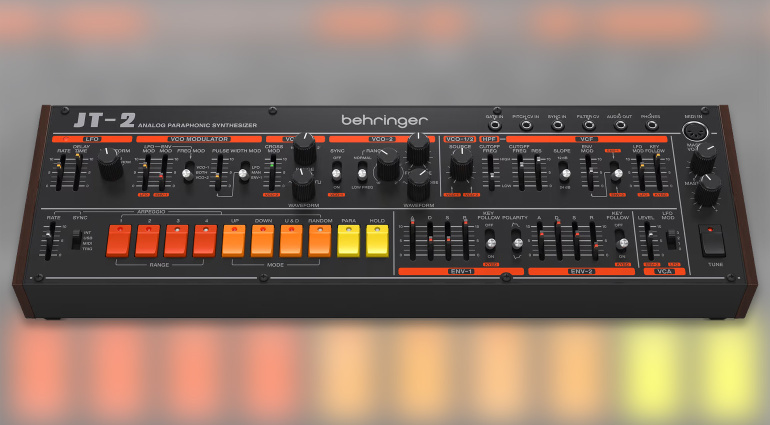
Let’s cut through the fog of Behringer’s perpetual announcement cycle. The JT-2 is not the mythical JT-16, their full-sized, keyboard-based clone of the Roland Jupiter 8. That beast remains in the “coming soon” purgatory we’ve grown accustomed to. Instead, the JT-2 is a tactical extraction: a compact, desktop and Eurorack-compatible module that packages two of the analog voice circuits destined for that larger synth. Think of it as a snack-sized portion of the main course, offered to stave off hunger pangs while the kitchen remains, ostensibly, busy.
It’s a duophonic (or more accurately, paraphonic) synthesizer, meaning it can play two notes, but they likely share filter and amplifier envelopes. This isn’t a true polyphonic experience, but it’s a step beyond monophonic for pads, intervals, or simple bass-and-lead combinations. The unit made its physical debut at NAMM 2026, a show that feels both futuristic and like a recurring dream where the same synths are announced annually. The core news is that you can now give a retailer your money for one, a transaction that currently buys you a promise and a place in a queue of indeterminate length.
Specs and Sound Philosophy
Diving into the panel, the JT-2 is a straightforward, no-preset analog voice. You get two VCOs per voice with the classic Jupiter-style waveform selection (saw, square, pulse with PWM), plus hard sync and cross modulation for those brassy, complex tones. The filter section is where the magic (or the homage) lies: an analog low-pass filter with cutoff and resonance control, accompanied by a high-pass filter with cutoff. This is the foundational sound of a thousand 80s records. Modulation comes from a single LFO and two dedicated ADSR envelopes for the filter and VCA.
Beyond the core synthesis, Behringer has included an arpeggiator and the now-standard feature on their desktop units: an external audio input to route your other gear through those lovely filters. Connectivity is basic but sufficient for its role: MIDI In/Out, USB, a mono output, and the requisite 3.5mm jacks for CV/Gate and sync. The philosophy here is pure, hands-on analog recreation at a price point that feels almost like a typo. The goal isn’t innovation; it’s replication, democratization, and, let’s be honest, a bit of market disruption.
The Polychain Gambit
Here’s where the marketing gets interesting, or perhaps absurd, depending on your tolerance for modular arithmetic and Behringer’s product strategy. The JT-2 supports polychaining. You can, in theory, connect up to sixteen of these units together via MIDI to create a single, monstrous 32-voice synthesizer. This is the “build-your-own-JT-16” sales pitch. It’s a clever idea on paper: start with one or two voices for €179 each, and gradually assemble your dream poly over time, like a sonic Lego set.
In practice, I have questions. Sixteen units would cost €2,864, not including the monstrous case, power supplies, and MIDI thru boxes you’d need to manage the spaghetti junction of cables. You’d have sixteen individual filter knobs to adjust if you wanted to change the cutoff globally. The logistical and financial reality of this “feature” makes it more of a thought experiment than a practical purchase path for most. It feels less like a genuine modular ecosystem and more like a justification for releasing a small, affordable module that keeps the JT-16 dream alive without having to deliver the finished keyboard.
Market Context and the Waiting Game
At €179, the JT-2 exists in a vacuum of its own making. There is no direct competitor. Roland’s own boutique JP-08 is long discontinued, and modern analog polysynths from other manufacturers command prices an order of magnitude higher. For the hobbyist, the Eurorack curious, or the producer who just wants a slice of that Jupiter filter on a channel strip, the price is undeniably compelling. It’s an impulse buy in a world of considered investments.
Yet, the context is everything. This announcement follows a now-familiar Behringer pattern: tease, showcase, open for orders, and then… wait. The JT-2 was first teased nearly three years ago. The community’s reaction, as seen in the source comments, is a mix of excitement, skepticism, and weary humor. One commenter jokes about getting a second job to fund the eventual Jupiter, while another astutely points out it could serve as a hands-on controller for a plugin or hardware like the MKS-80. The prevailing sentiment, however, is a plea for Behringer to “start to ship something before any more noise about upcoming…” We at Noxal feel that in our bones. The value proposition is clear, but its worth is contingent on the unit actually arriving in studios, not just in online shopping carts.
Frequently Asked Questions
Is the Behringer JT-2 truly polyphonic?
No, it is duophonic/paraphonic. It can play two notes simultaneously, but they typically share key modulation elements like the filter and amplifier envelopes. For true polyphony with independent voice shaping, you would need to polychain multiple units.
When will the JT-2 actually ship?
As of this writing, Behringer has only announced that the JT-2 is “available to order.” They have not provided a concrete shipping date. Based on the company’s history with new product launches, customers should be prepared for a potentially significant wait between placing an order and receiving the unit.
Can the JT-2 be used as a MIDI controller for other gear?
While its primary function is as a sound source, the front-panel knobs likely send MIDI CC data. However, it is not marketed as a dedicated controller. One insightful commenter on the original article suggested it could be repurposed as a plugin controller if Behringer implements the right SysEx messaging, but this is speculative and not a confirmed feature.
I’ll believe the JT-2 has truly landed when I see one on a studio desk next to a half-empty, cold cup of coffee—the ultimate testament to a new gear day. Until then, my credit card remains skeptically in my wallet.