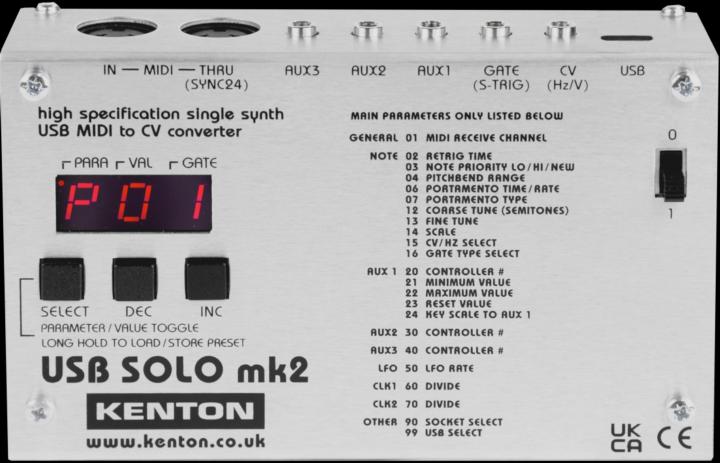
TL;DR: Kenton has released the USB Solo mk2, a significant update to its classic MIDI-to-CV converter. It bridges modern USB-C workflows with vintage analog synths, adding built-in modulation sources, extensive compatibility, and a configuration app. It’s available now for £199.80 (inc. VAT).
- The USB Solo mk2 acts as both a high-precision MIDI-to-CV converter and a USB MIDI interface, connecting vintage monosynths to modern DAWs.
- It features three continuously variable auxiliary outputs, a built-in MIDI-syncable LFO, and an ADSR envelope generator for added modulation.
- Compatibility is extensive, supporting scaling from 0.92V/Oct to 1.62V/Oct for rare instruments like Buchla or EML, plus Sync24 output for vintage Roland gear.
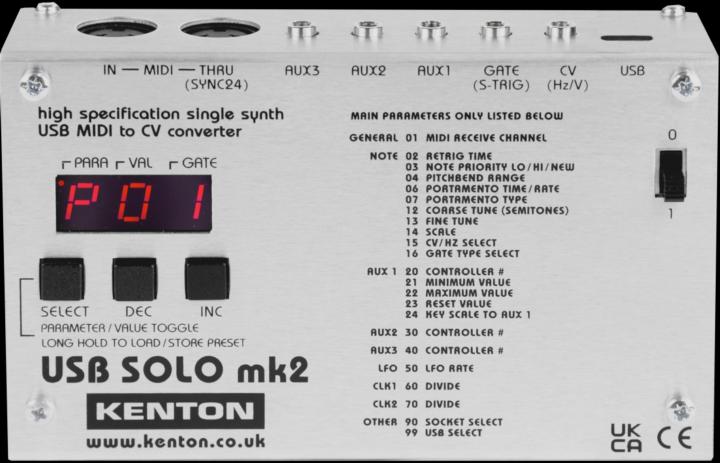
- Updated hardware includes USB-C for power and data, a rugged aluminium case, and configuration via a front-panel display or a dedicated desktop app.
- Priced at £199.80 (including VAT), it’s positioned as a professional tool for integrating classic analog hardware into contemporary studio and live setups.
Reading time: 4 min
Want more synth news before your next coffee break? Join the Noxal newsletter — no spam, just gear worth knowing about.
The Bridge, Rebuilt
Here at Noxal, we have a soft spot for gear that acts as a translator. Not between languages, but between eras. The classic Kenton USB Solo was one of those indispensable little boxes that sat humbly on your desk, quietly enabling conversations between your shiny computer and your temperamental, voltage-hungry analog synth from the 70s. Its announcement of a successor, the USB Solo mk2, isn’t just a product refresh; it’s a recognition that this bridge is now a major thoroughfare in the modern studio.
Kenton describes it as the tool to “bring legendary analogue monosynths into the modern production era,” and they’re not wrong. The core function remains elegantly simple: take MIDI data from either a USB stream or a traditional 5-pin DIN cable and convert it into the Control Voltage (CV) and Gate signals that pre-MIDI synths understand. But the mk2 expands this role significantly. It now operates in two distinct modes: ‘Standard Mode’ for straight MIDI-to-CV conversion, and ‘Interface Mode,’ where it simultaneously acts as a USB MIDI interface for other hardware while still doing its primary conversion job. This turns it from a simple translator into a central hub for hybrid setups.
I’ve lost count of the times I’ve had to daisy-chain interfaces and converters to get a Pro-One talking to my DAW while also syncing a drum machine. The promise of the mk2 is to collapse that spaghetti junction into a single, rugged aluminium box. For producers whose studios are a carefully curated museum of bleeps and bloops, this isn’t just a convenience—it’s a space-saving, sanity-preserving necessity.
Precision as a Premise
Anyone who has used a cheap MIDI-CV converter knows the pain: glitchy tracking, audible “zipper” noise on filter sweeps, and a general sense that your prized Moog is being fed a diet of digital gruel instead of the pure analog voltage it deserves. Kenton has always fought against this, and the mk2 doubles down. Its primary CV output is driven by a high-specification 16-bit DAC, which they claim provides “rock-solid pitch tracking” and eliminates the stepping artifacts of inferior converters. In practice, this means your synth stays in tune across its range, and pitch-bend becomes silky smooth, not a stair-stepped approximation.
But precision isn’t just about clean conversion; it’s about speaking the right dialect of voltage. While most synths use the 1V/octave standard, the world of vintage gear is wonderfully non-standard. The mk2’s adjustable scaling, from 0.92V/Oct to 1.62V/Oct, is a huge deal. It means you can finally get that quirky Korg MS-20 (which uses Hz/V) or that rare, esoteric Buchla module to track properly from your MIDI keyboard or sequencer. This isn’t just supporting the classics; it’s future-proofing for the increasingly popular world of modern modular and semi-modular gear that sometimes dances to its own tuning rules.
Then there’s the Sync24 support. By reconfiguring the MIDI THRU port, you can output the classic DIN Sync clock used by Roland’s TR-808, TR-909, and TB-303. This is a beautifully thoughtful touch. It acknowledges that the vintage revival isn’t just about monosynths; it’s about entire ecosystems. Being able to slave a 303 to your DAW’s tempo via a dedicated, stable sync pulse, all from the same box driving your synth, is a workflow dream for acid house enthusiasts and studio historians alike.
Beyond Conversion: Modulation on Tap
This is where the USB Solo mk2 stops being just a bridge and starts being a creative tool in its own right. The three auxiliary outputs, now on 3.5mm jacks and continuously variable, can be mapped to virtually any MIDI data stream: CCs, pitchbend, velocity, aftertouch. Imagine using channel aftertouch from your controller to sweep the filter cutoff on a SH-101 that lacks that input, or converting MIDI clock to a CV pulse for sequencer advance. This turns static control into dynamic expression.
Even more compelling are the built-in modulation sources: a MIDI-syncable LFO and a full ADSR envelope generator. This is genius. Many legendary monosynths have rudimentary or fixed envelopes, and few have LFOs that can sync to your DAW’s tempo. The mk2 effectively grafts these modern capabilities onto any vintage instrument. You can route a tempo-synced triangle wave from the internal LFO to your synth’s PWM input, or use the ADSR to shape a filter sweep independently of the synth’s own VCA envelope. It adds layers of movement and complexity to synths that were designed in a simpler time.
For me, this transforms the unit from a utility into an instrument expander. It’s no longer just about getting notes into your synth; it’s about unlocking new sonic possibilities that the original designers might never have imagined. It respects the past while firmly pulling it into the present creative toolkit.
Modern Touches for Analog Souls
The physical and logistical updates are what make the mk2 feel like a 2020s product. The move to USB-C for both power and data is overdue and welcome, reducing cable clutter and aligning with modern laptops. The brushed aluminium case promises the kind of durability that can survive the bottom of a gig bag or the constant patching of a busy studio.
Configuration has also received a major upgrade. While the three-character LED display on the front allows for on-the-fly tweaks, the new USB Solo mk2 Configuration Manager app is the real game-changer. Storing and recalling 32 program memories via software is far more intuitive than button-pressing sequences. You can have preset configurations for your Minimoog, your MS-20, and your modular rig, switching between them instantly as you swap instruments. Kenton founder John Price’s pride is evident, noting they’ve effectively packed the features of their flagship Pro Solo mk3 into this more compact, USB-centric unit.
Priced at £199.80 (including VAT), it sits firmly in the professional accessory bracket. It’s not an impulse buy, but for anyone seriously investing in vintage or analog hardware, it’s a justifiable and arguably essential cost. It’s an insurance policy against obsolescence and a key that unlocks the full potential of your analog investments. In a market flooded with nostalgic reissues, the USB Solo mk2 is something more practical and powerful: a tool that ensures the classics don’t just sit on a shelf, but remain vital, playable, and deeply integrated parts of the music-making process.
Frequently Asked Questions
Can the USB Solo mk2 control polyphonic synthesizers?
No, the USB Solo mk2 is designed specifically for monophonic analog synthesizers. It provides one primary pitch CV and one gate output, which is standard for controlling a single voice. For polyphonic control, you would need a device with multiple CV/Gate pairs, like Kenton’s own Pro-2000 mk3.
Does it require external power, or is it bus-powered via USB?
The USB Solo mk2 is bus-powered via its USB-C connection. This simplifies setup enormously—just one cable from your computer provides both data and power. No wall warts required, making it perfect for portable setups.
I have a synth with an S-Trigger input (like old Moogs). Will this work?
Yes. The USB Solo mk2 provides both standard V-Trigger/Gate and S-Trigger (Shorting Trigger) outputs. You can configure the gate output type to match the specific requirements of your vintage synthesizer, ensuring proper note triggering and envelope operation.
Now, if you’ll excuse me, I need to see if my coffee is still hot enough to justify testing the mk2’s LFO sync. The pursuit of the perfect tempo-synced wobble waits for no one, not even a cooling Americano.