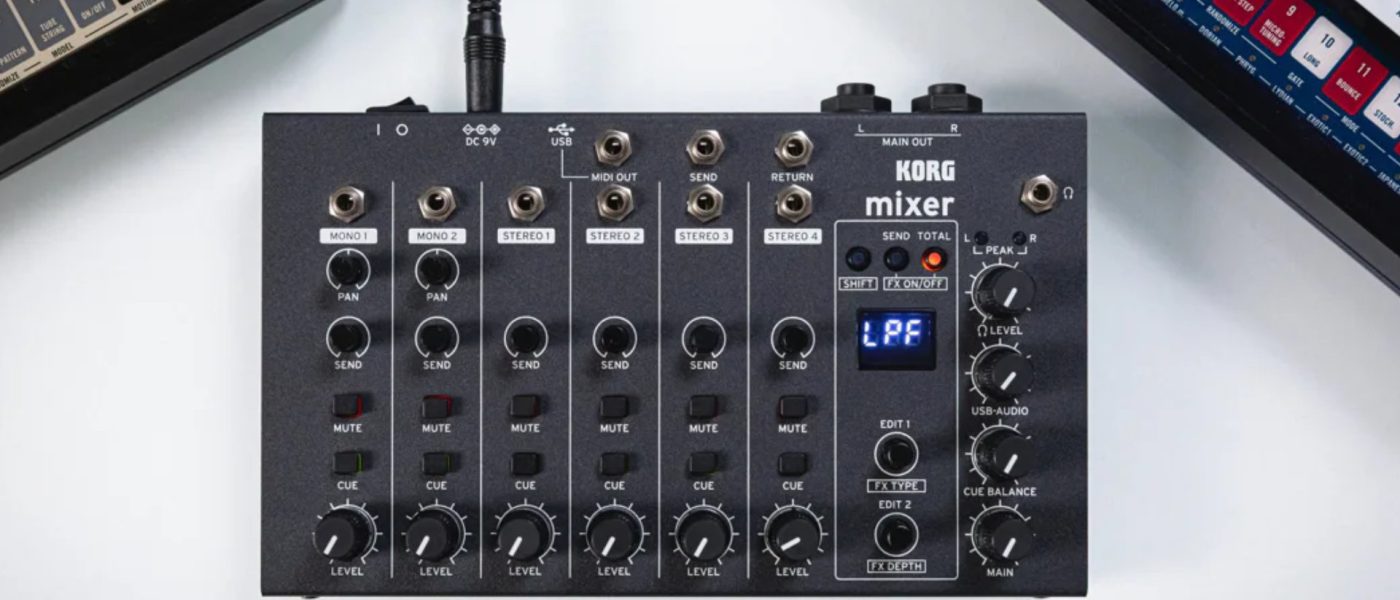
TL;DR: Korg has officially released the NTS-4, a compact 6-channel performance mixer kit with digital FX and USB-C audio interface capabilities. Priced at $249, this solder-free DIY kit offers 4 stereo and 2 mono inputs, per-channel send effects, and master FX processing — but notably lacks the user-programmable SDK Logue engine that made its NTS siblings so customizable.
- 4 stereo inputs (3.5mm) plus 2 Eurorack-compatible mono inputs (3.5mm) with switchable attenuators
- Built-in dual FX processor with per-channel send FX (delay, reverb, chorus) and master FX (filter, distortion, compressor)
- USB-C bus-powered 48kHz/24-bit audio interface with MIDI I/O via 3.5mm TRS jack
- Soldering-free DIY kit, available now for $249/£189/€219
- FX are fixed — no user-programmable SDK Logue engine support, contrary to early speculation
Reading time: 4 min
Want more synth news before your next coffee break? Join the Noxal newsletter — no spam, just gear worth knowing about.

What Is the Korg NTS-4?

At first glance, the Korg NTS-4 looks like a tiny mixing board from a parallel universe where everything runs on 3.5mm jacks and good intentions. It’s the latest addition to Korg’s Nu:Tekt series — a line that has given us the NTS-1 synth, the NTS-2 oscilloscope, and the NTS-3 kaoss pad, all in similarly compact, DIY kit form factors.
The NTS-4 is a 6-channel performance mixer, but don’t let the word “mixer” fool you into thinking it’s just for blending signals. It’s a digital mixer with analog roots: four stereo inputs (3.5mm stereo jacks) and two mono inputs (also 3.5mm) that are Eurorack-compatible with switchable attenuators. There’s also a stereo return socket, again on 3.5mm. The output section gives you main L/R on 1/4″ unbalanced mono phone jacks, a headphone out, and a send output, all on the same diminutive connector format.
Each channel offers dedicated controls for level, pan, and send FX, plus mute and cue buttons. It’s a layout that makes sense for a performance mixer — tactile, immediate, and uncluttered. We at Noxal appreciate a mixer that doesn’t require a PhD in menu diving to route a signal.
FX Processor: Fixed But Functional
Here’s where things get interesting, and slightly frustrating. The NTS-4 includes a dual stereo FX processor with per-channel send effects and master FX. The send effects include delay, ping-pong delay, hall reverbs A and B, slapback, and chorus. The master FX section offers filters (LPF, HPF), an isolator, flanger, phaser, decimator, drive, distortion, compressor, and limiter.
That’s a respectable arsenal for a mixer that fits in a jacket pocket. But — and this is a significant “but” — these effects are fixed. They are not based on Korg’s SDK Logue engine, which means you cannot load custom effects from third-party developers like Sinevibes. Early reports from Superbooth suggested otherwise, but Korg has since confirmed that the FX are hardwired. We at Noxal find this a missed opportunity, especially given how the NTS-1’s open architecture became its killer feature. The NTS-4 is more like a Swiss Army knife with preset blades — useful, but you can’t swap in a corkscrew.
That said, the effects themselves are well-chosen for live performance. The combination of send and master FX gives you real-time control over ambience and character without needing external pedals or rack units. You can dial in a reverb send on individual channels while applying master compression to glue the mix together. It’s a workflow that many electronic musicians will find intuitive and immediate.
USB-C Audio Interface and Connectivity
The NTS-4 doubles as a USB-C audio interface operating at 48kHz/24-bit. It’s bus-powered, so you can run it from a laptop, tablet, or even a phone with the right adapter. This makes it a compelling option for mobile setups — think live-streaming, podcasting, or dawless jams on a train (if you’re that person).
MIDI connectivity is handled via a 3.5mm TRS minijack socket, supporting USB MIDI when connected to a computer or mobile device. This allows you to route MIDI data through the mixer, which could be useful for controlling parameters on connected gear or syncing effects to tempo. It’s a thoughtful addition, though we’d have preferred full-size MIDI ports for durability. Then again, we say that about every piece of gear that uses minijacks, and the industry keeps proving us wrong.
The USB-C port also handles power, so there’s no wall wart required. For a mixer this small, that’s a significant convenience. You can toss it in a bag with a USB-C cable and be ready to mix anywhere.
DIY Kit Experience and Build
Like its Nu:Tekt siblings, the NTS-4 ships as a soldering-free DIY kit. That means you’ll be snapping PCBs together, attaching knobs, and possibly questioning your life choices when you realize you’ve installed the headphone jack upside down. Korg has designed these kits to be accessible to beginners, with clear instructions and no soldering required.
The build quality is what you’d expect from a kit at this price point: functional, lightweight, and slightly plasticky. The NTS-4 won’t survive being dropped from a stage, but it should handle the rigors of bedroom studio use and mobile setups. The 3.5mm jacks are the weakest link — they’re fine for eurorack patching and compact synths, but if you’re plugging and unplugging frequently, you may want to invest in some right-angle adapters to reduce strain.
We at Noxal have built our fair share of DIY kits, and the NTS-4 is one of the easier ones. Expect to spend about 30 minutes to an hour, depending on your patience level and whether you have a cat that likes to sit on your workspace.
Market Context and Competition
The NTS-4 enters a market that already includes the Teenage Engineering TX-6 — a similarly tiny mixer/audio interface that costs significantly more ($1,199). The TX-6 offers more inputs (7 stereo channels), Bluetooth, and a built-in sequencer, but it’s also a much larger investment. The Zoom L6 is another competitor at a similar price point, offering 6 inputs with full-size jacks and decent effects, though its FX are also considered mediocre by many users.
The NTS-4’s main selling point is its price and its DIY nature. At $249, it’s affordable enough to be an impulse buy for someone looking to upgrade from a basic passive mixer. The Eurorack compatibility is a nice touch for modular users who want a compact submixer for their system.
Who is this for? Primarily, it’s for the mobile musician who needs a compact, bus-powered mixer with effects for live performances or studio sessions on the go. It’s also for Korg enthusiasts who want to complete their Nu:Tekt collection, or for anyone curious about building their own gear without committing to soldering. If you need full-size jacks or user-programmable effects, look elsewhere. But if you want a tiny, functional mixer that fits in a pocket and doesn’t break the bank, the NTS-4 is worth considering.
Frequently Asked Questions
Can I load custom effects on the NTS-4?
No. Korg has confirmed that the FX are fixed and not based on the SDK Logue engine. You cannot upload third-party effects like you can on the NTS-1 or minilogue XD.
Does the NTS-4 work with iOS or Android devices?
Yes, it works as a USB-C audio interface and MIDI controller with iOS and Android devices, provided you use the appropriate adapter or cable. It’s bus-powered, so no external power is needed.
Is the NTS-4 compatible with Eurorack modular systems?
Yes, the two mono inputs are Eurorack-compatible with switchable attenuators. However, they use 3.5mm minijacks, so you’ll need standard patch cables. The stereo inputs are not Eurorack-compatible, but can accept signals from other gear.
The NTS-4 won’t replace your favorite mixer, but it might earn a spot in your travel bag — right next to the emergency caffeine stash and that half-empty bag of coffee beans you forgot about. Now, if you’ll excuse me, my espresso machine needs a firmware update.