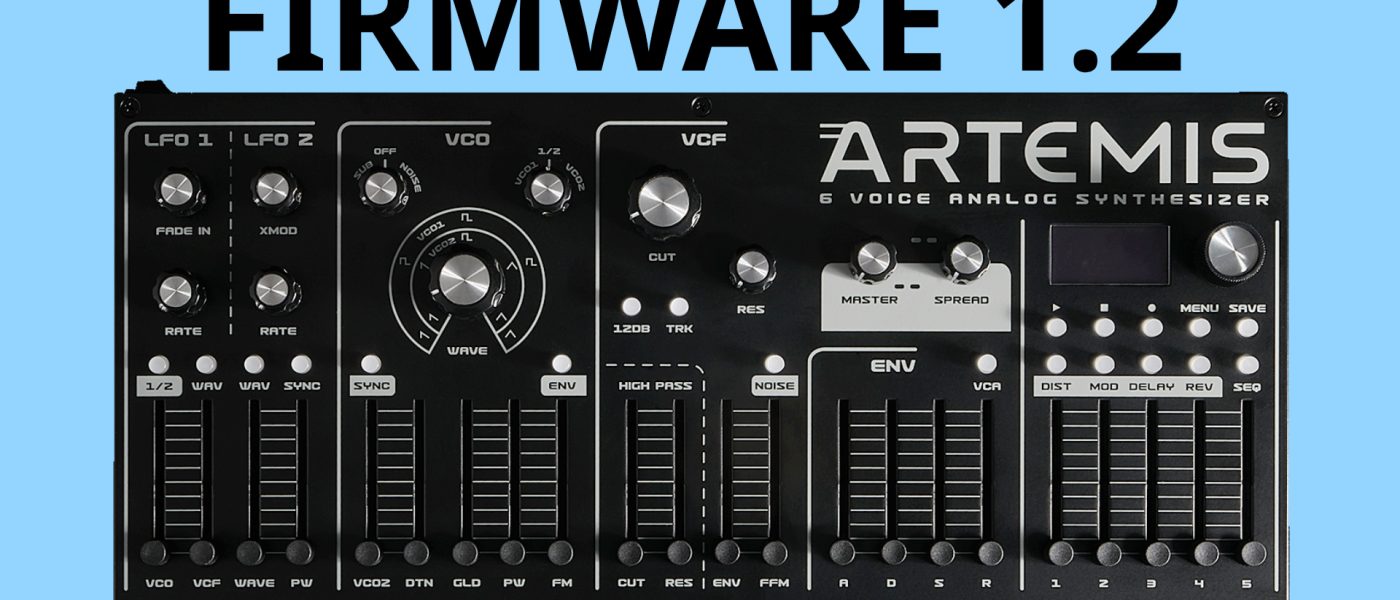
TL;DR: Dreadbox has announced firmware 1.2 for its 6-voice analog polysynth Artemis, adding new Sinevibes effects, a fully routable modulation matrix, arpeggiator upgrades, and a preset preview browser. The update is free and expected to land this week, following the earlier firmware 1.1 that introduced instability modes and improved MIDI support.
- Firmware 1.2 unlocks LFOs and envelopes from fixed destinations, making them fully routable via the modulation matrix, alongside VCO1 tune as a new destination for per-voice pitch modulation.
- New effects include a BBD Playground delay algorithm, plus updated reverb and BBD delay; the oscillator section now offers an improved drive and a no-oscillator mode that lets you use the filter as a sine wave via self-oscillation.
- The arpeggiator jumps to 32 notes with proper TIE behavior, triplets, dotted values, and slower divisions (including 8x), with refreshed on-screen visuals for better readability.
- Preset browser gains a preview function without automatic loading and now restores the last loaded preset on startup, streamlining workflow for live and studio use.
- Firmware 1.1 (already available) added instability mode, catch mode, improved preset management, delay BPM sync, LFO visual feedback, and keytracking in the mod matrix — so 1.2 builds on a solid foundation.
Reading time: 4 min
Want more synth news before your next coffee break? Join the Noxal newsletter — no spam, just gear worth knowing about.

What Is Artemis?

Dreadbox has carved a reputation for gritty, hands-on analog gear that doesn’t try to be everything to everyone. Their Typhon mono synth — a collaboration with Sinevibes’ Artemiy Pavlov — became a cult favorite precisely because it knew what it was: a focused, characterful monosynth with effects that punch above their weight class. Artemis is that same philosophy scaled to polyphony. It’s a 6-voice desktop analog polysynth, black, slathered in knobs and sliders, and backed by Sinevibes’ DSP magic for its multi-effects engine.
The analog core gives you two oscillators per voice with waveshaping, PWM, and FM, plus a sub-wave and noise source — though you have to choose between sub and noise, not both at once. There’s a highpass filter followed by a multimode filter, and the signal path is refreshingly direct. No menu-diving for the essentials; the front panel is a playground. And now, with firmware 1.2, that playground just got a lot deeper.
What Firmware 1.2 Brings
Let’s start with the headline: the modulation matrix is no longer a walled garden. Previously, LFOs and envelopes were tethered to a fixed set of destinations — a common compromise in compact analog designs. Firmware 1.2 breaks those chains. Now you can route LFOs, envelopes, mod wheel, velocity, and aftertouch to any destination in the matrix. There’s even a dedicated modulation page per source that lists active routings, so you’re not flying blind. And crucially, VCO1 tune is now a destination, opening up per-voice pitch modulation for everything from subtle detuning to wild FM-style wobbles.
On the effects side, Sinevibes has gifted Artemis a new BBD Playground delay algorithm. It joins updated reverb and BBD delay algorithms, and the oscillator section gets an improved drive mode alongside a “no oscillator” mode that turns the filter into a sine-wave oscillator via self-oscillation. This is a lovely touch for sound designers who want to push the filter as a tonal source without the oscillators getting in the way.
The arpeggiator has been bumped to 32 notes — a welcome upgrade — and now supports proper TIE behavior, triplets, and dotted values. These rhythmic divisions also extend to the sequencer, LFOs, and delays. Slower divisions, including 8x, are now available, and the on-screen visuals have been refreshed to keep up. The preset browser gets a preview function that doesn’t auto-load, plus it remembers your last loaded preset on startup. Small quality-of-life changes, but they add up.
A Look Back at Firmware 1.1
Before you ask, yes — firmware 1.1 already did some heavy lifting. Released ahead of Superbooth 2025, it added an instability mode that injects slight voice-to-voice variation into oscillator pitch, filter cutoff, pulse width, and envelope times. It also introduced catch mode for parameters (so your knobs don’t jump to their physical position unless you want them to), improved preset management with naming and renaming, delay BPM sync, LFO visual feedback, keytracking in the mod matrix, and an expanded preset level range of ±13 dB. MIDI support was upgraded to include CC and PC input, program change + bank select, and more.
What’s striking is the pace of these updates. Dreadbox launched Artemis in early 2025, shipped firmware 1.1 shortly after, and now 1.2 is landing within the same calendar year. That’s not just good support — it’s a sign that the company is treating Artemis as a living instrument, not a finished product they can walk away from. For a synth in this price bracket ($1399/€1299), that kind of commitment matters.
Market Context and Who It’s For
Artemis lives in a curious middle ground. It’s not a budget polysynth — the $1399 price tag puts it up against the Sequential Take 5, the Modal Electronics Argon8X, and the Moog Subsequent 25 if you squint. But it’s also not a flagship workstation. It’s a character piece: analog, six voices, desktop format, with effects that sound genuinely good rather than tacked on. The Sinevibes collaboration is the differentiator here. These aren’t generic reverb and delay algorithms; they’re designed by someone who treats DSP as an extension of the analog signal path.
Who should buy it? We at Noxal would point to the studio musician who wants a compact analog poly that doesn’t require a PhD in menu systems. The hands-on slider layout and the newly unlocked modulation matrix make it a strong candidate for sound designers who work fast. Live performers will appreciate the updated arpeggiator and preset browser. And anyone who already owns a Typhon will feel right at home — the workflow DNA is shared, and the effects engine is recognizably Sinevibes. This is a synth that rewards curiosity, and firmware 1.2 only deepens that relationship.
Frequently Asked Questions
Is the Dreadbox Artemis firmware 1.2 update free?
Yes, firmware 1.2 is a free update for all existing Artemis owners. It will be available for download from the Dreadbox website this week.
Does firmware 1.2 change the hardware or require modifications?
No — this is purely a firmware update. All features described are accessible through the existing hardware controls and display. No soldering, no chip swaps, no tears.
Can I still use the old fixed modulation destinations after updating?
Yes. The update adds fully routable modulation via the matrix, but the original fixed destinations remain accessible for users who prefer the simpler workflow. You can mix and match as you see fit.
I’m not saying I’d trade my morning espresso for an Artemis, but I’m also not saying I haven’t considered routing the BBD delay through my pour-over setup. Results were… aromatic.