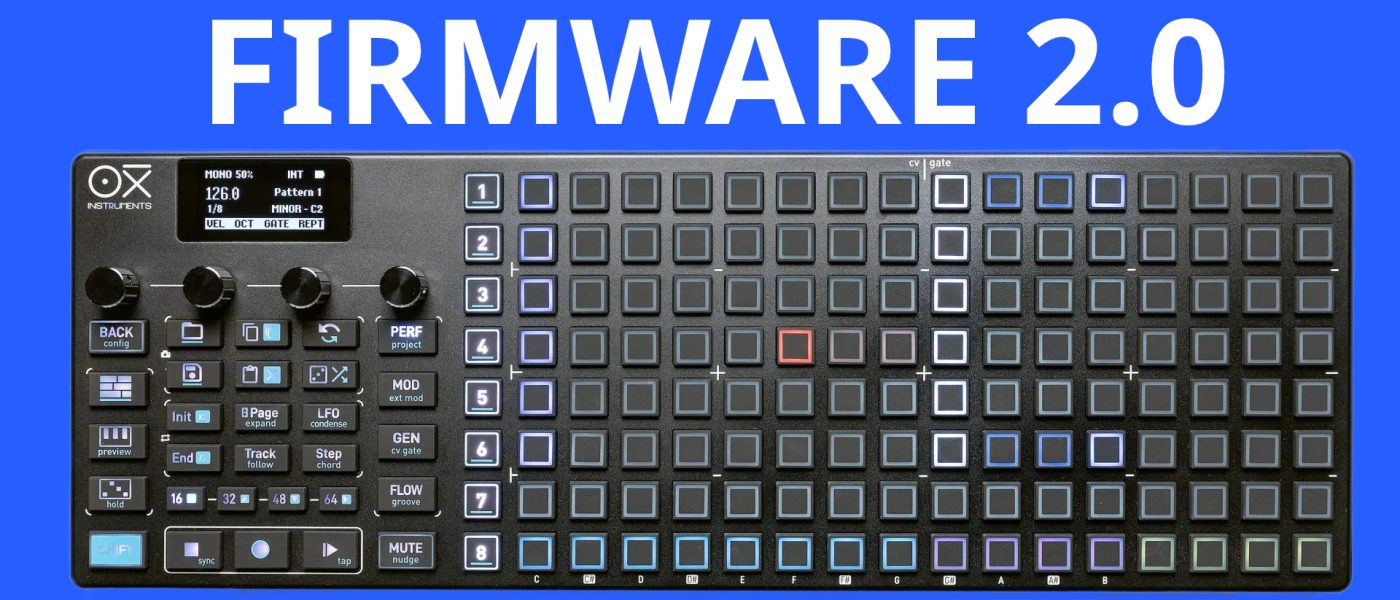
TL;DR: OXI Instruments has released firmware 2.0 for the OXI One MKII hardware sequencer at Superbooth 2026, adding three new sequencer modes — SAGA, DOMINO, and a MIDI Player — plus a MIDI capture buffer and chord palette. The update is free for existing users and further cements the OXI One MKII as one of the most versatile hardware sequencers on the market.
- SAGA mode introduces a duration-based step sequencer where each step has its own length, allowing polyphonic chords and notes at variable rhythms.
- DOMINO mode separates trigger and note layers with independent lengths (64 triggers, 32 notes) for complex, layered sequencing.
- MIDI Player now supports .MID file playback via microSD, enabling quick backing track integration.
- MIDI Capture records notes, chords, arpeggios, and multi-track MIDI data in the background, ready to populate sequences.
- The MKII now has 8 sequencers (up from 4), 64 tracks, 16 LFOs, a larger OLED display, and CV inputs — plus the new firmware adds independent parameter transport for mono, chord, and multitrack modes.
Reading time: 4 min
Want more synth news before your next coffee break? Join the Noxal newsletter — no spam, just gear worth knowing about.

The Three New Modes: SAGA, DOMINO, and MIDI Player

Let’s start with the headline act: firmware 2.0 brings three entirely new sequencer modes to the OXI One MKII. If you’ve been following the OXI ecosystem, you know the team at Oxi Instruments doesn’t do half measures. They’ve been on a roll since the MKII launched a year ago, and this update feels like a love letter to anyone who’s ever wanted a hardware sequencer that doesn’t make you choose between rhythmic flexibility and melodic complexity.
First up is SAGA. This is a duration-based step sequencer, which means each step gets its own length independent of a fixed grid. In practice, that means you can have a chord that holds for three beats while a single note clatters along for half a beat. It’s polyphonic per step, so you’re not limited to monophonic grumbles. Think of it as a cross between a Euclidean sequencer and a step sequencer on a very specific diet. It rewards experimentation, especially if you’re working with polyrhythms or generative patches. The key limitation? You’ll need to think in terms of durations, not grid divisions. That’s a mental shift, but one that opens up territory most grid-based sequencers ignore.
Then there’s DOMINO, which is trigger-layered sequencing. I’ll be honest: the name sounds like a cheesy 80s video game, but the implementation is anything but. DOMINO separates trigger and note layers. The trigger layer runs up to 64 steps, while the note layer runs 32 steps. Each trigger in the trigger layer advances the playback position in the note layer. This means you can create patterns where triggers happen at irregular intervals, and each one moves the melody forward in a different way. It’s a bit like having a second, parallel sequencer that controls the first one’s step position. For generative music or anything with a sense of controlled chaos, this is gold. You can do this in software, sure, but having it in a box you can grab and patch into your modular rig is a different feeling entirely.
Finally, the MIDI Player is exactly what it sounds like: you can now import .MID files via microSD and play them back directly. This is a quality-of-life feature for anyone using the OXI One as the brain of a live set. No more dragging a laptop to the studio. Just load up your MIDI files, assign them to tracks, and let the sequencer do the heavy lifting. It’s not revolutionary, but it’s a welcome addition that fills a gap many users were complaining about.
MIDI Capture and the Missing Aftertouch
The other major addition is the MIDI Capture function. This is a background buffer that records whatever you play on the keyboard or via an external MIDI controller — notes, chords, arpeggios, multi-track data, tied notes, and last events. You can then convert that buffer into a sequence and populate it into the active sequencer. It’s like having a scratchpad that never complains. The capture buffer can also be cleared and reset, so you’re not stuck with random noodling from three hours ago. This is one of those features that sounds simple but dramatically changes workflow. Instead of pausing the creative flow to program a sequence, you just play and later decide what to keep. It’s the hardware equivalent of voice memos for musicians.
There’s also a new chord palette and keyboard chord recognition. The chord mode now lets you define chords and recall them quickly, which is handy for anyone who thinks in harmonies but doesn’t want to learn 12 different voicings by heart. Independent parameter transport for velocity, gate, and repeat is now available in MONO, CHORD, and MULTITRACK modes, giving you finer control over how these parameters behave per mode. And MIDI channel multiplexing is now supported, which means you can send multiple MIDI channels down a single cable — useful for larger setups with lots of instruments.
Now, the elephant in the room: OXI Instruments has confirmed that aftertouch animations will not be available. This is a small disappointment for anyone hoping for visual feedback tied to aftertouch pressure. It’s not a dealbreaker, but it does feel like a missed opportunity, especially given the MKII’s larger OLED display. I suspect the hardware simply doesn’t support the polling rate needed for smooth animations. It’s a shame, but not tragic.
MKII Hardware: The Big Picture
It’s worth stepping back to remember what the OXI One MKII actually is. This is not a minor refresh. The MKII doubled the number of sequencer tracks from 4 to 8, with up to 64 tracks total. It also added a larger OLED display, more function buttons, and pads to access the extra tracks directly. The battery indicator is improved, which is a small but important detail for live use. The microSD card slot is now standard, letting you store infinite projects, grooves, and scales. And the new OXI app makes data management less of a headache — though I’ll reserve judgment until I see if it’s actually usable or just another “companion app” that gathers dust.
On the connectivity side, you get two extra CV inputs, which means more modulation possibilities. The CV/gate outputs now support the four extra tracks, and if you need even more MIDI ports, the OXI Split V2 expander gives you up to 6 MIDI ports and 96 MIDI channels. That’s enough to control a small orchestra, or at least a very large Eurorack case. The eight modulation lines per sequencer track remain, but with eight tracks, you now have 64 modulation lines. LFOs double to 16. For anyone who uses modulation as a compositional tool rather than just vibrato, this is a significant upgrade.
Performance mode and arranger mode have also been improved, though the details are still a bit vague. The custom scale configuration is a nice touch for microtonal enthusiasts. Generative tools, including the arpeggiators from previous firmware updates, remain on board. The OXI One MKII has always been a Swiss Army knife of sequencing, and the MKII hardware plus firmware 2.0 makes it even sharper.
Who Is This For, and Should You Upgrade?
If you already own an OXI One MKII, the firmware 2.0 update is free. There’s no reason not to install it — just remember to back up your projects and instrument definitions first, because OXI warns they’ll be cleared. For MKI users, this is a reminder that the MKII is the current platform, and while the MKI is still a capable sequencer, you’re missing out on all the hardware improvements. The SAGA and DOMINO modes alone are worth considering the upgrade if you’re deep into generative or rhythmic experimentation.
For newcomers, the OXI One MKII is one of the most powerful hardware sequencers available. It competes directly with the Squarp Hapax, the Deluge, and the Elektron Octatrack in terms of raw sequencing capability, but its combination of CV and MIDI outputs, deep modulation, and now three new modes gives it a unique edge. The learning curve is real — this is not a grab-and-play device — but the visual feedback and logical layout make it easier than most. If you’re building a DAW-less setup and want a central brain that can handle both MIDI and Euroack, this is a strong contender.
Is it perfect? No. Aftertouch animations are missing, the app integration is still unproven, and the price point (around €999) is not for the faint of heart. But for the depth of sequencing available, the free update policy, and the sheer creativity of the new modes, the OXI One MKII remains a benchmark in the hardware sequencer world. We at Noxal are impressed, and we don’t say that lightly.
Frequently Asked Questions
Is firmware 2.0 free for existing OXI One MKII users?
Yes, the update is free. Just back up your projects and instrument definitions before installing, as OXI warns they’ll be cleared during the update process.
What is the difference between SAGA and DOMINO modes?
SAGA is a duration-based step sequencer where each step has its own length, supporting polyphonic chords. DOMINO is a trigger-layered mode with independent trigger (64 steps) and note (32 steps) layers, where each trigger advances the note playback position. Both are creative, but SAGA is better for polyrhythms and chords, while DOMINO excels at generative, layered patterns.
Can I use the MIDI Player to play backing tracks live?
Yes. The MIDI Player supports .MID files imported via microSD. You can assign them to tracks and play them back, making it useful for live sets where you want to trigger backing tracks without a laptop.
Now if you’ll excuse me, I have to go re-learn how to think in durations instead of grid steps — and my espresso is getting cold. At least the OXI One MKII won’t judge my timing.