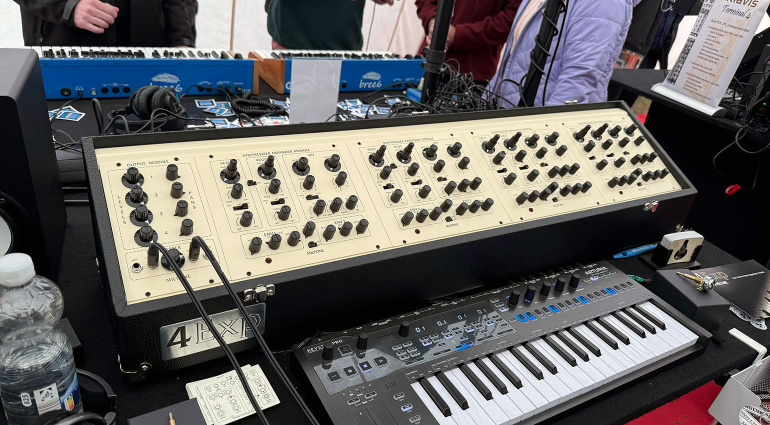
TL;DR: Miltone, a German synth repair specialist, has unveiled the 4Exp — a painstakingly accurate replica of the Oberheim Four Voice at Superbooth 2025. Every component, from the custom ball-bearing potentiometers to the through-hole PCB, is designed to match the original, but the €11,955 price tag will make your espresso shot taste bitter.
- Four SEM-based voices with discrete through-hole components, identical to the original Four Voice architecture.
- Custom-built potentiometers replicate the original’s ball-bearing structure — no shortcuts on feel or sound.
- Prototype currently uses CV/Gate only; MIDI is planned for the production version.
- Can chain with an original Oberheim Four Voice to create an Eight Voice system.
- Price: €11,955 — roughly the cost of a small car or a very large collection of instant noodles.
Reading time: 4 min
Want more synth news before your next coffee break? Join the Noxal newsletter — no spam, just gear worth knowing about.
The Oberheim Four Voice Legend

Let’s be frank: the Oberheim Four Voice is the synthesizer equivalent of a unicorn riding a dragon. Built in the mid-1970s, it was the world’s first polyphonic synthesizer — a remarkable feat that assembled four of Tom Oberheim’s glorious SEM modules into a single instrument. But here’s the secret sauce: each voice could be programmed independently, creating lush, evolving textures that no single-architecture poly could touch. Those detuned saw waves, the state-variable filter’s liquid sweep, the organic drift between voices — it’s the sound of a dozen rock albums you’ve heard and countless more you haven’t.
Original units are rare, expensive (we’re talking six figures at auction), and about as reliable as a British sports car in winter. So when a clone appears, we at Noxal sit up straighter, adjust our headphones, and prepare to be either delighted or disappointed. This year, Superbooth gave us two contenders: the NRSynth Quatuor, which takes creative liberties, and now the Miltone 4Exp, which seems to have been built by someone who photocopied the original and then painstakingly re-drew every trace by hand.
Miltone 4Exp: A Clone by Obsession
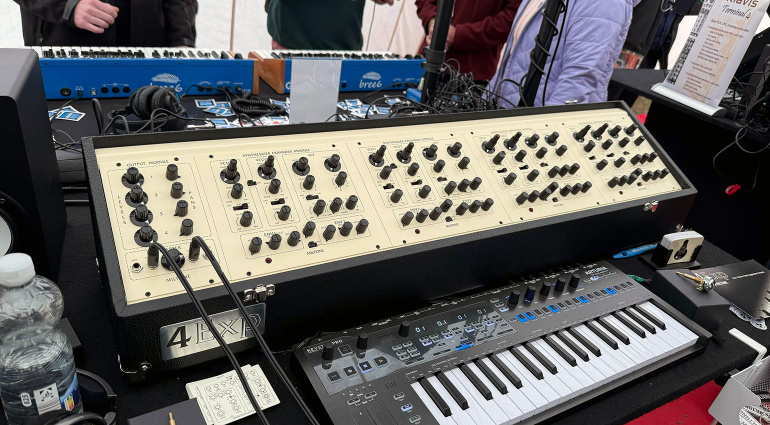
Miltone, operating under the repair shop name Vintage Synths & Co., knows vintage gear inside out. They’ve spent years fixing the real thing, and it shows. The 4Exp is not a homage; it’s a replica. The color scheme, the labeling, the custom potentiometers with their ball-bearing construction — all match the original. Even the PCB uses discrete through-hole components, not surface-mount shortcuts. The only thing missing is the keyboard, and honestly, after spending €11,955, you probably own a few good controllers already.
Superbooth attendees have been glowing. “I saw this in person today and played it. And it’s phenomenal!! And I say that as a Two Voice owner,” said one commenter on Miltone’s Instagram. Another wrote, “Absolutely nails the SEM sound (those saws!) and the attention you’ve put into getting all the components right (the dual concentric tuners) is phenomenal.” That’s not marketing fluff — that’s the sound of people who know, nodding in approval.
Sound and Specs: The SEM Core
Each of the four voices in the 4Exp is a faithful SEM clone: two VCOs with sync, the classic state-variable 12dB/Oct low-pass filter, two ADSR envelope generators, and an LFO. The output module, sitting to the left, gives you individual volume and pan for each voice, a master volume, and two headphone outputs alongside left and right line outs. It’s the same architecture that made the original so expressive — you can program each voice to be slightly different, creating that massive, breathing polyphonic texture that no modern digital synth can quite replicate.
Currently, the prototype only accepts CV/Gate, but Miltone has promised MIDI in the final version. That’s a sensible move — while purists might prefer the old-school connection, most of us don’t want to dedicate a modular system to play our chords. The ability to chain the 4Exp with an original Four Voice to make an Eight Voice? That’s both mad and wonderful. It’s the kind of feature that says, “We built this for people who already own the real thing and want more.”
Market Context and the Price of Authenticity
Let’s talk about the elephant in the room — or rather, the elephant in the studio budget. The Miltone 4Exp costs €11,955. That’s roughly the price of a used car, a semester of university tuition, or a lifetime supply of quality coffee beans. For that money, you could buy three Prophet-5s and still have change for a nice dinner. But here’s the thing: the Oberheim Four Voice isn’t just a synth — it’s a piece of history, and this clone is built with an obsessive attention to detail that borders on religious devotion.
Compared to the NRSynth Quatuor, which takes some design liberties and likely costs less, the 4Exp is for the purist. It’s for the collector who wants to preserve the original sound without worrying about 50-year-old capacitors failing mid-session. It’s for the studio that needs that specific, unholy combination of detuned saws and filter resonance. And yes, it’s for people who can afford to spend a small fortune on a single instrument. We at Noxal admire the craftsmanship, even as we check our bank accounts and sigh.
Who Is This For?
If you’re a working musician on a budget, the Miltone 4Exp is probably not for you — and that’s okay. This synth is aimed at serious collectors, high-end studios, and producers who absolutely need that specific Four Voice sound for their next project. It’s also for people who appreciate the art of recreation: the custom potentiometers, the through-hole components, the ability to chain with original hardware. This is a synth for people who understand that sometimes, authenticity is worth the premium.
But let’s be honest: for most of us, the Oberheim sound can be approximated with software emulations or more affordable SEM-based modules. The 4Exp is a luxury item, a statement piece, a work of functional art. If you have the means, I highly recommend it — just don’t expect to afford coffee for the next few months.
Frequently Asked Questions
What makes the Miltone 4Exp different from other Oberheim Four Voice clones?
The 4Exp is built with an obsessive level of authenticity: custom ball-bearing potentiometers, discrete through-hole components, and exact color/label replication. It’s designed to be indistinguishable from the original in sound and feel, down to the PCB level.
Does the Miltone 4Exp include MIDI connectivity?
The prototype currently uses CV/Gate only, but Miltone has confirmed that MIDI will be added to the production version. No word yet on USB or DIN specifics, but expect standard implementation.
Can I use the 4Exp with an original Oberheim Four Voice?
Yes. The 4Exp can be chained with an original Four Voice to create an Eight Voice system. This is a testament to its authentic design — it’s built to integrate seamlessly with the vintage hardware.
I’ll take my coffee black, like my bank account after preordering one of these. But hey, at least the saw waves will be warm at -€11,955.