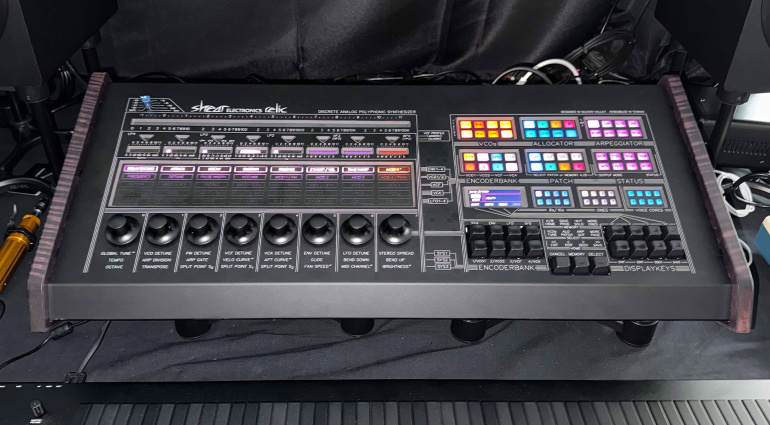
TL;DR: After nearly a decade of development, Jacob Brashears’ Shear Electronics Relic — a faithful desktop recreation of the Oberheim OB-X — is finally ready for preorder. The catch? It’s leapt from a hopeful $3,500 to a staggering $14,000, making it a serious proposition for only the most dedicated vintage synth enthusiasts.
- Six-voice, two-VCO analog architecture with a 12dB/oct 2-pole low-pass filter, based on original OB-X schematics.
- Unique front panel design with touch-sensitive knobs and an LED strip that displays parameter values in color across the synth.
- Developed by Jacob Brashears, who first debuted the prototype at NAMM 2017 at age 18.
- Price has ballooned from the original $3,500 target to $14,000 — a 400% increase over nearly 10 years.
- Available for preorder now via the Shear Electronics website, with no firm shipping date beyond “finally ready.”
Reading time: 4 min
Want more synth news before your next coffee break? Join the Noxal newsletter — no spam, just gear worth knowing about.
The Long-Awaited Return
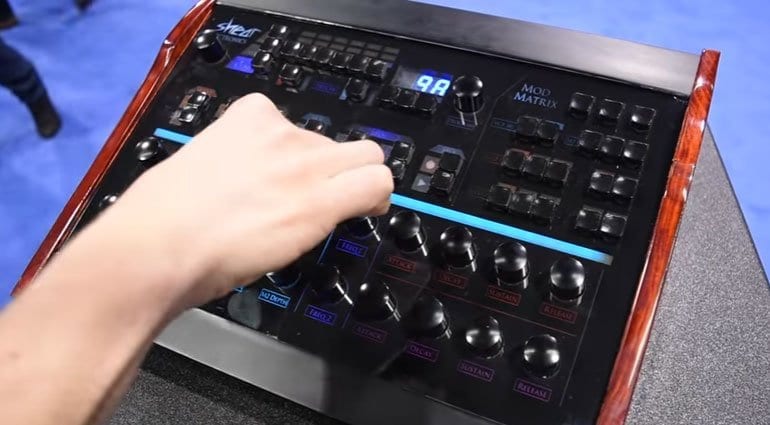
We at Noxal have been following the Shear Electronics Relic since it was a glint in an 18-year-old’s eye at NAMM 2017. Back then, Jacob Brashears wowed the floor with a prototype that sounded unmistakably Oberheim — thick, brassy, and unapologetically analog. We wrote about it with the cautious optimism we reserve for teenage prodigies and Kickstarter dreams. Then, silence. For years.
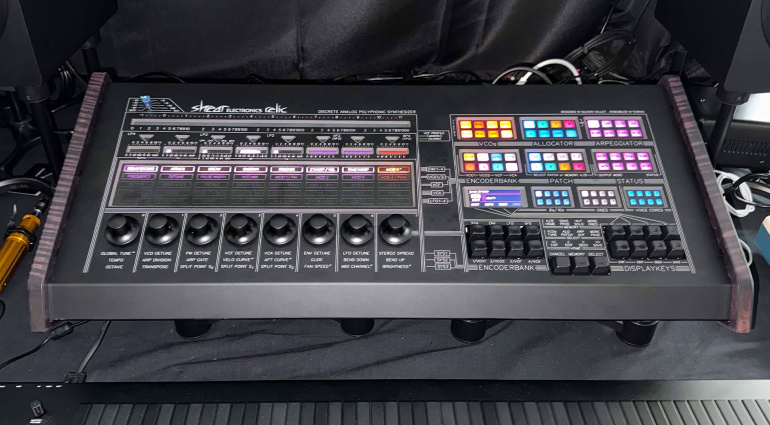
Now, finally, at Superbooth 2025, Brashears announced the Relic is ready for preorder. And we have to admit: the finished product is a visual and sonic statement. The desktop unit features a raked front panel with wooden cheeks, a large LED display, and a glowing strip of lights that traces parameter values across the synth’s midsection. It’s a design that owes more to the Oberheim Xpander than the OB-X, but that’s part of its charm. The Relic isn’t trying to be a museum piece; it’s a reimagining with a modern, almost sci-fi interface.
What Makes the Relic Tick
Under the hood, the Relic is a faithful recreation of the OB-X’s analog signal path. Six voices, each with two VCOs and a 12dB per octave, 2-pole low-pass filter. That’s the recipe for the OB-X’s signature punch — the kind of sound that made Van Halen’s “Jump” unforgettable and underpinned countless 80s pop records. Brashears based the circuit design on original OB-X schematics, so the core tone should be authentic.
Where the Relic diverges is in its control interface. The front panel is dominated by touch-sensitive knobs and that central LED strip. Touch any knob, and the corresponding parameter value lights up in color along the strip. It’s a gimmick, sure, but a delightful one. It turns the act of tweaking a filter cutoff into a small visual performance. We’ve seen modern synths try to be minimalist or retro; the Relic is neither. It’s maximalist and futuristic, and we kind of love it for that.
The unit is desktop-friendly, with a raked angle and wooden cheeks that give it a premium, furniture-like feel. This isn’t a synth you tuck away in a rack; it’s meant to sit on your desk, begging to be touched.
The Elephant in the Room: Price
Let’s address the number that’s making everyone choke on their espresso: $14,000. When Brashears first showed the Relic, he hoped to hit $3,500. That was already a premium for a boutique clone, but justifiable. Now, we’re talking about a price that puts it in the same league as a used car — or a vintage Oberheim OB-X, which can fetch $10,000 to $15,000 on the used market.
I have to be honest: this stings. The Relic was supposed to be the accessible alternative to chasing down a vintage OB-X with its dodgy voice cards, aging capacitors, and questionable reliability. At $14,000, it’s no longer an alternative; it’s a collector’s item for those who can afford both. Brashears hasn’t explained the jump in detail, but we suspect it comes down to the cost of hand-building these units with premium components, the years of R&D, and the sheer complexity of the control interface.
We at Noxal respect the craftsmanship, but we can’t help wondering if the dream got away from the designer. For the same money, you could buy a modern Oberheim OB-X8 — which is a fantastic synth in its own right — and still have enough left over for a nice trip to Superbooth.
Who Is This For?
The Relic is for the collector who insists on having the most exclusive, limited-run version of a classic sound. It’s for the studio owner who wants a conversation piece that also delivers world-class analog tones. And it’s for the die-hard Oberheim fan who has already exhausted the modern options and wants something that feels bespoke, hand-built, and utterly unique.
It is not for the working musician on a budget. It is not for the hobbyist looking to add a vintage voice to their setup. At $14,000, the Relic exists in a rarefied air where price is almost irrelevant. If you have to ask, as the saying goes, you can’t afford it.
But for those who can, the Relic represents a decade of obsession by a young designer who clearly loves the OB-X. Brashears has poured his youth into this project, and the finished product shows it. The question is whether the synth community will embrace a $14,000 desktop clone, or whether the Relic will remain a beautiful, expensive footnote in synth history.
The Market Context
We’ve seen a boom in vintage synth recreations over the past decade. Behringer brought clone prices down to absurdly low levels. Sequential and Oberheim themselves have released updated versions of their classics (the OB-X8, for instance). Even boutique builders like UDO and Black Corporation have found success with modern takes on vintage designs. The Relic enters a crowded field, but it positions itself at the very top — not just in sound, but in price.
Is there a market for a $14,000 OB-X clone? Probably. There’s a market for $10,000 modular systems and $20,000 vintage synths. But it’s a small market. The Relic will be a rare sight in the wild, more likely to appear in a YouTube demo than in a local studio. That’s a shame, because the sound deserves to be heard. But then again, exclusivity is part of the appeal.
We at Noxal wish Jacob Brashears well. The Relic is a labor of love, and we respect that. But we’ll be sticking with our coffee-stained OB-X8 and dreaming of what could have been.
Frequently Asked Questions
What exactly is the Shear Electronics Relic?
The Relic is a desktop analog synthesizer that faithfully recreates the Oberheim OB-X’s circuit design, featuring six voices, two VCOs per voice, and a 12dB/octave low-pass filter. It adds a modern digital control interface with touch-sensitive knobs and an LED parameter display.
Why does the Relic cost $14,000?
The price reflects nearly a decade of development, hand-built construction, premium components, and the unique control interface. It’s positioned as a high-end collector’s item rather than an affordable clone, targeting enthusiasts who value exclusivity and craftsmanship.
How does the Relic compare to the Oberheim OB-X8?
The OB-X8 is a modern reissue from Oberheim themselves, offering multiple filter types and more features for around $4,000. The Relic is a more faithful reproduction of the original OB-X’s sound, but at a significantly higher price and with a more experimental interface. For most players, the OB-X8 offers better value and versatility.
I’ll be over here, nursing my third espresso and wondering if I can justify a $14,000 synth by selling my car. (Spoiler: my car is not worth $14,000.)