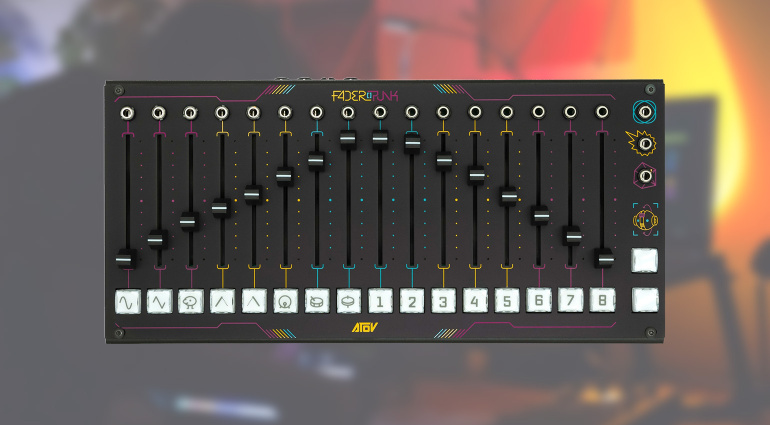
TL;DR: ATOV’s already absurdly cool Faderpunk MIDI controller just got a firmware update (v1.9) that adds three new apps, including a full port of Mutable Instruments’ beloved Grids topographic drum sequencer. Owners can now run Grids’ pattern-generation brain on the Faderpunk’s 16 faders and CV jacks, alongside sharper MIDI 14-bit support and better clock swing. The €650 controller is at Superbooth this weekend—and we’re still kicking ourselves for not covering it sooner.
- Faderpunk v1.9 firmware adds FP-Grids, a community port of Mutable Instruments’ open-source Grids drum sequencer, controllable via the device’s 16 faders and CV.
- Two other new apps: Random+ (random CC/CV with assignable CV input) and Clock Divider+ (clock divider with assignable CV input).
- Update also brings sharper MIDI 14-bit CC and NRPN support, better clock swing, and a new information page.
- Faderpunk remains a 16-channel MIDI/CV controller with ALPS faders, RGB backlit buttons, and CV I/O—now even more of a Swiss Army knife for studio and stage.
- Available now at ATOV for €650; current owners can download the firmware for free from the ATOV website.
Reading time: 3 min
Want more synth news before your next coffee break? Join the Noxal newsletter — no spam, just gear worth knowing about.
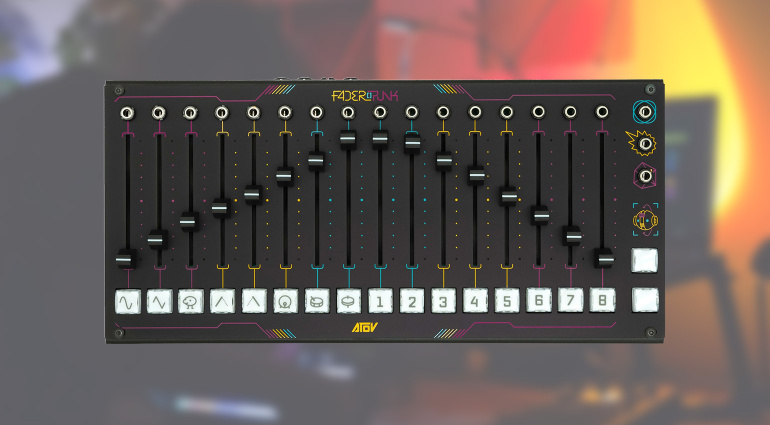
Faderpunk is not just another fader bank
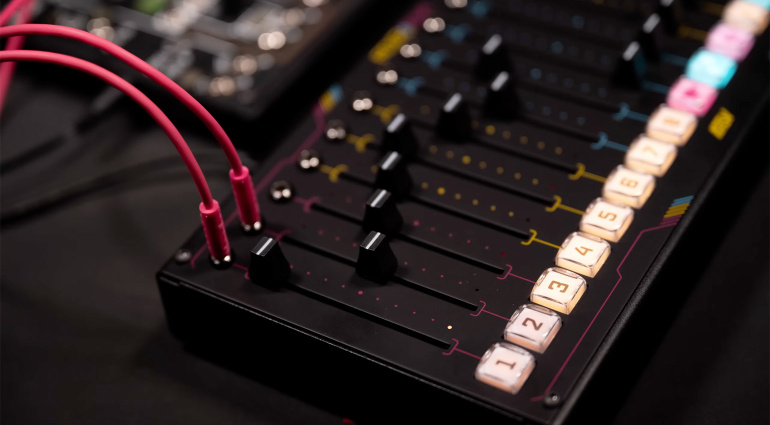
Let’s be honest: when we first saw the ATOV Faderpunk, we thought, “Oh, another fancy fader controller with RGB lights and a price tag that makes you wince.” We were wrong. Dead wrong. And we owe the Noxal readership an apology for not covering it sooner—especially since Gearnews somehow missed it entirely. (We’re not naming names, but we’re side-eyeing our colleagues.)
Faderpunk is, at its most basic, a MIDI/CV controller with 16 channels, each boasting a 60mm high-end ALPS fader (yes, the same ones DJs swear by), a mechanical RGB backlit button, and a CV jack that can be configured as either input or output. You also get three auxiliary input/output CV jacks, proper MIDI in and out, and USB power with MIDI. That’s already a solid spec sheet for €650—but the real magic lives in the firmware.
The app ecosystem: where it gets weird (and wonderful)
The Faderpunk isn’t just a controller; it’s a platform. The device hosts “apps” that radically change its functionality. The existing app list reads like a modular synth user’s wishlist: an AD Envelope, Random Triggers, a Sequencer, a Slew Limiter, and more. Each app turns the 16 faders and buttons into something entirely different—a variable envelope generator one minute, a random gate source the next. It’s like having a tiny Eurorack brain in a box that fits on your desk next to your coffee mug.
And that’s the key: the hardware is good, but the software is what makes Faderpunk special. It’s a MIDI controller that can think—or at least, it can pretend to be a few different modules when you need it to. We at Noxal love gear that punches above its weight class, and this thing does a one-armed pull-up with a piano on its back.
Grids comes home: a drum sequencer in a controller
Now, firmware v1.9. The headline act is FP-Grids, a community-submitted port of Mutable Instruments’ open-source Grids topographic drum sequencer. For the uninitiated: Grids is a Euclidean-inspired sequencer that generates drum patterns based on probability and topology. It’s not a straightforward step sequencer; it’s a brain that spits out common electronic drum patterns, which you can shape via CV or manual control. Think of it as a drum machine that’s read too many books on chaos theory.
FP-Grids maps Grids’ controls to Faderpunk’s 16 faders and buttons, letting you tweak pattern complexity, density, and fills in real time. There’s also a drum and bass alternative mode, which is exactly as fun as it sounds. Starsky Carr’s demo video shows it in action—and it looks like a genuinely productive way to jam. No menu-diving, no tiny screens, just faders and LEDs doing their thing.
This is the kind of update that makes you wonder why more companies don’t embrace open-source ports. ATOV didn’t build Grids from scratch; they let the community do the heavy lifting and then integrated it seamlessly. Respect.
v1.9: the other improvements that matter
Beyond FP-Grids, the update adds two more apps: Random+ (random CC/CV with assignable CV input) and Clock Divider+ (clock divider with assignable CV input). Both are welcome additions for anyone who’s ever wanted to introduce controlled chaos into their setup without buying another module.
There’s also sharper MIDI 14-bit CC and NRPN support—a godsend for those of us who use high-resolution controllers with modern synths. Better clock swing means your offbeat hi-hats will feel more human. And a new information page helps you keep track of what app is running without needing a second monitor. These are small, quality-of-life improvements, but they matter when you’re in the middle of a session and your third coffee hasn’t kicked in yet.
Market context and who is this for
At €650, the Faderpunk isn’t cheap. You could buy a decent used Eurorack sequencer for that money, or a handful of cheap MIDI controllers. But you wouldn’t get the flexibility. This is for the person who wants a single, well-built device that can morph from a fader bank to a sequencer to a random CV source to a clock divider—all without plugging in a new module or loading a different piece of software.
It’s also for the Mutable Instruments fan who doesn’t want to buy a full Eurorack system just to use Grids. The port is faithful enough that you’ll recognize the behavior, but the hardware is more portable and less expensive than a full modular setup. Superbooth attendees can see it in person this weekend, and we’re hoping for more demo videos of FP-Grids. Owners can download the firmware from the ATOV website right now.
Is it for everyone? No. But for the right person—the one who loves tweaking, hates menus, and has a soft spot for open-source firmware—Faderpunk is a genuine standout. And with this update, it just got even harder to ignore.
Frequently Asked Questions
What is the ATOV Faderpunk?
The ATOV Faderpunk is a 16-channel MIDI/CV controller with high-quality ALPS faders, RGB backlit buttons, and configurable CV jacks. Its key differentiator is an app-based firmware that lets it function as a sequencer, envelope generator, random trigger source, and more—essentially a multi-tool for studio and live setups.
What does FP-Grids do?
FP-Grids is a port of Mutable Instruments’ open-source Grids topographic drum sequencer. It generates drum patterns based on probability and topology, controllable via the Faderpunk’s faders and buttons. It includes a drum and bass alternative mode and can be modulated via CV inputs.
How much does the Faderpunk cost and where can I get the firmware update?
The Faderpunk costs €650 and is available through ATOV’s website. Current owners can download the v1.9 firmware for free from the ATOV site. The update adds FP-Grids, Random+, Clock Divider+, and several MIDI and usability improvements.
We’re off to download the firmware and see if we can make Grids play nice with our morning espresso ritual. If the faders smell like coffee, we’ve gone too far.