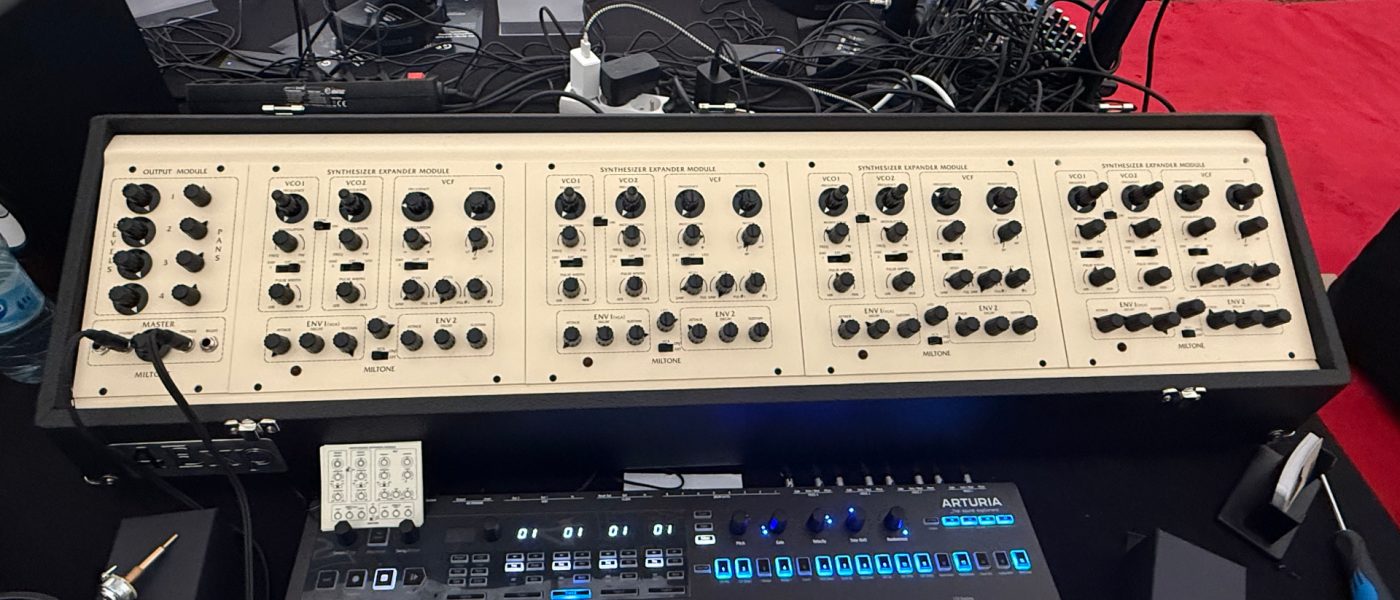
TL;DR: Parisian synth repair veterans Miltone (Vintage Synths & Co) have unveiled the 4EXP at Superbooth 2026, an ultra-authentic, through-hole, hand-built clone of the legendary Oberheim Four Voice – sans keyboard, in expander format. At €11,995, it’s a museum-grade replica for the ultra-wealthy or the obsessive, featuring reverse-engineered potentiometers, NOS components, and a service manual to keep it running for decades.
- Four independent SEM voice modules, each built with discrete through-hole circuitry and, where possible, vintage NOS components – no SMD shortcuts.
- No keyboard, arpeggiator, sequencer, or MIDI (yet – MIDI is in development); currently CV/Gate only, designed as an expander for existing Four Voice owners or a standalone behemoth.
- Potentiometers reverse-engineered from original Oberheim parts, including ball-bearing mechanisms, for identical tactile feel.
- Hand-built and hand-calibrated per unit, ships with a full service manual (schematics, part list, calibration data).
- Pre-order price: €11,995 – firmly in “if you have to ask, you can’t afford it” territory, but significantly cheaper than an original Four Voice (if you can find one).
Reading time: 4 min
Want more synth news before your next coffee break? Join the Noxal newsletter — no spam, just gear worth knowing about.

What Is the Miltone 4EXP?

Let’s get the obvious out of the way: the Oberheim Four Voice is one of the most coveted, rare, and sonically massive synthesizers ever built. It’s the kind of instrument that makes grown synthesists weep into their coffee when they see one on Reverb for the price of a small car. Enter Miltone, a Paris-based company that, until now, was known for repairing vintage synths under the name Vintage Synths & Co. At Superbooth 2026, they unveiled the 4EXP, a clone that borders on the obsessive.
The 4EXP is not a keyboard instrument. It’s an expander – a four-voice SEM module that, like the original, packs four independent Oberheim SEM voice cards plus a control section on the left. No arpeggiator, no sequencer, no extra bells and whistles. Just raw, unadulterated analog voice architecture. Currently, it speaks only CV/Gate, though MIDI is reportedly in the works. The idea is clear: if you already own a Four Voice and want to expand to an Eight Voice, this is your ticket. If you don’t, you’ll need a controller and a lot of patch cables.
Why This Matters: The Obsession with Authenticity
We at Noxal have seen our share of clones. Some are excellent (the Sequential reissues), some are pragmatic (Behringer’s cost-cut take), and some are… let’s say “inspired.” But the 4EXP takes a different path. Miltone didn’t just copy the schematic; they reverse-engineered the potentiometers, including the ball-bearing mechanism that gives the original Oberheim knobs that buttery, precise feel. They spent months on this. Months. On knobs.
In an era where surface-mount components and firmware updates are the norm, Miltone went through-hole. They sourced vintage NOS (New Old Stock) components where possible, and when they couldn’t, they found modern equivalents that match the original’s electrical and sonic behavior. According to the developers, each unit is hand-built and hand-calibrated. The goal isn’t just accuracy – it’s longevity. The 4EXP is designed to be serviceable for a lifetime, with a full service manual included. That’s the opposite of planned obsolescence. That’s a love letter.
Specs and Construction: A Clone for the Ages
Per voice, the 4EXP offers the same architecture as the original SEM: a VCO, a VCF (with both high-pass and low-pass modes), a VCA, and an envelope generator. The control section provides global tuning, modulation, and voice assignment. There’s no memory, no presets, no digital trickery. It’s pure analog, and it’s meant to be played, not programmed.
The interface is nearly identical to the original, down to the layout and labeling – except it says “Miltone” instead of “Oberheim.” That’s a subtle but important distinction for collectors and purists. The chassis is robust, the wiring is hand-soldered, and the attention to detail is almost pathological. You can use the 4EXP to expand an existing Four Voice to an Eight Voice, which is a thoughtful touch for the handful of people who own one.
At €11,995, it’s not cheap. But compare that to the price of an original Four Voice (if you can find one in working condition, you’re looking at €25k–€40k), and suddenly the 4EXP starts to look like a bargain – for a very specific definition of “bargain.”
Who Is This For (and Should You Care)?
Honestly? This is not for 99.5% of us. We at Noxal are realistic: most synthesists will never touch a 4EXP. It’s a niche within a niche within a niche. But that’s okay. The 4EXP exists for the collector who wants the sound and feel of a Four Voice without the anxiety of owning a 50-year-old instrument that could fail at any moment. It’s for the studio that already has a Four Voice and wants to expand. It’s for the museum, the university, the wealthy enthusiast who values authenticity over convenience.
From a market context, this follows the Shear Electronics OB-X clone – another costly, obsessive reproduction. It signals a growing demand for “as original as possible” clones, where the goal is not to improve but to preserve. And in a world of Behringer’s cost-cut approximations, that’s refreshing. Annoyingly expensive, but refreshing.
Will it sound identical? Probably. Will it feel identical? Miltone certainly thinks so. And if you’re the sort of person who can drop five figures on a synthesizer, you’ll sleep better knowing it’s built to last.
Frequently Asked Questions
Does the Miltone 4EXP have MIDI?
Not yet. Currently, it’s CV/Gate only. Miltone has stated they are working on adding MIDI, but no timeline has been given. If you want to use a MIDI controller, you’ll need a CV/Gate interface for now.
Can I use the 4EXP to expand my original Oberheim Four Voice?
Yes. The 4EXP is designed as an expander and can be used to turn an original Four Voice into an Eight Voice. The voice architecture and connectivity are compatible.
Why is it so expensive? Is it worth the price?
At €11,995, you’re paying for hand-built, through-hole construction, reverse-engineered potentiometers, NOS components, and a service manual. Compare that to an original Four Voice (€25k–€40k), and it’s actually cheaper – but it’s still a luxury item for collectors and professionals, not a budget synth.
I’ll be honest: I’ll never own one. But I’ll pour myself another espresso, fire up my Korg minilogue, and dream of the day I can afford a single potentiometer from the 4EXP. That’s the synth life, baby.