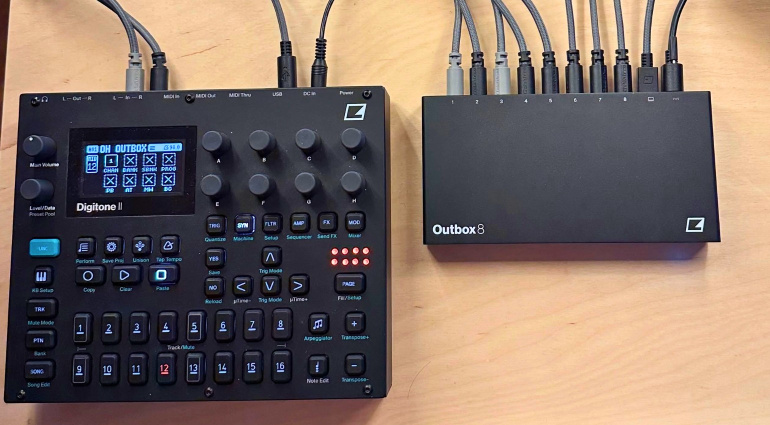
TL;DR: Elektron surprised Superbooth 2024 with two new hardware accessories: the Outbox 8, a multi-output interface that gives Overbridge-compatible devices eight discrete mono (or four stereo) outputs with zero-latency offset, and the Powerhub, a USB-C hub for up to six devices. Official specs and pricing are pending, but early floor demos suggest the Outbox 8 could be a game-changer for anyone tired of routing everything through a single stereo pair.
- Outbox 8 provides eight balanced mono outputs (four stereo pairs) for Elektron Overbridge devices, solving the single-stereo-output limitation.
- Latency is claimed to be identical to the internal stereo output—no offset when recording simultaneously, confirmed at the booth.
- Right-side outputs can be reconfigured as CV outputs, opening up Eurorack and hybrid setup possibilities.
- Powerhub is a six-device USB-C hub; specifics on power delivery, data, or device-to-device communication are still unclear.
- Pricing rumored at €249-€299, with a possible June 2026 release—no official confirmation yet.
Reading time: 4 min
Want more synth news before your next coffee break? Join the Noxal newsletter — no spam, just gear worth knowing about.
What Is the Elektron Outbox 8?

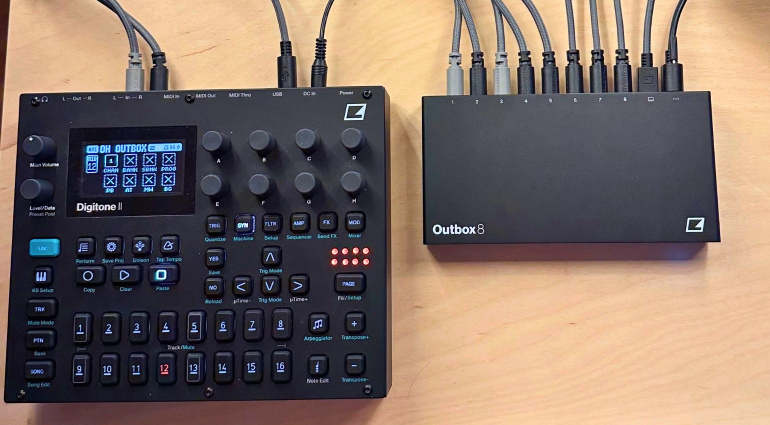
Let’s cut through the hype: the Outbox 8 is a dedicated output interface for Overbridge-compatible Elektron devices. No inputs. Just eight mono balanced quarter-inch jacks, one USB-C data port, and one USB-C power port. That’s it. The design is minimalist to the point of being almost confrontational, but in the context of Elektron’s ecosystem, it makes perfect sense.
Anyone who has wrestled with a Digitone II, Digitakt 2, or the upcoming Tonverk knows the pain: everything runs through a single stereo output. Want separate bus outputs for drums, bass, lead, and pads? Not easily possible without some cumbersome routing or external mixing. The Outbox 8 is Elektron’s answer to that problem, and we at Noxal have been waiting for something like this for years. It’s not a mixer; it’s a breakout box that turns your Elektron device into a proper multitrack machine.
Making Sense of the Outputs and CV Flexibility
At the Digitone II demo on the Superbooth floor, a new menu was shown that lets you configure which tracks route to which output. Multiple tracks can share the same output, and the device’s master output remains independently usable. Outputs can be combined in pairs into balanced stereo outputs—maximum of four stereo pairs—which is more than enough for most live setups.
But here’s where it gets interesting: outputs on the right-hand side can be reconfigured as CV outputs, with a dedicated menu for voltage settings. That opens the Outbox 8 up to hybrid setups with Eurorack or other CV-controlled gear. I can already imagine routing a kick drum to a CV output to trigger a modular envelope, or using it to modulate a filter on an external synth. For a device this size, that’s genuinely clever engineering.
Latency: The Impressive Detail
One detail that made me pause mid-sip of my third coffee of the morning: the Outbox 8’s latency is said to be exactly identical to the internal stereo output of the connected Elektron device. Recording both simultaneously and comparing waveforms should show no offset at all. This was explicitly confirmed at the booth, and if it holds up in real-world testing, it’s genuinely impressive.
Full synchronicity between the internal output and eight additional outputs with zero latency offset is a real game changer for recording workflows. No more phase issues, no more manual alignment in your DAW. You can record your entire setup in one take and have everything perfectly aligned. That’s the kind of detail that separates a thoughtful accessory from a mere afterthought.
Powerhub and Practical Use Cases
Also spotted at the booth was the Elektron Powerhub, a USB-C hub for up to six devices. Whether it only delivers power, functions as a proper powered USB-C hub for a computer, or even enables communication between multiple Elektron devices is still unclear. Even just centralized power delivery for multiple Elektron boxes would be a genuine quality-of-life upgrade, especially for live performers. Anyone running three or four Elektron boxes on stage right now knows exactly how much cable chaos that currently involves. Think of it as the unsung hero of cable management—not flashy, but absolutely necessary.
Obvious use cases for the Outbox 8: separate outputs for drums, lead, bass, and pads; an isolated kick output for sidechain routing into a master compressor; or using the outputs as FX sends to external effects pedals, with returns coming back into the Elektron device’s audio inputs. The Powerhub complements this by keeping your power delivery clean and centralized.
Market Context and Who This Is For
The Outbox 8 is not for everyone. If you’re happy with a single stereo output and don’t need multitrack recording or CV routing, you can safely ignore this. But for anyone working with Overbridge hardware who’s been waiting for flexible bus outputs, CV routing, and latency-free multitrack recording, this is exactly what you’ve been waiting for. It’s a niche product for a specific audience, but within that niche, it’s a winner.
Pricing is still unconfirmed—both €249 and €299 were mentioned at the booth, so the final number is open. A release in June 2026 seems likely. The Powerhub’s pricing and release timeline are even more vague. We’ll keep you updated as soon as we hear more from Elektron.
Frequently Asked Questions
Can I use multiple Outbox 8 units with one Elektron device?
No. Multiple Outbox 8 units on a single Elektron device are apparently not combinable. Think of this as bus outputs rather than individual track outputs—eight mono or up to four stereo outputs per device.
Does the Outbox 8 work as a standalone audio interface?
Yes. The Outbox 8 also works as a standalone audio interface connected to a computer or iPad, with Overbridge drivers built in. You can use it without an Elektron device as a simple multi-output interface.
What is the Powerhub’s exact functionality?
Official details are still scarce. It’s a USB-C hub for up to six devices, but whether it only delivers power, functions as a data hub, or enables device-to-device communication is unclear. Even just centralized power delivery would be a major upgrade for live performers.
Now if you’ll excuse me, I need to re-cable my entire studio for the fourth time this week. At least with the Powerhub, I can pretend the spaghetti is intentional.