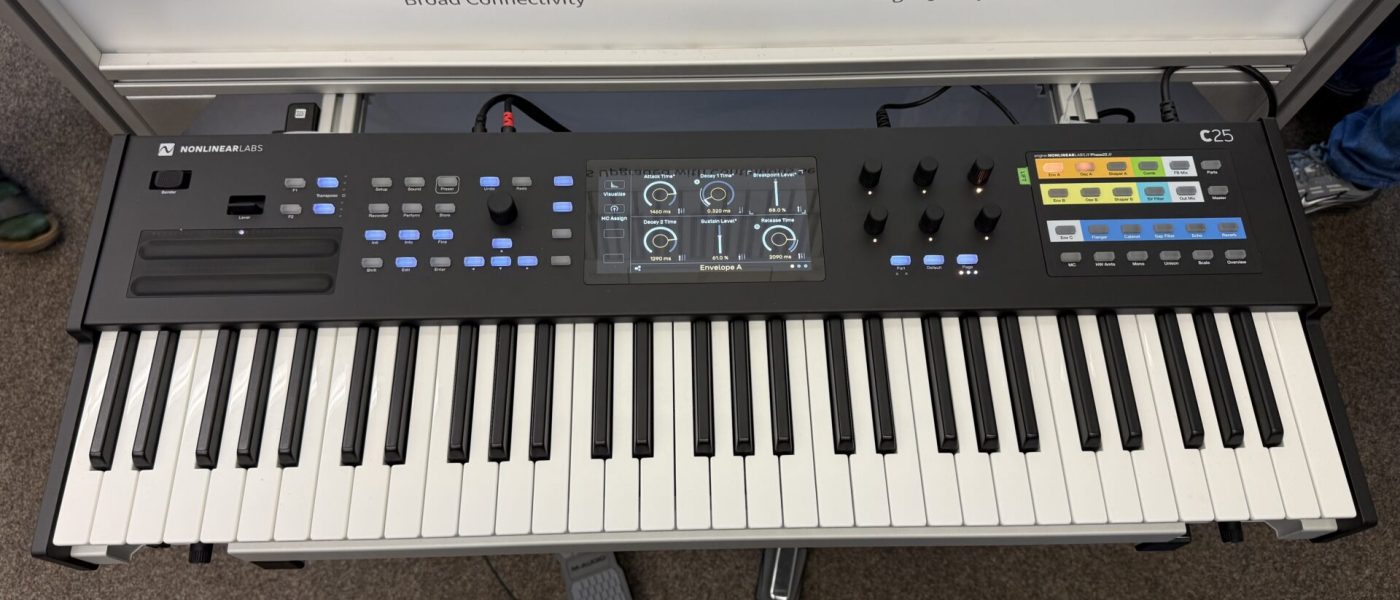
TL;DR: Nonlinear Labs has previewed the C25, the long-awaited evolution of their utterly unique C15 phase modulation synthesizer. The new model is smaller, lighter, and built for the touring musician, while retaining the core 48-voice hybrid engine and adding replaceable overlay buttons for future third-party synth engines. Expect it in 2027 for around 3500€.
- The C25 is a compact, lightweight, and robust redesign of the C15, explicitly targeting touring musicians.
- It retains the C15’s 48-voice polyphonic architecture combining phase modulation, waveshaping, physical modeling, and subtractive synthesis with splits/layers.
- The new interface features 24 selection buttons with replaceable overlays, allowing the UI to be reconfigured for different synth or effect engines from third-party developers.
- Most components are manufactured in Europe with a focus on durability and sustainability.
- Price is estimated around 3500€, with release planned for 2027.
Reading time: 4 min
Want more synth news before your next coffee break? Join the Noxal newsletter — no spam, just gear worth knowing about.

The return of Stephan Schmitt’s brainchild

Ten years ago, Nonlinear Labs—founded by Native Instruments founder Stephan Schmitt—dropped the C15 phase modulation synthesizer. It was, and remains, one of the most sonically singular instruments we at Noxal have ever touched. The interface was a kind of modernist sculpture: a slanted panel with capacitive touch sensors, endless encoders, and a screen that looked like it belonged on a spaceship’s bridge. It sounded like nothing else. But it was also expensive, heavy, and not exactly built for the road.
Now, at Superbooth 2026, Nonlinear Labs has previewed the C25. And if the C15 was the lab experiment, the C25 is the field-deployable version. The company explicitly says it was designed “with the touring musician in mind.” That alone should raise some eyebrows. The C15 was not a touring instrument—it was a studio anchor. The C25, by contrast, comes in a compact, lightweight, and robust housing. I can already hear the road cases sighing with relief.
What makes the C25 different
The most immediately obvious change is the physical form factor. The C25 is smaller and lighter. But the real innovation—and the part that made me genuinely excited—is the replaceable overlay system for the 24 selection buttons. These buttons provide quick access to all synth engine components, opening the corresponding parameter page on the screen. The button labels are printed on a replaceable overlay. This means the user interface can be reconfigured for different synth or effect engines.
This is not just a cosmetic tweak. Nonlinear Labs is positioning the C25 as a platform for future developments, explicitly stating it will support synthesis or effect engines from third-party developers. That’s a bold move. Imagine swapping out the FM engine for a granular processor or a physical modeling piano, all through the same hardware. The C25 remains adaptable and up-to-date in the long term, which is exactly what we want from an instrument in this price bracket.
The screen itself is also reportedly much better than the C15’s—higher resolution, more legible in stage lighting. Combined with the overlay system, the UI has even more potential than the original. And the original’s UI, let’s be clear, was actually quite good once you wrapped your head around it. This one is just better.
The engine under the hood
Under the hood, the C25 retains the same core DNA as the C15. It is a 48-voice polysynth that combines phase modulation (FM), waveshaping, physical modeling, and subtractive synthesis. You can configure it in splits or layers. It has a unique feedback signal routing with two groups of five audio effects. There’s also a built-in recorder that captures hours of lossless audio—a feature that touring musicians will appreciate for capturing ideas on the fly.
One question that emerged from the community is: does the C25 have MIDI or MPE? The original C15 famously had no MIDI at all, relying instead on its own proprietary protocol. Nonlinear Labs has not yet confirmed full specs, but the fact that they’re targeting touring musicians and third-party engines strongly suggests they’ve added standard connectivity. We’ll update as soon as we know more.
The market context and who’s it for
The C25 is planned for 2027 with a price tag around 3500€. That’s still an expensive instrument—let’s not pretend otherwise. But considering the C15 launched at a significantly higher price and remains sought-after on the used market, this is a relative bargain for what you’re getting. The C15 owner who bought theirs used at a steep discount (like the commenter in the source article) will likely find the C25 appealing for its improved screen and simpler UI.
Who is this for? It’s for the musician who needs something that sounds like nothing else, who values deep synthesis over presets, and who can afford to invest in a platform rather than a product. It’s also for the performer who previously looked at the C15 and thought, “I love the sound, but I can’t take that thing on tour.” The C25 answers that call. Most components are manufactured in Europe with a passionate focus on durability and sustainability—so you’re also buying into a philosophy, not just a piece of gear.
Frequently Asked Questions
Does the C25 have MIDI or MPE support?
Nonlinear Labs has not yet confirmed full specifications. The original C15 lacked MIDI entirely, but given the C25’s focus on touring musicians and third-party engine support, we strongly suspect standard MIDI and possibly MPE will be included. We’ll report as soon as details are available.
What is the price and release date for the Nonlinear Labs C25?
The C25 is planned for release in 2027 with an estimated price of around 3500€. This is a significant reduction from the C15’s launch price, though still a premium instrument.
Can the C25 use third-party synth engines?
Yes. Nonlinear Labs explicitly states the C25 is designed as a platform for future developments and will support synthesis or effect engines from third-party developers. The replaceable button overlays allow the user interface to be reconfigured for different engines.
I’m already clearing space on my studio desk and mentally budgeting for 2027. The coffee budget may have to tighten its belt, but some sacrifices are worth making.