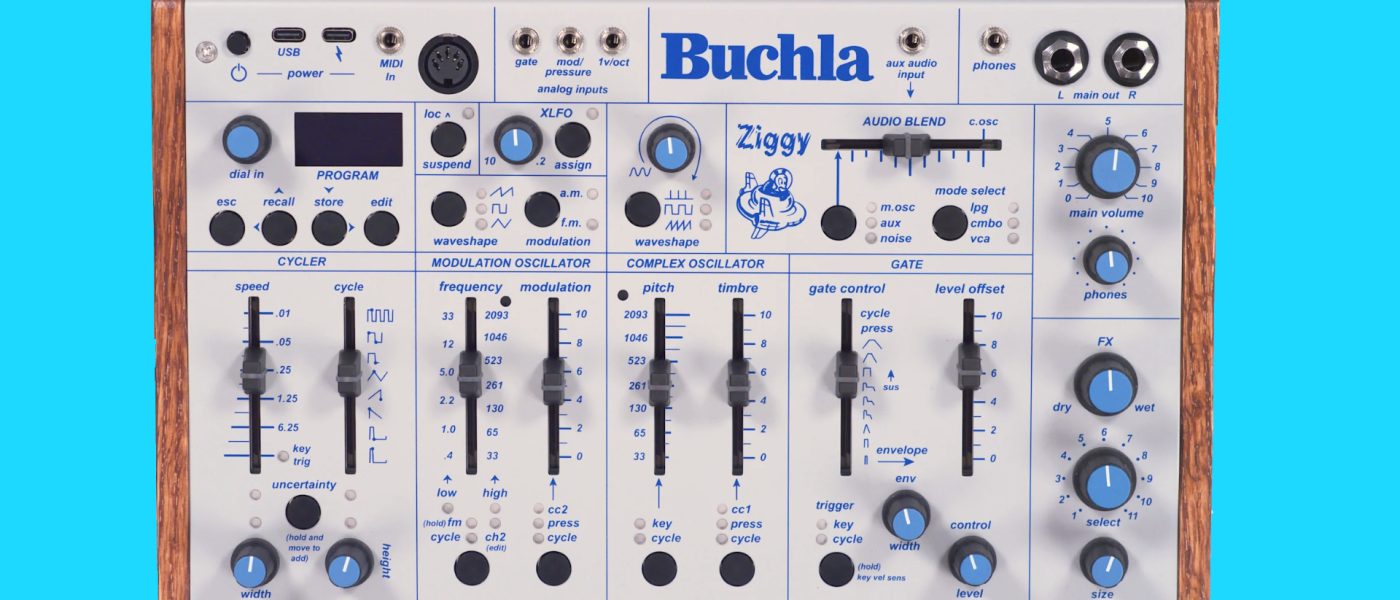
TL;DR: Buchla has announced the Ziggy, a compact West Coast synthesizer that brings the company’s signature sound—complex oscillators, lowpass gates, and digital control—to a wider audience for the first time. At $999, it’s the most portable and affordable Buchla ever made, with a flat, slanted design that fits on a desk or in a backpack. It’s available for pre-order ahead of Superbooth 2026.
- Buchla Ziggy is a West Coast synth with analog complex and modulation oscillators, wavefolding, and a lowpass gate (no traditional filter).
- It includes digital effects (reverb, delay, flanger, pitch-shifter, distortion) and over 100 factory presets plus user memory.
- Connectivity supports Eurorack via 1V/oct, gate, and CV inputs, plus USB-C MIDI, five-pin DIN, and 3.5mm Type A MIDI.
- Power is via USB-C, meaning you can run it off a power bank or computer—ideal for mobile studios.
- Pre-order price is $999 / €1039, a fraction of typical Buchla costs, making it the most accessible entry point yet.
Reading time: 4 min
Want more synth news before your next coffee break? Join the Noxal newsletter — no spam, just gear worth knowing about.

What Is the Buchla Ziggy?

Let’s be honest: when most of us think “Buchla,” we picture a rack of expensive, esoteric modules that require a PhD in patching and a mortgage application for funding. The Ziggy flips that script. Announced ahead of Superbooth 2026, it’s a self-contained, desktop-ready West Coast synthesizer that’s as portable as it is approachable.
The design is flat, with a slanted interface that looks like a friendly, slightly retro calculator from the future. At $999, it’s not pocket change, but it’s a fraction of what a full Buchla system would set you back. We at Noxal have been waiting for something like this—a device that brings Don Buchla’s philosophy to a broader audience without diluting the character.
Buchla describes it as incorporating “many of the Buchla innovations that have long been taken for granted.” That’s a bold claim, but from the specs, it’s clear they’ve packed a lot into this little box: digital control over analog audio, additive synthesis, and unique interactions that reward exploration over precision.
Core Sound Engine: West Coast, No Filter
The heart of the Ziggy is its analog complex oscillator and modulation oscillator. The complex oscillator starts from a sine wave and lets you apply frequency and amplitude modulation from the modulation oscillator. There’s also a timbre wavefolder to add harmonics—a classic West Coast technique that turns simple waveforms into rich, evolving textures.
The modulation oscillator can run at low or audio frequencies, with selectable shapes: sawtooth, square, and triangle. You can tune and quantize it for both Western and non-Western scales, which is a thoughtful touch for adventurous musicians. But here’s the real kicker: like in a classic Buchla, there is no traditional filter. Instead, you get an advanced lowpass gate (LPG) that operates as a VCA, filter, or both, using a Sallen-Key filter architecture. This is the kind of circuit that gives Buchla its signature “thwack” and woody resonance—something no digital emulation quite captures.
Envelopes are blended shapes rather than the usual ADSR. Buchla says they “encourage discovery, rather than precision,” and I think that’s a fair description of the entire West Coast ethos. You don’t dial in a perfect envelope; you twist and listen until it feels right. There’s also a Cycler modulator that offers mixable shapes and can be assigned to parameters for living, breathing modulation, plus an XLFO—a triangle wave LFO that can map to any parameter.
Digital Controls and Effects
While the core is analog, the Ziggy leans into digital for flexibility. A built-in digital effects unit offers reverbs, pitch-shifter, flanger, delays, distortions, and more. That’s a welcome addition for a synth that’s meant to be used standalone—you don’t need to patch in external processors to get polished sounds.
You can save your own patches in user memory, or choose from over 100 factory presets. That may sound like a compromise for purists, but let’s be real: having a starting point is useful, especially when you’re new to the Buchla way of thinking. And for those who like to dig deeper, a web browser with WebMIDI lets you edit and archive patches and update firmware. It’s not a full editor on the unit itself, but it’s a practical solution for a synth this compact.
We at Noxal appreciate that Buchla didn’t try to cram everything into a tiny screen. Instead, they’ve kept the interface knob-heavy, with clear labels and a layout that invites tweaking. It’s a good balance between modern convenience and hands-on control.
Connectivity and Power
The Ziggy is designed to play nice with others. It has 1V/oct pitch, gate, and CV inputs, so you can integrate it with Eurorack systems or the Buchla LEM 218 controller. That’s a big deal for modular users who want a dedicated voice without building a whole Buchla system.
For MIDI, there’s USB-C, five-pin DIN, and a Type A 3.5mm MIDI port—covering almost every modern standard. Audio outputs are stereo via 6.3mm mono sockets, plus a headphone jack. And here’s the best part for mobile sessions: the synth can be powered over USB-C using a power bank, computer, or wall adapter. No wall wart required.
This makes the Ziggy genuinely portable. You can set it up on a park bench, in a coffee shop (if you’re that person), or in a cramped studio corner. It’s the kind of instrument that encourages you to actually make music rather than just obsess over patch cables.
Market Context and Who It’s For
The Ziggy arrives at a time when interest in West Coast synthesis is higher than ever, thanks to affordable modules from companies like Make Noise, Intellijel, and others. But Buchla itself has remained largely out of reach for most musicians. The Ziggy changes that. At $999, it’s competing with flagship desktop synths from Moog, Sequential, and Korg, but it offers a distinctly different philosophy.
Who is it for? First, it’s for the curious musician who has heard about Buchla but never had the budget to explore. Second, it’s for the Eurorack user who wants a Buchla voice without committing to an entire system. Third, it’s for anyone who values sound design over preset surfing—the Ziggy rewards patience and experimentation.
Of course, there are trade-offs. You can’t expand it with modules, and the digital effects might not satisfy purists who want all-analog signal paths. But for a first step into the Buchla world, the Ziggy is a brilliant move. It’s not a toy; it’s a legitimate instrument that honors the company’s legacy while making it accessible. We at Noxal are genuinely excited to hear what people do with it.
Frequently Asked Questions
Is the Buchla Ziggy fully analog?
No—the core sound engine (oscillators, wavefolder, lowpass gate) is analog, but the effects, preset storage, and control system are digital. It’s a hybrid design that Buchla says offers the best of both worlds.
Can I use the Ziggy with Eurorack?
Yes. It has 1V/oct pitch, gate, and CV inputs, so it can integrate with Eurorack systems. It also supports standard MIDI over USB, five-pin DIN, and 3.5mm Type A ports.
How much does the Buchla Ziggy cost and when is it available?
The Ziggy is available for pre-order now at $999 (USD) or €1039. It’s expected to ship around Superbooth 2026, though exact dates haven’t been confirmed yet.
I’ll be honest—this is the first time I’ve felt tempted to sell a kidney for a Buchla. But at this price, I can keep both kidneys and still have enough left over for a nice pour-over coffee. Priorities, people.