
TL;DR: SOMA Laboratory has announced the Enigma, a synthesizer that forgoes traditional keys and knobs for a sensor-filled surface controlled by placing metallic objects on it. Priced at €590 and expected by mid-summer, it promises to be an exploration-driven instrument where identical object placements yield identical sonic results—though much of its internal behavior remains deliberately mysterious.
- Enigma uses eight touch sensors and electromagnetic field sensing to detect metallic objects placed on or near its surface, with sensitivity up to 20mm.
- The interface has multiple operating states, but SOMA is keeping the specifics hidden to encourage hands-on discovery.
- It includes MIDI (5-pin DIN) and CV clock input, though not all modes respond to external control.
- Stereo audio outputs plus a headphone jack are provided; the unit is expected to ship by mid-2025 at €590.
- Identical object placement under identical sensor states produces identical sonic behavior—this is not random noise generation.
Reading time: 4 min
Want more synth news before your next coffee break? Join the Noxal newsletter — no spam, just gear worth knowing about.

What Is the SOMA Enigma?
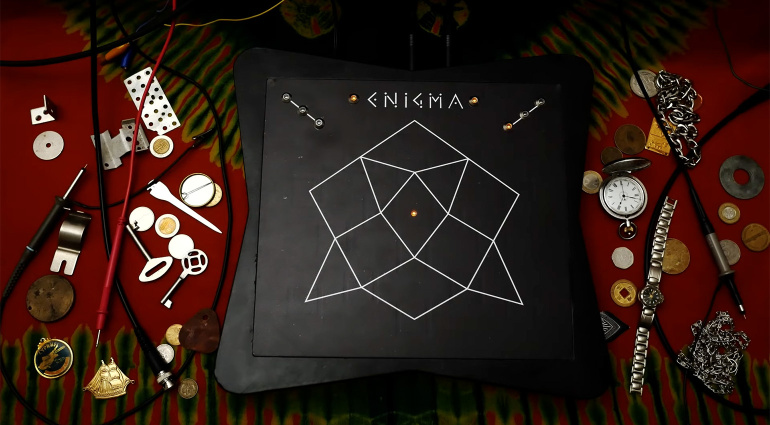
Let’s be honest: when you see the SOMA Enigma for the first time, your brain might short-circuit. It doesn’t look like a synthesizer—not in any conventional sense. There are no keys, no knobs, no patch cables. What you get is a flat, board-game-like surface that wouldn’t look out of place next to a Ouija board at a flea market. But this is SOMA Laboratory we’re talking about, the same people who gave us the Lyra-8 and the wooden Terra. They’ve never been interested in what a synth “should” be, and the Enigma is perhaps their most radical departure yet.
The Enigma is described by SOMA as “dedicated to the spirit of exploration and discovery.” That’s not marketing fluff—it’s a literal design constraint. The instrument is built around electromagnetic field sensors that detect metallic objects placed on or near its surface. The idea is that you, the performer, become a kind of alchemist, arranging coins, screws, gears, or whatever scrap metal you’ve got lying around to shape sound in real time. It’s part instrument, part puzzle, part ritual object.
How the Enigma Works
The core of the Enigma is its sensor system. Eight touch sensors allow you to switch between operating states, though SOMA is notably tight-lipped about what those states actually are. The company’s stance is that you need to discover them yourself—a philosophy that will either thrill experimentalists or frustrate anyone who just wants to dial in a pad sound before dinner.
What we do know: the sensors are extremely sensitive, responding to metallic objects held up to 20mm above the surface. A fractional millimeter shift in position can alter the sound. SOMA explicitly states that the Enigma is not random—identical object placement and movement under identical touch sensor states will produce identical sonic behavior. This is crucial for anyone who wants reproducibility in performance or composition. The instrument may also “remember gestures over time,” hinting at some kind of internal memory or learning algorithm, though specifics are absent.
I appreciate that SOMA is leaning into the mystery, but I can’t help but wonder: will this be a tool for deep exploration or a party trick you tire of after an hour? The answer probably depends on how much you enjoy spending an afternoon with a handful of paperclips and a lot of patience.
Key Specifications and Connectivity
Despite its unconventional interface, the Enigma does include some familiar ports. You get a 5-pin DIN MIDI input, a CV clock input, stereo audio outputs, and a headphone jack. Not every operating mode will respond to external control, but when they do, the Enigma can receive MIDI clock, start/stop/continue messages, MIDI notes (velocity ignored, which is a bit of a bummer), and pitch bend. CV clock is also supported.
There’s no mention of USB MIDI or any kind of software editor, so this is clearly a hardware-first experience. The price is set at €590, with availability expected by mid-summer. SOMA will be at Superbooth this week, where founder Vlad Kreimer will give a presentation on the Enigma. Expect long queues of curious synth nerds holding fistfuls of loose change.
Market Context and Who It’s For
In a world where we’re drowning in analog reissues and menu-diving digital workstations, the Enigma is refreshingly weird. It’s not trying to be a better Minimoog or a more powerful workstation. It’s an instrument that asks you to rethink what a synthesizer even is. That’s a hard sell for most musicians, but for a certain subset—the ones who own multiple theremins, who build their own Eurorack modules out of salvaged electronics, who find joy in unpredictability—the Enigma will be irresistible.
At €590, it’s not cheap, but it’s not outrageous for a boutique instrument from a respected builder. The real cost is time: you’ll need to invest hours just to understand how the thing works. If that sounds like fun, you’re the target audience. If you want to get a track done before midnight, maybe stick with a digitakt.
We at Noxal are cautiously excited. The Enigma is the kind of instrument that could spark a whole new genre of performance art, or it could end up on Reverb in six months with the description “bought it, never figured it out.” Either way, it’s a welcome reminder that synthesis is still a frontier worth exploring.
Frequently Asked Questions
What kind of objects can I use with the SOMA Enigma?
Any metallic object will work: coins, screws, gears, tools, fragments, even kitchen foil. The shape, size, and type are entirely up to you. The sensitivity is high enough that objects held up to 20mm above the surface will still be detected.
Does the Enigma support MIDI or CV?
Yes. It includes a 5-pin DIN MIDI input and a CV clock input. Some operating states will respond to MIDI clock, start/stop/continue, notes (velocity ignored), and pitch bend. Not every mode allows external control, however.
When will the Enigma be available and how much does it cost?
SOMA expects the Enigma to be available by mid-2025 at a price of €590. They will be demonstrating it at Superbooth, where founder Vlad Kreimer will present the instrument on May 9.
I’m off to raid the junk drawer for paperclips and a rusty socket wrench. If you hear strange noises coming from my studio, it’s either the Enigma or my espresso machine needing descaling—hard to tell the difference sometimes.