TL;DR: Baloran, the French synth wizard behind The Pool and The River, has unveiled The 3FX — a stereo analog multi-FX unit with three independent voices, each packing dual PT2399 delays, a multimode filter, and eight LFOs. The kicker? No knobs on the box: you control it via a dedicated Bluetooth touchscreen remote, a web app, or a VST3 plugin. It’s available now for 552€ (696€ with the remote).
- The 3FX is a three-voice analog effects workstation, each voice built around two PT2399-based delays (series or parallel) and a 12dB/oct multimode VCF (LP/BP/HP).
- Each voice has independent dry/delay levels, pan, and its own multi-wave LFO — totalling 24 LFOs across the unit, plus three macro controls for morphing up to 24 parameters each.
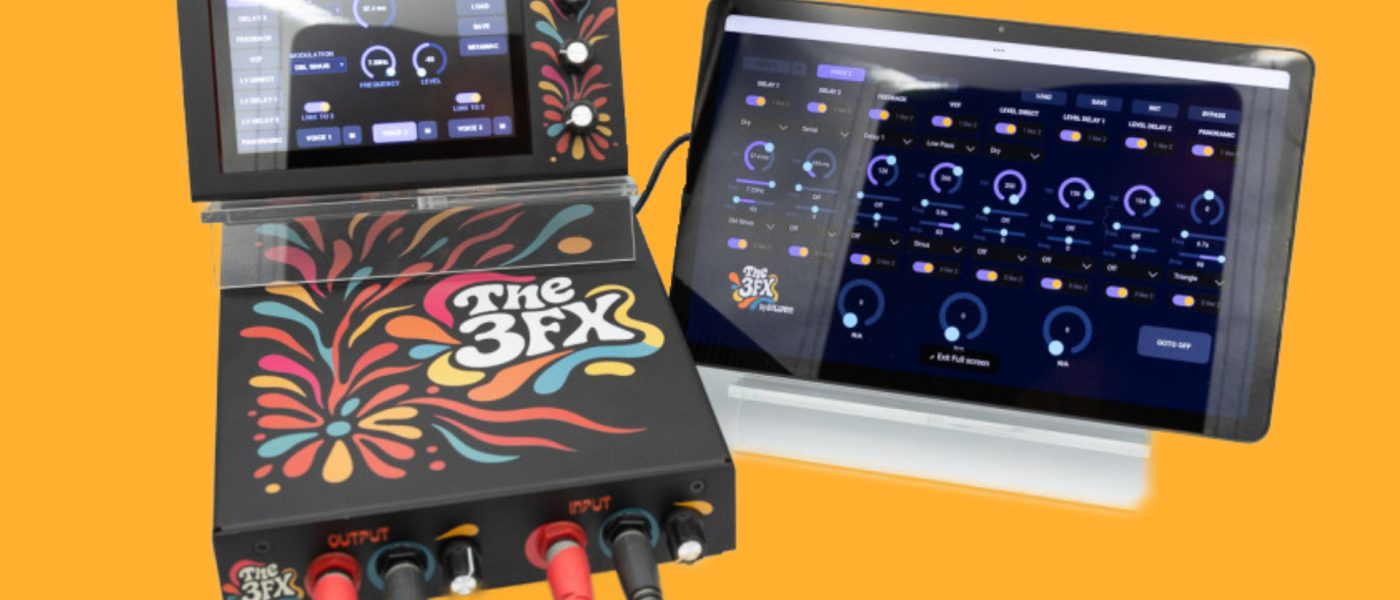
- Hardware has zero front-panel controls (except gain) — you operate it via a PC/Mac app, a web server, a VST3 plugin, or an optional Bluetooth remote with a 5-inch touchscreen and three physical pots.
- Pricing: 552€ for the base unit, 696€ with the dedicated remote controller — available now.
Reading time: 4 min
Want more synth news before your next coffee break? Join the Noxal newsletter — no spam, just gear worth knowing about.

What Is The 3FX?

Laurent Baloran doesn’t do small. The man who gave us The River and The Pool — sprawling, multi-timbral analogue beasts that make other synths look like moody toys — has turned his attention to effects. The result is The 3FX, a stereo analog multi-FX unit that looks like a flat black brick and sounds like a cathedral full of clockwork echoes.
At SynthFest France 2026, Baloran’s booth was conspicuously synth-free. Instead, he showed off The 3FX, which he describes as an “analog FX workstation.” The name is apt: this isn’t a pedal you stomp on between riffs. It’s a studio-grade processor that wants to live on your desk, wired into your patchbay and controlled from a tablet while you sip your second espresso of the morning.
The 3FX is built around three fully independent effect voices, each sharing the same architecture but capable of being used alone, stacked, or linked in various configurations. The result is a sound design tool that can go from pristine echo to chaotic, self-oscillating noise textures — all without a single knob on the unit itself.
Architecture Deep Dive: Three Voices, Infinite Textures
Each voice in The 3FX contains two PT2399-based delay lines. Yes, the PT2399 is technically a digital chip, but the surrounding circuitry is fully analog — a distinction that matters when you’re chasing that grainy, lo-fi character that made the chip a cult favorite in boutique delays. The delays can be configured in series or parallel, and they feed into an advanced feedback path that can push the unit into controlled self-oscillation. That’s not just a gimmick; it’s a way to turn your dry signal into something that breathes and howls.
After the delays, each voice hits an analog 12dB/oct multimode VCF with lowpass, bandpass, and highpass options. Crucially, the filter can process both the delay lines and the dry signal, so you’re not just filtering repeats — you’re reshaping the entire sound. Each voice also has independent level controls for dry and each delay line, plus panorama control for stereo placement. Mono signals get distributed across all three voices; stereo signals map left-left/right-right. There’s even a link mode that ties modules from voices 1 and 3 to the corresponding module of the center voice, turning the whole thing into a kind of macro-instrument.
Then there’s modulation. Each of the three voices has its own multi-wave LFO — but wait, there are eight modules per voice (delay A, delay B, filter, dry level, delay A level, delay B level, pan, and the LFO itself). That gives you 24 LFOs in total, all assignable to various parameters. Plus, three macro controls can house up to 24 settings each, letting you morph between completely different patches in real time. And yes, you can map those macros to MIDI CC. This is not a box that sits still.
The Remote Control Conundrum
Here’s where The 3FX gets divisive: the hardware has no controls other than a gain knob. No sliders, no pots, no buttons — just a black box with input and output jacks, MIDI, USB-C, and a 5V power port. All parameter tweaking happens remotely, and Baloran offers four options: a PC/Mac software application, a Wi-Fi-enabled web server for tablets or smartphones, a VST3 plugin that integrates directly into your DAW, or a dedicated Bluetooth hardware remote controller with a 5-inch capacitive touchscreen and three physical pots.
At 552€ for the base unit, you’re paying for the analog engine and the software/plugin control. Add another 144€ (696€ total) for the dedicated remote. I’ll be honest: my first reaction was skepticism. A hardware effects unit with no hands-on control feels like a contradiction — like a guitar with no neck. But after sitting with the concept, it makes a twisted kind of sense. If you’re using The 3FX in a studio, you probably already have a DAW or hardware sequencer doing the heavy lifting. The VST3 plugin means you can automate every parameter without ever touching the box. And the remote? It’s a luxury, but it’s a well-designed one — a dedicated touchscreen with three real pots for the stuff you actually want to grab in a live situation.
We at Noxal appreciate the flexibility, even if we miss the tactile immediacy of a row of knobs. Baloran is betting that integration trumps immediacy for this particular product, and given the price point, I suspect he’s right.
Market Context and Verdict
The 3FX enters a market crowded with delay and chorus pedals, from Strymon’s digital masterpieces to the analog dirt of the Moogerfooger line (RIP). But The 3FX isn’t competing with pedals. It’s competing with rackmount processors like the Eventide H9 or the discontinued Lexicon PCM series — though it does so with an all-analog signal path and a distinctly French, eccentric design philosophy.
Baloran explicitly positions The 3FX as a replacement for his discontinued Triko tri-chorus rack unit. But it goes well beyond that. With its three independent voices, extensive modulation, and remote control, it’s a sound design tool for producers who want more than “just delay.” Think elegant echoes, vintage choruses, phasing effects, ambient washes, and noisy, self-oscillating textures. It’s also a great choice if you’ve ever wanted to integrate a hardware FX unit into a DAW-centric workflow without compromise.
Who is it for? Studio musicians who value recall and automation. Live performers who can stomach a touchscreen and a Bluetooth remote. And anyone who’s ever felt that their delay pedal was holding back their creativity. The 3FX is an ambitious, uncompromising box from a developer who clearly loves sound more than convention. At 552€, it’s not cheap, but it’s priced fairly for what it offers. We at Noxal are genuinely curious to hear what it does to a simple monophonic line — and we suspect you will be too.
Frequently Asked Questions
Does The 3FX have any physical controls at all?
Only a gain control on the hardware itself. All other parameter adjustments are handled via the included software (PC/Mac app, web server, VST3 plugin) or the optional Bluetooth remote controller with a 5-inch touchscreen and three physical pots.
Can I use The 3FX with a guitar or other high-impedance sources?
Yes. The 6.35mm stereo input is switchable between line level and high-impedance, so you can plug a guitar or bass directly into it without needing a separate DI box.
What’s the difference between the 552€ and 696€ versions?
The 552€ base unit includes the software/plugin control options but no dedicated hardware controller. The 696€ version adds the Bluetooth remote with the 5-inch capacitive touchscreen and three physical pots. All other hardware is identical.
We at Noxal will be testing The 3FX with a cup of black coffee and a single, slightly out-of-tune Juno-60. If the echoes sound as good as the third espresso of the morning, we’ll be happy. If they don’t, we’ll just drink more coffee and try again.