
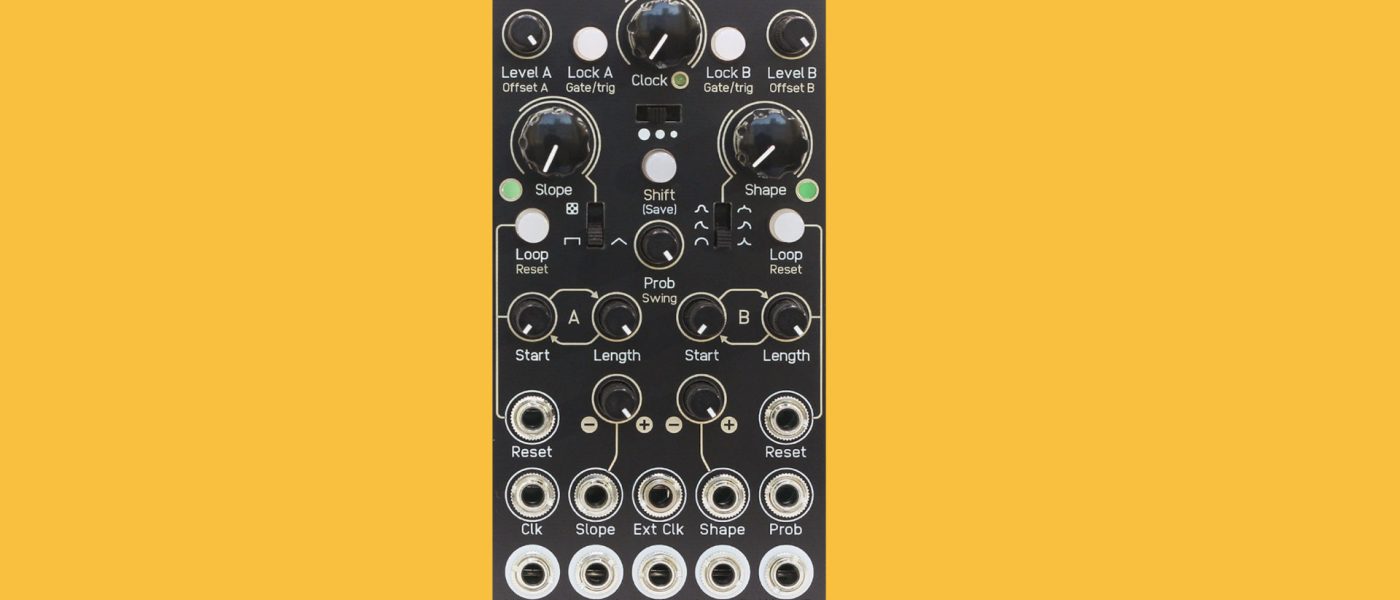
TL;DR: Teia Synthesizers has unleashed the DriftLog, a 12HP dual-channel random voltage generator for Eurorack that lets you capture, loop, and morph randomness in real-time. This Portuguese powerhouse offers slope, shape, probability, and loop controls—all without menu diving—making it a must-have for modular improvisers seeking controlled chaos.
- Dual independent random voltage channels (A and B) with shared motion controls for slope, shape, probability, and clock rate.
- Loop function on each channel replays recent random values with dedicated Start and Length controls, enabling live performance tweaks.
- Lock button preserves per-channel settings independently, allowing two distinct motion behaviors simultaneously.
- Secondary control layer (DC Offset, Swing, Manual Reset, Gate/Trigger) accessed via Shift, with settings saved and recalled on power-up.
- Available now for $369/285€ + VAT, offering a unique blend of structured randomness and Eurorack-friendly hands-on control.
Reading time: 4 min
Want more synth news before your next coffee break? Join the Noxal newsletter — no spam, just gear worth knowing about.

What Is Teia Synthesizers DriftLog?

We at Noxal have a soft spot for anything that makes modulation feel alive—and the DriftLog is precisely that. Teia Synthesizers, a boutique builder from Portugal, has given us a 12HP dual-channel cycling random voltage generator that’s as much a performance tool as it is a sound design engine. At its core, the DriftLog lets you generate, capture, and reshape random voltages in real-time, but it’s the loopable nature that sets it apart. Each channel independently records recent random values, and with a button press, you can replay a selectable portion of that history. This isn’t just another “patch random and hope” module; it’s a way to inject controlled variation into your rack without losing the plot.
The layout is refreshingly tactile. On the left, you have slope controls that morph the output from classic stepped random voltages to smooth, continuous glides. On the right, shape controls sculpt the curvature of those glides—linear, Bezier, exponential, or peak-based curves. Both channels share a clock that sets the rate of new value generation, plus a probability control that introduces controlled variation on whether changes occur at each clock step. The lock button on each side is a small but brilliant touch: press it, and the channel retains its current settings independently, letting you build two distinct motion behaviors. It’s like having two different LFOs that talk to each other but don’t always agree.
The Magic of Controlled Randomness
Randomness in Eurorack is a double-edged sword. On one hand, it can breathe life into a static patch; on the other, it can turn your carefully crafted sequence into a chaotic mess. The DriftLog walks this tightrope with elegance. The loop function is the star here. Each channel continuously records a buffer of recent random values, and the dedicated Start and Length knobs let you tweak the loop range in real-time. This means you can capture a particularly inspiring moment of randomness and repeat it, or stretch it out for evolving textures. It’s a feature that blurs the line between random and deterministic, and we’ve found it surprisingly addictive during late-night patching sessions.
What really impresses us is the secondary control layer. Holding the Shift button gives you access to DC Offset, Swing, Manual Reset, and Gate/Trigger selection—all clearly labeled in gold on the panel. This is a detail that speaks to Teia’s design philosophy: no deep menus, no cryptic button combos. Every function is there, ready to be tweaked, and holding Shift for three seconds saves your settings for automatic recall on power-up. It’s the kind of thoughtful implementation that makes a module feel like an extension of your hands, not a puzzle to solve.
Key Specs and Design Philosophy
Let’s get into the nitty-gritty. The DriftLog is 12HP, which is a sweet spot for a dual-channel module—it’s small enough to fit in a compact rack but deep enough to offer real control. The motion-sharing controls (slope, shape, clock, probability) give you a unified framework for both channels, but the lock button ensures independence. The loop modes are per-channel, and the shift layer adds depth without clutter. Pricing at $369/285€ plus VAT puts it in the premium range, but for what you get—structured randomness with live-loopable segments—it’s competitive with similar modules like the Make Noise Wogglebug or the Random*Source Smooth & Stepped Generator, though the DriftLog offers a more performance-oriented approach.
Teia Synthesizers hails from Portugal, a country that’s quietly becoming a hotspot for boutique Eurorack design. Their approach is hands-on and musician-focused, and the DriftLog reflects that. The panel is clean, with gold alternate functions that are easy to read under dim studio lighting (we’ve tested this, trust us). The build quality feels solid, and the knobs have a satisfying resistance that suggests they’ll hold up to years of abuse. It’s a module that rewards exploration, but it’s also one you can dial in quickly for a live set.
Market Context and Who It’s For
We at Noxal have seen our share of random generators, but the DriftLog fills a specific niche. If you’re a modular enthusiast who loves the unpredictability of random voltages but wants the ability to lock in a favorite pattern and loop it, this is your module. It’s ideal for ambient, generative, and experimental music, but it’s also a powerful tool for techno and house producers who use random modulation for evolving textures. The DriftLog’s loop function makes it a standout for live performance—you can capture a happy accident and build a track around it, then let it drift again when you’re ready.
Compared to the competition, the DriftLog offers more hands-on control over looping than most. The Make Noise Wogglebug is a classic, but its randomness is more chaotic and less structured. The Random*Source Smooth & Stepped Generator gives you great control over shape, but lacks the loopable history. The DriftLog bridges that gap, and at 12HP, it’s a space-efficient solution. It’s also worth noting that Teia has designed this module for the modern modular user—someone who wants depth without complexity. There’s no screen, no firmware updates, just pure analog-style control with digital precision.
Frequently Asked Questions
Can I use the DriftLog as a traditional LFO?
Not directly, as it’s designed for random voltages rather than cyclical waveforms. However, by setting slope to smooth and using the clock to create a slow rate, you can approximate a pseudo-LFO effect. The loop function can also create repeating patterns that feel like an LFO with a twist.
How does the loop function work in practice?
Each channel continuously records recent random values into a buffer. The loop button triggers playback of a selectable portion of that history, controlled by Start and Length knobs. You can tweak these in real-time, making it perfect for live performance or evolving soundscapes. Think of it as a “random sampler” for modulation.
Is the DriftLog compatible with all Eurorack systems?
Yes, it’s a standard Eurorack module with a 10-pin power connector. It requires +12V and -12V rails, drawing minimal current (check the manual for exact specs). The outputs are CV-compatible, so it works with any module that accepts 0-5V or 0-10V control voltages.
I’ll be honest: I spent an entire morning patching DriftLog to control a filter cutoff while my coffee went cold. Worth it. The loop button saved the best randomness, and the caffeine can wait.