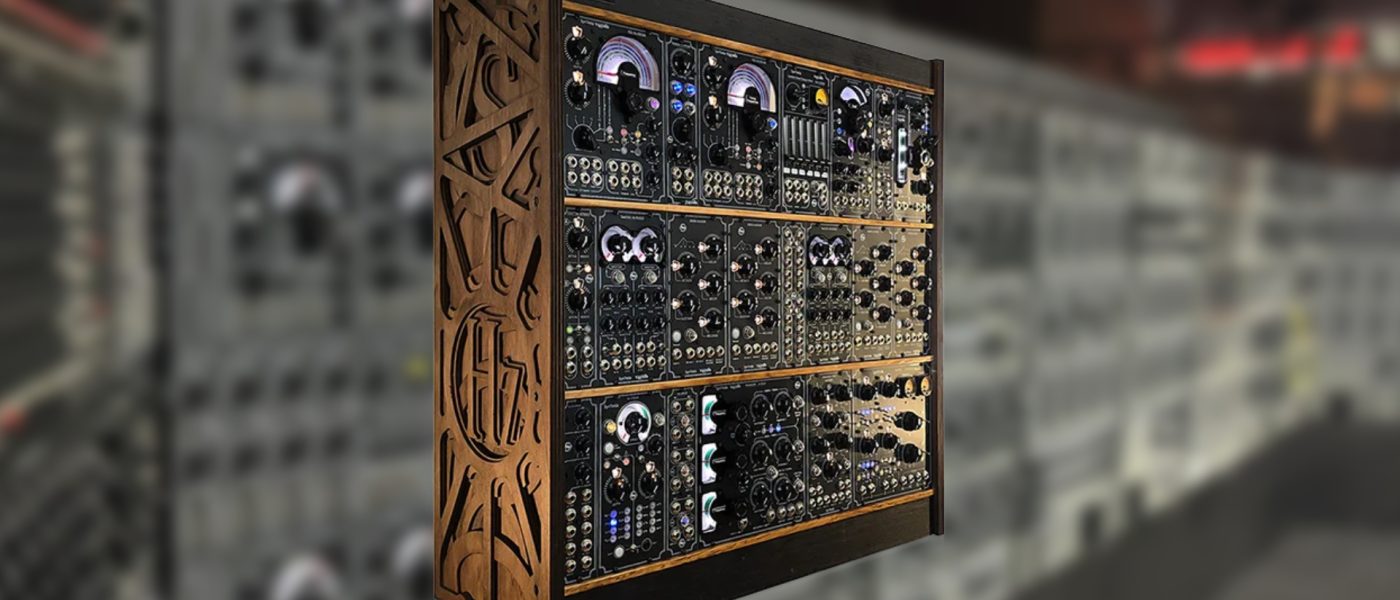
TL;DR: SynTesla, the French duo behind Hans Zimmer’s gargantuan Giorgio III modular, has released its first commercial offshoot: the MegaHertz. This 42-MU, hand-carved oak 5U system packs 20 new modules (including dual VCOs with through-zero FM, a wavefolder, and a “super” LFO) and is available now for €6,800 (ex VAT). Two even larger models—GigaHertz and TeraHertz—are on the horizon.
- Handcrafted in France with solid oak sides and stained wood finishes; side colours are customizable.
- 20 distinct modules: dual VCOs with TZFM/TZPM, a wavefolder, diode-ladder filter, 6–24 dB lowpass filter, four DADSRs, and the feature-packed “Super LFO” with 16 waveforms and an expander.
- Priced at €6,800 (ex VAT) / €8,160 including tax; shipping now.
- Two larger systems—GigaHertz (late 2026) and TeraHertz (2027)—are already announced.
- SynTesla also released three Eurorack versions of these modules for the 3U crowd: Toolbox STBX-10 MKII, SLFO-16, and Diode Ladder Filter DLF-V1.
Reading time: 4 min
Want more synth news before your next coffee break? Join the Noxal newsletter — no spam, just gear worth knowing about.

The Monster’s Progeny

When Hans Zimmer’s team commissioned SynTesla to build the Giorgio III—a 5U modular behemoth that reportedly required ten months of pure R&D—most of us assumed it would remain a one-off, a bespoke tool for a stadium-filling composer. But Pierre Jean Tardiveau and Yves Usson had other plans. At SynthFest France 2026, they unveiled the MegaHertz, the first commercial product born from that collaboration. And unlike many “inspired by” products, this one shares actual bloodlines: the same handcrafted French cabinetry, the same module architecture, and—most importantly—the same sonic DNA.
The MegaHertz is not small. At 42 MU (3 x 5U x 14 MU), it’s a serious commitment of studio real estate. But it’s also a deliberate reduction from Giorgio III’s sprawling scale. Think of it as the “greatest hits” of that monster: the essential voice architecture, the core modulation toolkit, and the utility modules that make a modular system playable. SynTesla promises that GigaHertz (second half of 2026) and TeraHertz (2027) will expand this foundation, but for now, the MegaHertz stands alone as a complete, self-contained instrument.
What’s in the Box: 20 Modules of French Craftsmanship
Let’s talk modules. MegaHertz ships with 20 distinct units, and unlike many boutique 5U systems that rely on reissues or clones, these are all newly designed. The voice architecture begins with two analog VCOs offering sine, triangle, square, and pulse waveforms, plus an internal mix of saw+tri+pulse. Each VCO includes PWM, through-zero phase modulation (TZPM), through-zero frequency modulation (TZFM), and both soft and hard sync. There’s also a prominent VU meter on each oscillator—a visual treat that I suspect exists as much for live performance as for calibration.
A dedicated wavefolder module brings West Coast grit into the palette, while the C.L.O. (Constant Level Output) mixer ensures you can blend signals without losing headroom. The filter section is dual: a diode-ladder filter with LP/BP/HP modes, and a separate 6–24 dB lowpass filter. This isn’t a “one filter to rule them all” approach—it’s a deliberate choice to give you two distinct characters, which I appreciate. The diode-ladder leans aggressive; the lowpass is smoother and more traditional.
For modulation, you get four DADSR envelope generators—generous for a system this size—and the aforementioned “Super LFO.” The Super LFO offers 16 waveforms in two banks, with built-in waveform distortion, a smooth filter, and the ability to create waveform sequences. The optional expander adds two direct outputs, two inverted outputs, and extensive CV routing. This is the kind of modulation hub that can replace three or four separate modules in a larger system.
The utility section is equally well-considered: dual attenuators/boosters, a buffered multiplier, a triple logic module, a quadruple attenuator with mixer, and a 4-2 mixer. You also get dual VCAs and a 3-band resonator. Nothing feels like an afterthought.
The Super LFO and Other Modulation Treasures
I want to linger on the Super LFO, because it’s the kind of module that could define a system’s personality. Sixteen waveforms is unusual for an LFO—most modules offer four or eight. Having two banks means you can morph between shapes without repatching, and the built-in waveform distortion lets you introduce asymmetry or chaos. The ability to create waveform sequences (essentially a primitive sequencer built into the LFO) opens up generative patching that would normally require additional modules. It’s not quite a Maths replacement, but it’s close.
The 3-band resonator is another highlight. Resonators in modular are often an afterthought—a single band with a feedback knob. Here, you get three bands with individual CV control, which means you can use it as a spectral processor, a pseudo-filter bank, or even a rudimentary physical modelling tool. It’s the kind of module that rewards exploration, and it’s one of the reasons the MegaHertz feels like a complete instrument rather than a collection of parts.
SynTesla has also released three Eurorack versions of these modules—the Toolbox STBX-10 MKII, SLFO-16, and Diode Ladder Filter DLF-V1—presumably for those who want a taste of the MegaHertz sound without committing to a 5U system. I haven’t had hands-on time with those yet, but the diode ladder filter alone is tempting.
Market Context, Price, and Who This Is For
Let’s address the elephant in the room: €6,800 (ex VAT) is not a small sum. That’s €8,160 including tax. For that money, you could buy a fully loaded Eurorack system, a modern polysynth, or a used car. But the MegaHertz isn’t competing with those. It’s competing with other high-end 5U systems from manufacturers like Mos-Lab, Moon Modular, and Synth-Werk. In that context, the price is competitive—especially considering the handcrafted French cabinetry, the solid oak sides, and the fact that every module is newly designed.
Who is this for? It’s for the modular enthusiast who values ergonomics and visual impact as much as sound. 5U systems are larger, more tactile, and (let’s be honest) more impressive to look at than Eurorack. If you’re playing live or building a studio centrepiece, 5U makes a statement. If you’re purely interested in sound per square inch, Eurorack is more efficient. The MegaHertz is a luxury object as much as a musical instrument—and there’s nothing wrong with that.
But I’d be remiss if I didn’t note the cynic’s view: you could pack the MegaHertz’s functionality into 120 HP of Eurorack and still have room for a blank panel. The VCOs, wavefolder, filters, and modulation could be replicated with off-the-shelf modules for significantly less money. You wouldn’t get the oak sides or the VU meters, but you’d get the same sounds. The MegaHertz is an experience, not a value proposition.
Frequently Asked Questions
Is the MegaHertz a limited edition?
No. SynTesla plans to produce the MegaHertz as an ongoing product, with the GigaHertz and TeraHertz models following in 2026 and 2027. However, given the handcrafted nature of the cabinets, availability may be limited by production capacity.
Can I use Eurorack modules with the MegaHertz?
Not directly. The MegaHertz uses 5U format with Moog Unit (MU) standard power and connectors. You would need a separate Eurorack power supply and adapter cables to integrate Eurorack modules. SynTesla does not currently offer a dedicated format converter.
What is the difference between MegaHertz and the Giorgio III?
The Giorgio III is a custom, one-off system built for Hans Zimmer’s tour, featuring a significantly larger module count and bespoke modules not found in the MegaHertz. The MegaHertz is a curated, commercially available “greatest hits” version of that system, with 20 modules designed for practical studio and live use.
I’d say the MegaHertz is the kind of synth that makes you want to brew a pour-over, sit down, and spend an afternoon exploring wavefolder cross-modulation—preferably while the oak sides catch the morning light. Just don’t ask me to carry it up three flights of stairs.