
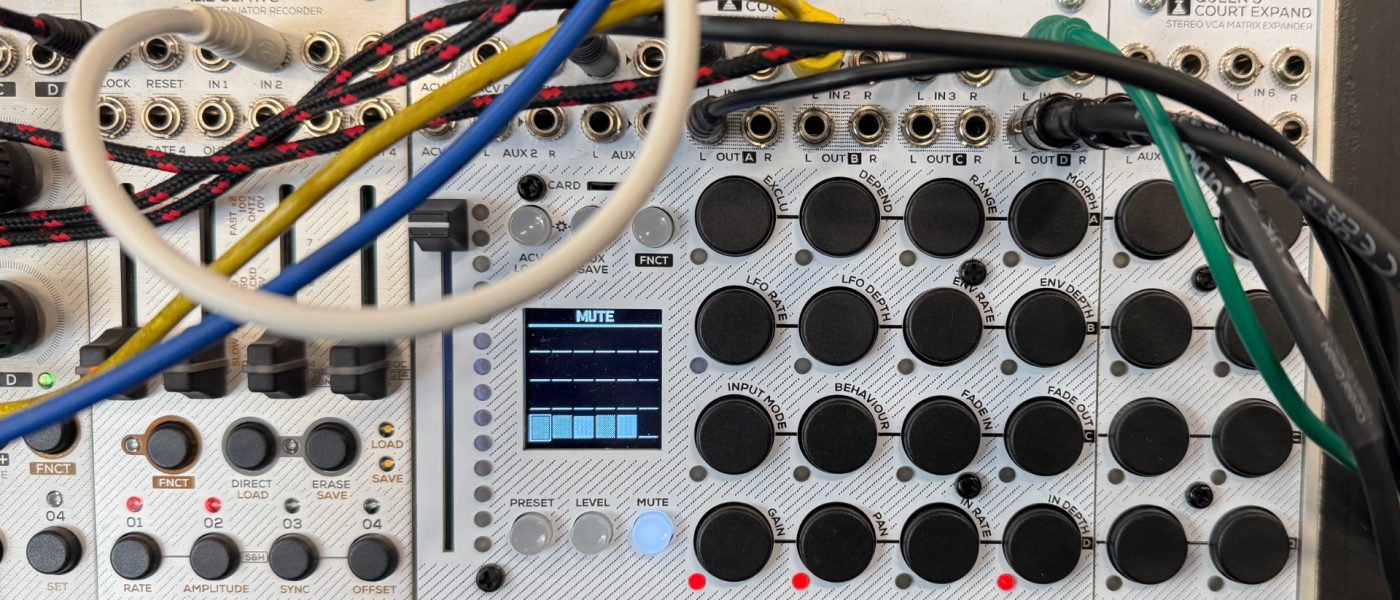
TL;DR: Shakmat Modular unveiled Queen’s Court at Superbooth 2026 — a 4×4 stereo analog matrix mixer for Eurorack that adds digital recall, 36 built-in modulators, and preset morphing. It’s the rare beast that marries analog signal path with modern modulation and memory, all for under €500 for the main module.
- 4×4 stereo analog matrix mixer with three additional stereo AUX inputs and four stereo outputs, all freely routable.
- Digital recallability: 256 presets saved via internal digital core, compatible with Bus Select for live or studio recall.
- Built-in modulation engine: 36 modulators including LFOs, envelopes, autopanner, and bipolar envelopes per routing point — no extra modules required.
- Expandable: up to two Queen’s Court expanders add four stereo inputs, two AUX inputs, and four assignable CV inputs each.
- Price: main module under €500, full setup with two expanders under €1,000 — a steal for a professional-grade performance mixer.
Reading time: 4 min
Want more synth news before your next coffee break? Join the Noxal newsletter — no spam, just gear worth knowing about.

The Queen’s Court Arrives

Let’s face it: Eurorack matrix mixers have been the domain of the brave — or the cable-obsessive — for years. You patch sixteen points, you lose track, you swear you’ll never touch another attenuator. Then Shakmat Modular drops Queen’s Court at Superbooth 2026, and suddenly the game changes. This is not your dad’s matrix mixer. It’s a 4×4 stereo analog matrix mixer with a digital brain, 256 presets, and enough modulation to make a small modular orchestra blush.
We at Noxal have a soft spot for anything that makes complex routing feel like play, not punishment. Queen’s Court promises exactly that: four stereo inputs (or dual mono if you’re feeling frugal), three auxiliary stereo inputs, and four stereo outputs, all freely routable within a flexible matrix. It’s designed for performance as much as studio work — a rare claim that often smells of marketing fluff, but here it’s backed by latch and momentary mute functions with adjustable fade times. You can morph between presets, mute channels, and adjust levels without breaking a sweat. It’s the kind of module that makes you want to rearrange your entire rack.
Analog Heart, Digital Brain
The magic of Queen’s Court lies in its hybrid nature. The signal path stays analog — warm, immediate, with that lovely tactile response we hardware nerds crave. But the control layer is digital, meaning you can save up to 256 presets and recall them at any time. And yes, it’s compatible with Bus Select, so your preset recall can sync with your entire modular system. For those of us who’ve spent hours dialing in a routing only to lose it when the power dies, this is nothing short of salvation.
I’ve been guilty of treating modular as a temporary art form — “it sounded great last night, but now it’s gone forever.” Queen’s Court fixes that. The digital core lets you capture those fleeting moments, and the analog path ensures they don’t sound sterile. It’s the best of both worlds, assuming you can stomach a little latency-free analog warmth with your recallable digital convenience. Spoiler: you can.
Modulation Mayhem Without Cable Spaghetti
Here’s where Queen’s Court truly earns its crown. It integrates 36 internal modulators directly into the matrix — LFOs, envelopes, autopanner, and more. Per-input panning with LFO-based autopanning? Yes. Per-routing-point bipolar envelopes triggerable via CV or extracted from audio signals? Yes. Clockable LFOs on each routing point with sine and random waveforms? Yes, yes, yes.
What does this mean in practice? You can achieve internal sidechaining, dynamic routing, and animated spatial movement without a single extra module. It’s like having a modulation powerhouse hiding inside your mixer. You can use it as a feedback processor, a performance mixer, or a chaotic generative routing engine. The four freely-assignable CV/MIDI inputs add further external control. For the Eurorack user who wants to work creatively with complex signal routing without turning their case into a rat’s nest, this is a dream.
Expandability and Verdict
Not enough I/O? Shakmat has you covered. You can add up to two Queen’s Court expanders, each adding four additional stereo inputs, two AUX inputs, and four additional assignable CV inputs. Suddenly your 4×4 mixer becomes a 12×4 behemoth with more modulation than a small moon. The price is the real shocker: main module under €500, and with two expanders, under €1,000. For a professional-grade hybrid matrix mixer with analog signal path and digital recall, that’s a bargain.
Who is this for? The Eurorack user who wants to move beyond static patching into dynamic, performance-oriented routing. The studio rat who needs recallable setups without sacrificing analog warmth. The live performer who wants to morph between presets while keeping hands on physical controls. It’s also for anyone who’s ever looked at a matrix mixer and thought, “I’d love that, but I don’t want to spend hours patching.” Queen’s Court makes complex routing accessible, even fun.
Frequently Asked Questions
What is the difference between Queen’s Court and other Eurorack matrix mixers?
Queen’s Court combines a fully analog stereo signal path with digital recallability (256 presets) and a built-in modulation engine of 36 modulators. Most matrix mixers are either fully analog with no memory or fully digital. Queen’s Court offers the best of both: analog warmth with digital control and modulation.
Do I need additional modules to use the modulation features?
No. The modulation engine is built directly into the matrix. You get LFOs, envelopes, autopanner, and bipolar envelopes per routing point — all internal. You can trigger them via CV or extract them from audio signals, but you don’t need any extra modules to start modulating.
Can I expand Queen’s Court later?
Yes. You can add up to two Queen’s Court expanders. Each expander provides four additional stereo inputs, two AUX inputs, and four assignable CV inputs. This scales the module from a 4×4 to a 12×4 matrix mixer.
We at Noxal will be testing Queen’s Court with a triple shot of espresso and a feedback loop that may or may not be safe for human ears. If you hear a distant hum, it’s probably us — or the module doing something brilliant.