TL;DR: Mayer EMI’s MD850 Vibes gets a major free Aurora firmware update with SFZ multisample support via drag-and-drop, a redesigned UI, and a new lower price of €1,899. The MD900 is discontinued due to component shortages, but the MD850 carries the torch with firmware 4.0 already available and Aurora landing in Q2 2026.
- SFZ multisample support added to the noise oscillator – drag-and-drop entire string ensembles or piano samples into hybrid patches.
- Price drops from €2,299 to €1,899 incl. VAT, sold directly through a new online shop.
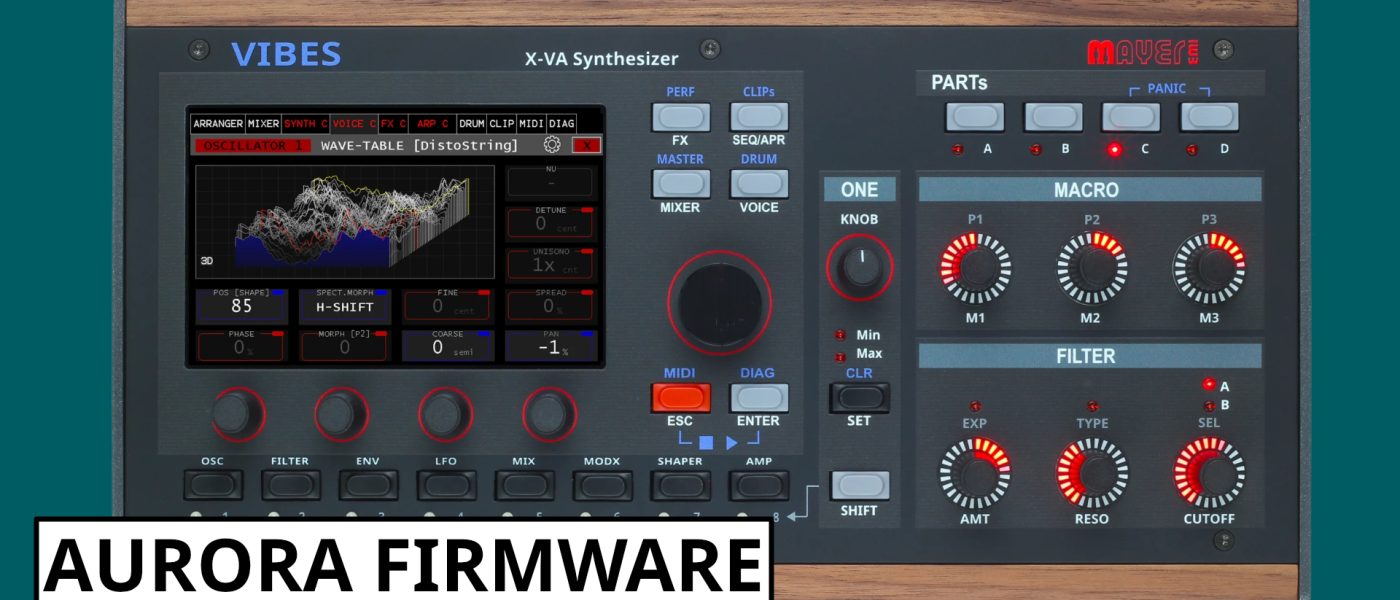
- Aurora firmware includes a redesigned darker UI, expanded vintage mode, new studio-grade reverb, and 130 new factory presets.
- Firmware 4.0 already out now with new wavetable unison modes, ADSR+R envelopes, DJ filter/tremolo FX, and 72 new presets.
- VibesConnect browser-based control (WiFi/Ethernet) gets refinements, no DAW or driver needed.
Reading time: 4 min
Want more synth news before your next coffee break? Join the Noxal newsletter — no spam, just gear worth knowing about.

Aurora Arrives: SFZ Support and a Dark New Look

Superbooth 2026 brought us many things — blistered feet, questionable lanyard designs, and, thankfully, some actual news. Mayer EMI used the show to unveil the Aurora firmware for the MD850 Vibes, and we at Noxal have to admit: this is the kind of update that makes us forget we’ve been standing for six hours.
The headline feature is SFZ multisample support. Previously, the MD850 only accepted its proprietary sample format. Now you can load SFZ files directly into the noise oscillator with drag-and-drop. Think of it as a back door to sample-based synthesis without the walled garden. Want a multi-sampled grand piano blended with a wavetable sweep? Go ahead. A string ensemble layered over a gnarly bass? The Aurora firmware lets you do it, and it’s all free for existing owners.
Alongside that, the UI gets a full redesign. It’s darker, cleaner, and — dare I say — actually pleasant to look at. The original interface wasn’t ugly, but it felt like a spreadsheet that learned to make sounds. Aurora fixes that. There’s an expanded vintage mode with more character options, a new studio-grade reverb (algorithmic, not a cheap impulse response job), and 130 new factory presets that use the MD850’s full 4-part multitimbral capability. More sounds, always welcome. The MD900’s initial weakness was a thin preset library; Mayer EMI seems determined not to repeat that mistake.
Firmware 4.0: Already Here and Free
While Aurora is the shiny new thing, let’s not ignore that firmware 4.0 is out right now and free. It’s like finding a forgotten coffee in your thermos — still warm, still good.
Firmware 4.0 adds new wavetable oscillator unison modes with 5th and 7th intervals, a wavetable bend parameter, and 23 new wavetables. You can still import Serum wavetables, which is a nice middle finger to format lock-in. Envelope modes now include ADSR+R, AD+R, and AR+R, while the LFO range extends from 0.001 Hz to 1,000 Hz. That’s slow enough to modulate over a minute, fast enough to cause audible aliasing if you’re careless. Beautiful.
Two new effects — a DJ filter and a tremolo — add real-time performance tools. The arpeggiator gets sync modes (FREE-CLK, FREE-STEP, TRANSPORT) and there’s a sustain pedal mode for those of us who still own pedals. 72 new presets and 10 performances come preloaded, and the sound browser now has a preview function. Dynamic encoder speed? Yes, that’s here too. Small stuff, but it adds up. The MD850 is becoming the instrument it always should have been.
The MD900 Is Dead, Long Live the MD850
Let’s address the elephant in the room. The MD900 is discontinued. Component shortages, says Mayer EMI. We’ve heard that before from every manufacturer this decade. But the MD850 Vibes is the direct successor, and honestly, it’s the better instrument now.
The MD900 was a flagship but felt like a prototype in some ways — limited presets, a steeper learning curve, and a price that made you think twice. The MD850 keeps the 4-part multitimbral engine, the drum machine, the Ableton-style clip launcher, and the touchscreen, but adds more connectivity and a more mature software ecosystem. With firmware 4.0 and Aurora on the way, the gap between the two models is widening in the MD850’s favour.
It’s a shame to see a flagship go, but we at Noxal prefer a living product over a museum piece. The MD850 is alive, receiving updates, and now cheaper. The MD900, for all its ambition, was a first draft. The MD850 is the revised edition.
VibesConnect: Browser Control Without the DAW
Mayer EMI’s VibesConnect is one of those features that sounds gimmicky until you use it. It connects the MD850 to a computer or tablet via the device’s built-in WiFi or Ethernet — no USB cables, no drivers, no DAW. Just a browser.
You can control the clip launcher, edit sequences, swap files, and tweak all parameters from any standard web browser. It’s like having a web app that talks directly to your hardware. No install, no bloatware, no subscription. The Aurora firmware refines this further, and honestly, it’s the most frictionless hardware control I’ve seen in years. It pairs nicely with a Novation Launchpad if you want tactile clip launching, but the touchscreen alone is enough for most tasks.
For live performers and studio tinkerers alike, VibesConnect eliminates the “let me open the DAW” bottleneck. It’s a small freedom that feels disproportionately valuable when you’re in the flow.
Price Drop and Direct Sales: Who Is This For?
The MD850 Vibes now costs €1,899 incl. VAT, down from €2,299. That’s a €400 reduction, and it’s being sold directly through Mayer EMI’s new online shop, bypassing the old distributor model. This is good news for customers — lower price, direct support, and presumably faster firmware updates.
Who should buy this? If you want a hardware groovebox that doesn’t force you into a single workflow, the MD850 is a strong candidate. It’s a synthesizer, a sampler, a drum machine, and a clip launcher in one box. The 4-part multitimbral engine means you can build full arrangements without a computer, but VibesConnect lets you integrate with one when you need to. It’s not cheap, but it’s cheaper than buying four separate boxes and a mixer.
For sound designers, the new SFZ support opens up a world of sample libraries. For live performers, the clip launcher and reworked arpeggiator sync make it a capable centrepiece. For the rest of us, it’s a very well-supported instrument from a company that clearly cares about firmware updates. That’s rarer than it should be.
Frequently Asked Questions
Is the Aurora firmware free for existing MD850 Vibes owners?
Yes. The Aurora firmware is a free update for all current MD850 Vibes users. It will be available in Q2 2026. Firmware 4.0 is already free and available now.
Does the MD850 support Serum wavetables?
Yes. You can import Serum wavetables into the oscillator engine. Combined with the new SFZ multisample support in Aurora, this makes the MD850 one of the most flexible hybrid sound design tools at its price point.
Is the MD900 still being produced?
No. The MD900 has been discontinued due to component shortages. The MD850 Vibes is the current flagship model and receives ongoing firmware updates. The price has been reduced to €1,899 incl. VAT.
I’m writing this between sips of a cold brew that’s gone lukewarm — proof that good things, like the MD850’s firmware, only get better when you let them sit. Now if you’ll excuse me, I need to find a fresh cup and figure out where I left that Launchpad.