
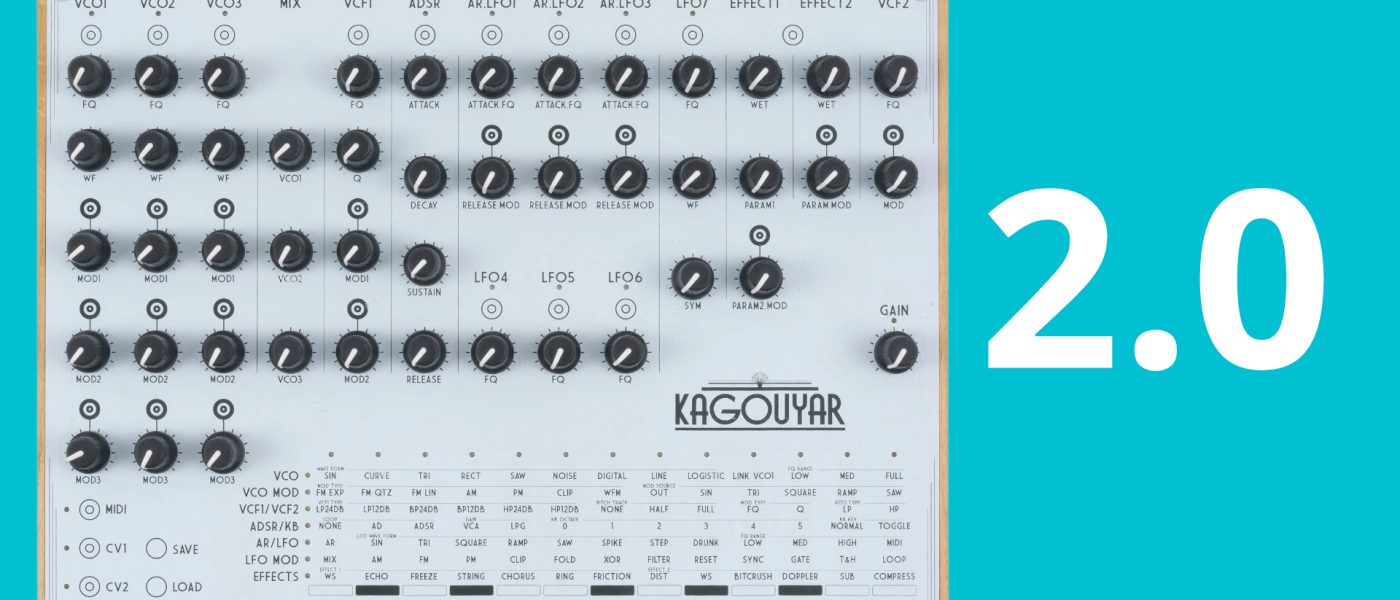
TL;DR: French indie developer nozoïd has released firmware 2.0 for its deeply peculiar Kagouyar four-voice digital polysynth, adding new waveforms, effects, and a DJ mode — then slashed the price by €300. The synth’s semi-modular, cable-free architecture remains gloriously weird, and it now ships via Perfect Circuit for $999/€849.
- Firmware 2.0 adds two new VCO/LFO waveforms, two new audio FX, a DJ mode in VCF 2, A/D envelope mode, and a very slow LFO mode — all free and open-source under GPL-3.0.
- Kagouyar is a four-voice digital polyphonic synth with three oscillators, seven LFOs (three can double as AR envelopes), and a tactile-based semi-modular matrix that requires no patch cables.
- Price drops from its original €1,149 to €849 / $999, making it more accessible to anyone brave enough to explore its noise-scapes and cross-modulation madness.
- Effect section includes experimental gems like Karplus-Strong string emulation, comb-filter freeze, granular sub-frequency generator, and metallic resonance compressor — all fully modulable.
- No patch memory, but you can save and recall matrix settings; hardware runs on an Electrosmith Daisy Seed and is refreshingly lightweight at 1.4 kg.
Reading time: 4 min
Want more synth news before your next coffee break? Join the Noxal newsletter — no spam, just gear worth knowing about.

The Return of nozoïd

French indie developer Cyrille — the one-person operation behind nozoïd — has a habit of vanishing like a ghost in a reverb tail, then reappearing with something that makes you question your definition of “synthesizer.” We at Noxal have been following his work since the MMO-3 back in 2017, a digital synth so idiosyncratic it felt like it had been beamed in from a parallel dimension where patch cables were outlawed. After a quiet period that stretched long enough for us to wonder if he’d retired to a monastery, he dropped the Kagouyar in early January 2025. Then, silence again. Until now.
Firmware 2.0 is here, and with it a price cut that feels like an apology for the synth’s initial obscurity. The Kagouyar is not a synth for everyone — it’s a synth for people who look at a Eurorack case and think “too conventional.” But if you’re willing to embrace its tactile, cable-free semi-modular interface, you’ll find a four-voice polysynth that rewards deep exploration with sounds that are crisp, digital, and often unhinged. I’ve spent a few evenings with it, and I can confirm: this is not your father’s virtual analog.
What Makes Kagouyar Unique
The Kagouyar’s core is a four-voice digital polysynth with three oscillators per voice. Standard VA waveforms are present — sine, saw, square — but the real fun begins when you dive into the digital generators, chaotic variations, and other specific waveforms nozoïd cooked up. Each VCO has three potentiometers that unlock AM, FM, phase modulation, waveform modulation, and cross-modulation between oscillators. It’s like having a modular system’s patch bay hardwired into knobs, with no cables to trip over.
The semi-modular engine is controlled via a tactile interface on the bottom of the hardware — a touch circle above the knobs that manages all virtual patch connections. There’s no menu diving; it’s all hands-on, immediate, and gloriously tactile. Seven LFOs are on board, three of which can act as AR envelopes or low-frequency oscillators. The real magic is in the cross-modulation: you can interconnect LFOs to modulate each other, creating rhythmic sequences, random variations, or automation that sounds like a robot learning to tap dance.
The effects section is where things get properly weird. Beyond the usual distortion, echo, and ring modulation, you’ll find Karplus-Strong string emulation, comb-filter freeze, a granular sub-frequency generator, friction, and a metallic resonance-based compressor. Every effect parameter is fully modulable, meaning you can patch an LFO to the “freeze” depth and watch your sound dissolve into a crystalline drone. It’s experimental in the best sense — not for the faint of heart, but for those who want their synth to occasionally sound like it’s arguing with itself.
Firmware 2.0: What’s New and Why It Matters
Firmware 2.0 is a free update, and nozoïd has been characteristically cryptic about some of its features. We know it adds two new VCO and LFO waveforms, accessible via a long-press on the waveform selector. Two new audio FX have also been added via long-press on the effect slot, though the developer hasn’t revealed what they are yet — a move that feels either mischievous or like a teaser for future documentation. There’s a new DJ mode in VCF 2, which we suspect allows for filter sweeps that don’t kill the low-end entirely, but we’ll need hands-on time to confirm.
An A/D mode in the envelope generator is a welcome addition, giving you attack/decay shaping without sustain — perfect for percussive stabs and plucks. And for the truly patient, there’s a “very slow” mode for LFOs 4, 5, and 6, letting you create modulation cycles that last for minutes. The firmware is available under the GPL-3.0 License on GitHub, which means the open-source community can tinker, fork, and extend it. That’s a level of transparency we appreciate, even if the code requires an outdated and custom library to compile.
Specs and Build Quality
The Kagouyar is housed in a lightweight chassis — 350mm x 250mm, just 1.4 kg — with a sloped profile that’s comfortable for desktop use. On the back, you get stereo headphone out, mono balanced line out, 5-pin MIDI in, two CV inputs, a single gate input, and a 9V DC power supply with a dedicated on/off switch. No USB MIDI, but that’s fine; this synth is about analog-style control, not dongle management.
The synth runs on an Electrosmith Daisy Seed DSP, a platform that’s become a darling of the open-source hardware community. There’s no patch memory in the traditional sense, but you can save and recall the matrix settings — a pragmatic compromise that keeps the interface clean. The build feels solid, with a tactile quality to the knobs and touch circle that invites interaction. It’s not a flagship flagship; it’s a tool for sound design that rewards patience and playfulness.
Market Position and Who This Is For
At $999/€849, the Kagouyar positions itself in the upper tier of boutique digital synths, but the price cut makes it more competitive with offerings like the Modal Argon8 or the ASM Hydrasynth Explorer. However, comparing it to those synths is like comparing a typewriter to a theremin — the Kagouyar is fundamentally different in its approach. It’s for sound designers who crave cross-modulation chaos, for experimental musicians who want a synth that can do things no other hardware can, and for anyone who’s ever looked at a modular system and thought, “I love the concept, but I don’t have the space or the patience for cables.”
It’s not for you if you need a workhorse polysynth for bread-and-butter pads and leads. The Kagouyar is a specialist tool, and it wears that label proudly. But if you’re willing to embrace its quirks, you’ll find a synth that can generate sounds that are genuinely new — not just variations on the same analog tropes. And now that it’s available through Perfect Circuit, it’s easier to get your hands on one without crossing the Atlantic.
Frequently Asked Questions
Is the Kagouyar fully polyphonic?
Yes, it’s a four-voice polyphonic synthesizer. Each voice has three oscillators and independent modulation routing, so you can create complex, layered sounds without sacrificing voice count.
Does it have patch memory?
Not in the traditional sense — there’s no full patch recall. However, you can save and recall the matrix settings, which store your modulation routings. It’s a compromise that keeps the interface immediate and menu-free.
Can I use it with Eurorack?
Yes, partially. The rear panel includes two CV inputs and one gate input, so you can integrate it with modular gear for clock syncing or external modulation. Just don’t expect a full CV/Gate output section — it’s designed primarily as a standalone instrument.
I’ll be honest: the Kagouyar made me spill my coffee twice during the first session — once from excitement, once from confusion. That’s the sign of a synth worth keeping around.