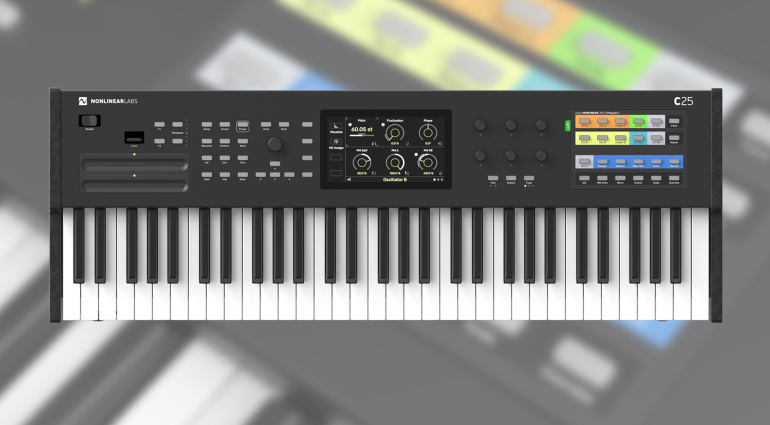
TL;DR: Stephan Schmitt, the mind behind Native Instruments and Reaktor, is back with the C25 — a follow-up to his revered C15 synth. This streamlined, gig-focused instrument runs a new Phase 22 engine, opens up to third-party developer engines (like Reaktor for hardware), and ships in early 2027.
- Nonlinear Labs C25 ditches the C15’s wooden, button-heavy design for a more portable, performance-oriented layout with a 7-inch touchscreen and replaceable button overlays.
- It runs the digital Phase 22 Synthesis Engine (FM, waveshaping, physical modeling, subtractive) and supports third-party synth and effect engines — a first for the hardware synth world.
- 48 voices at 48kHz, 24 at 96kHz; dual mode for splits/layers; built-in lossless audio recorder; Fatar TP/8S keybed with polyphonic modulation via key position, velocity, and aftertouch.
- Release expected early 2027; no price yet, but likely cheaper than the C15’s premium tier.
- Connectivity includes USB host/device, MIDI I/O, high-end stereo audio interface, four pedal and four CV inputs.
Reading time: 4 min
Want more synth news before your next coffee break? Join the Noxal newsletter — no spam, just gear worth knowing about.

What Is the C25?
When a legend steps back into the ring, you pay attention. Stephan Schmitt — the man who gave us Native Instruments and Reaktor — has been quietly building what many consider the finest hardware synthesizer ever made: the C15. Now, Nonlinear Labs has revealed the C25, a follow-up that looks almost pedestrian next to the C15’s wooden, button-studded altar. Almost.
The C25 is a digital synthesizer with a performance-focused design. It’s a streamlined, black-and-metal slab with a seven-inch TFT touchscreen, a Fatar TP/8S keybed, and a replaceable button overlay that can be swapped to match different synth engines. It’s the kind of synth that looks like it belongs in a touring rig, not a museum. And that’s exactly the point.
We at Noxal appreciate a synth that knows what it wants to be. The C15 was a studio instrument for deep dives into physical modeling. The C25 wants to be played live, tweaked on the fly, and — crucially — expanded by people who aren’t Stephan Schmitt.
The Engine That Makes It Sing
Under the hood, the C25 runs the Phase 22 Synthesis Engine. That’s a mouthful, but the list of synthesis methods is even longer: phase modulation (think FM, but weirder), waveshaping, physical modeling, and subtractive synthesis. It also has unique feedback signal routing and two groups of five audio effects. It’s digital, yes, but Nonlinear Labs has a track record of making digital sound like it’s alive.
The headline feature, however, is third-party support. The C25 will allow developers to create their own synthesis and effect engines, much like Reaktor does in software. This is unprecedented in a hardware synth of this caliber. Imagine loading a custom granular engine or a spectral morpher onto a keyboard with a Fatar keybed and CV ins. That’s the promise.
Specs: 48 voices at 48kHz sample rate, 24 voices at 96kHz, dual mode for splits and layers, and a built-in recorder for hours of lossless audio. It also has a high-end audio interface with stereo ins and outs, USB host and device, and MIDI I/O. If you’re counting jacks, there are four pedal and four CV inputs.
Design and Playability
The C15’s control surface was a thing of beauty — a maze of buttons and wooden panels that invited hours of exploration. The C25 is more like a Swiss Army knife. The touchscreen is there, but every function also has a hardware button. The replaceable button overlay is a clever touch: swap the overlay to match the engine you’re using, and the labeling changes with it.
The Fatar TP/8S keybed is a welcome choice. It’s a high-quality, semi-weighted action that feels substantial without being sluggish. More interestingly, the keys themselves become polyphonic modulation sources. The vertical position of the key, its velocity, or aftertouch pressure can all be used to modulate parameters. This is the kind of expressive control that makes a synth feel like an extension of your hands.
Other performance controls include the Bender (inherited from the C15), a new Lever, and two Ribbons with LED position indicators. It’s a thoughtful layout that prioritizes live manipulation over menu diving.
Ecosystem and Context
The C25 is not just a synth; it’s a platform. By opening up to third-party developers, Nonlinear Labs is effectively creating a hardware ecosystem for synthesis. This is a bold move. It means the C25 could evolve over time, gaining new engines and effects long after its release. It’s a hedge against obsolescence, and it’s exactly the kind of thinking you’d expect from the inventor of Reaktor.
That said, there’s a catch: the C25 won’t ship until early 2027. That’s two years from now. Nonlinear Labs promises frequent updates on its development, and they’ll be showing it at Superbooth, but patience will be required.
Pricing is still under wraps. The C15 commands a premium — think high four figures — so the C25 will likely be expensive, though hopefully less so. The use of high-quality parts (Fatar keybed, metal chassis, touchscreen) doesn’t come cheap.
Who Is It For?
The C25 is for the player who wants more than a preset machine. It’s for the live performer who needs expressive controls and the ability to shape sound in real time. It’s for the sound designer who wants to build custom engines without touching a soldering iron. And it’s for the collector who appreciates the lineage: this is the next chapter from the mind behind Reaktor.
If you’re looking for a cheap, cheerful groovebox, this isn’t it. The C25 is a serious instrument for serious musicians. But if you want a synth that could literally become anything — given a good developer and a few years — this might be your next obsession.
We at Noxal will be watching the development closely. And we’ll be brewing extra coffee to stay awake until 2027.
Frequently Asked Questions
When will the Nonlinear Labs C25 be released?
Nonlinear Labs expects the C25 to ship in early 2027. The company will provide regular updates on its development via its website, and the synth will be shown at Superbooth.
What is the Phase 22 Synthesis Engine?
The Phase 22 engine is a digital synthesis core that supports phase modulation (similar to FM), waveshaping, physical modeling, and subtractive synthesis. It also includes unique feedback routing and two groups of five audio effects. Crucially, it will support third-party synthesis and effect engines, much like Reaktor does in software.
How much will the C25 cost?
No official price has been announced yet. Given the use of high-quality components (Fatar keybed, metal chassis, touchscreen) and the C15’s premium pricing, the C25 will likely be expensive but probably more affordable than its predecessor.
I’ll be marking my calendar for 2027 and stocking up on single-origin beans. If the C25 sounds half as good as the hype, it’ll be worth the wait — and the caffeine debt.