TL;DR: Modal Electronics has unveiled the ELEMENT One at Superbooth 2026, an 8-voice virtual-analog synthesizer built on the Cobalt8 engine but redesigned for live performers. It strips away deep menu-diving in favor of immediate hands-on control, comes in a fresh Axel Hartmann-designed housing with a 4-axis joystick, and is compatible with existing Cobalt8 patches. At €649, it’s a focused instrument for players who want sound over synthesis theory.
- 8-voice virtual-analog engine derived from the Cobalt8, with up to 64 total oscillators per patch (8 per voice) and full Cobalt8 patch compatibility.
- 37-key velocity-sensitive keyboard with aftertouch, plus a new 4-axis joystick replacing traditional pitch/mod wheels.
- Over 30 resonant filter types, multi-FX with three freely routable slots, and two ADSR envelopes plus three LFOs — all with minimal knob-per-function interface.
- No built-in sequencer, but includes an arpeggiator, 300 factory presets, and free MODALapp editor for deeper tweaking on a computer or tablet.
- Priced at €649, aimed squarely at performing musicians who want playable, expressive sounds without wading through menus.
Reading time: 4 min
Want more synth news before your next coffee break? Join the Noxal newsletter — no spam, just gear worth knowing about.

What Is the ELEMENT One?

Modal Electronics has been quiet since its 2024 relaunch, but Superbooth 2026 has finally given us something to talk about over lukewarm coffee. The ELEMENT One is an 8-voice virtual-analog synthesizer that, on paper, looks awfully familiar to anyone who’s spent time with the Cobalt8. And that’s because it’s built on the same engine — but Modal has repackaged it for a very different kind of musician.
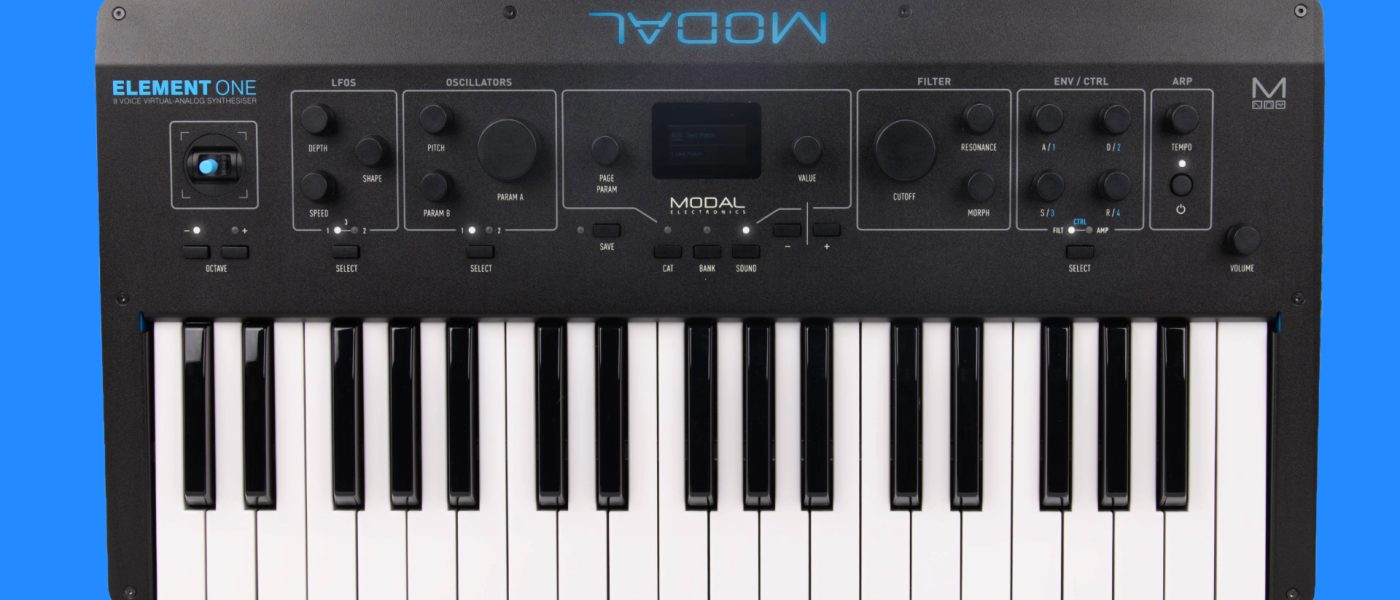
The first thing you notice is the chassis. Designed by Axel Hartmann’s team, it’s a clean, uncluttered panel with just 17 knobs, a handful of buttons, and that new 4-axis joystick. It’s the first Modal synth in years to not borrow the Argon8 or Cobalt8’s visual DNA. The keyboard is 37 full-size, velocity-sensitive keys with aftertouch — a welcome inclusion for expressive playing. The joystick handles pitch and mod duties, which is a smart move for live tweaking without fumbling for wheels.
Inside, it’s Cobalt8 territory: 8 voices, 8 high-resolution oscillators per voice (for a total of 64), and a filter section with over 30 resonant types. Modal claims full patch compatibility with the Cobalt8, so if you already own one, your sound library isn’t dead weight. But here’s the kicker — there’s no sequencer, and the interface intentionally hides deep parameters behind a menu system or the free MODALapp editor.
Design Philosophy: Play, Don’t Tweak
Modal’s press release is refreshingly honest: “designed for playing, not thinking.” That’s a bold statement in a world where every synth seems to demand a PhD in signal flow. We at Noxal appreciate the clarity. The ELEMENT One is for musicians who want to plug in, dial a sound, and perform — not scroll through submenus to modulate LFO3’s phase offset.
The interface is sparse compared to most modern polysynths. Two ADSR envelopes (filter and amp), three LFOs with depth/shape/speed, and a multi-FX section with three freely routable slots (reverb, delay, chorus, etc.). That’s it for dedicated controls. Everything else — oscillator waveform selection, modulation routing, FX type choices — lives in the menu or the MODALapp. It’s a trade-off. You lose the tweaker’s paradise, but you gain immediate, tactile control over the essentials.
I’ve spent enough mornings staring at a synth’s tiny screen while my coffee went cold to appreciate this approach. The ELEMENT One is a statement: not every synth needs to be a modular-in-a-box. Sometimes you just want a fat pad or a biting lead in seconds, not hours.
Engine and Sound Architecture
Under the hood, the ELEMENT One is essentially a Cobalt8 with a fresh interface and some engine tweaks. The 8-voice virtual-analog engine uses eight oscillators per voice, which is generous even by modern standards. The press release is frustratingly vague on waveforms, but looking at the panel layout, there appear to be two main oscillator sections (each with four sub-oscillators, like the Cobalt8), plus pitch and parameter controls labeled A and B. We’ll need a hands-on to confirm whether these are wavetable, VA, or something hybrid.
The filter section is where things get interesting: over 30 resonant filter types, including morphable and static variants. You get classic cutoff, resonance, and a morph knob — a nod to the Cobalt8’s flexible filter architecture. Modulation is also inherited, with the three LFOs offering depth, shape, and speed controls. The two ADSR envelopes are standard, but without more detailed routing options visible on the panel, we suspect the MODALapp will be essential for complex patches.
Multi-FX are present with three slots, but again, the interface doesn’t reveal which algorithms are available beyond “reverbs, delays, choruses, and more.” The arpeggiator is front-panel accessible with tempo control, but the missing sequencer is a notable omission for a “performer” synth. Perhaps Modal assumes you’ll use an external sequencer or DAW — fair enough, but it limits the standalone appeal.
Connectivity and Target Audience
The back panel is sensible: headphone out, stereo 6.3mm outputs, expression and sustain pedal inputs, an audio input for routing external signals through the FX, sync in/out, 5-pin MIDI in/out, USB-C, and a 9V power input. The audio input is a nice touch for live setups — run a drum machine or vocal through the ELEMENT One’s effects for extra texture.
The free MODALapp for macOS, Windows, iOS, and Android handles deep editing. This is a common pattern these days, and it works — you get the tactile experience on stage and the deep dive on the couch. But we’d be remiss not to note that the ELEMENT One’s 300 factory presets are all new, categorized by sonic type, and you can load any existing Cobalt8 patch. That’s a solid library out of the box.
Who is this for? Not the synthesis nerd who wants to route LFO3 to oscillator phase via a matrix. It’s for the keyboardist in a cover band, the electronic musician who needs reliable sounds for a live set, or the beginner who finds the Korg Minilogue XD or Yamaha refaceCS too limiting but doesn’t want a full modular exploration. At €649, it’s competitively priced against the Korg KingKORG Neo and the ASM Hydrasynth Explorer, though those offer more synthesis depth.
Market Context and Verdict
We at Noxal have been watching Modal’s revival with cautious optimism. The Carbon8 series was a solid re-entry, but the ELEMENT One feels like a pivot — a recognition that not every musician wants to be a sound designer. It’s a niche that the microKORG 1 and refaceCS once filled, but those are aging. The ELEMENT One is a modern, well-built alternative with a clean interface and great connectivity.
Is it underwhelming for synthesis enthusiasts? Yes. It’s essentially the Cobalt8 in a different dress, with fewer controls and a higher focus on playability. But that’s the point. Modal is betting that there’s a market of players who care more about feel and immediacy than modulation matrix depth. I’ll be checking it out at Superbooth to see if the joystick, keybed, and sound engine live up to the promise. For now, it’s a thoughtful, if not revolutionary, addition to the poly synth landscape.
Frequently Asked Questions
Is the ELEMENT One just a re-skinned Cobalt8?
Not exactly. The engine is based on the Cobalt8, and patches are fully compatible, but the ELEMENT One has a redesigned interface, a new 4-axis joystick, and a different housing. It also lacks a sequencer and has a streamlined panel focused on live performance. Think of it as a Cobalt8 variant tuned for players, not tweakers.
Does the ELEMENT One have a sequencer?
No. It includes an arpeggiator with tempo control, but there is no built-in sequencer. Modal likely expects users to pair it with an external sequencer or DAW, which is a reasonable trade-off for the simplified interface.
What is the price and availability?
The ELEMENT One is priced at €649 and was announced at Superbooth 2026. Availability hasn’t been detailed yet, but it’s expected to ship later this year. Check Modal Electronics’ official site for updates.
We’ll be at Superbooth with a fresh thermos and a skeptical eyebrow — if the ELEMENT One’s joystick is as smooth as the press release claims, we might just forgive the missing sequencer. Now if you’ll excuse me, my espresso has gone cold while writing this.