
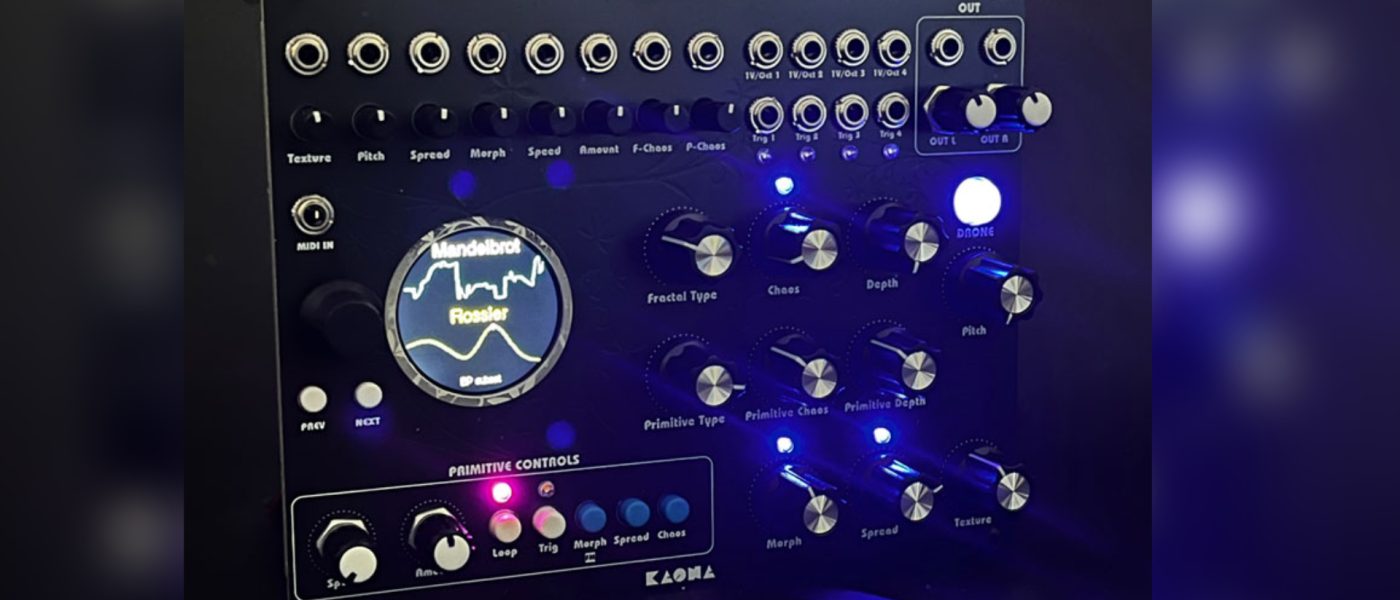
TL;DR: Kaona Modular is back with Fractaos, a 32HP Eurorack module that brings fractal synthesis to a 4-voice polyphonic oscillator and synth voice. It uses mathematically generated, self-similar shapes instead of classic waveforms, offering eight independent oscillators per patch, drone modes, and deep CV control. Pre-orders are open at €474.30, with shipping starting May 2026.
- Four-voice polyphonic oscillator with two fractal oscillators per voice (eight total), generated in real-time.
- Core synthesis uses fractal shapes with chaos and calculation depth controls, plus morphing, detune, chord, and formant extraction.
- Includes polyphonic ADSR envelope, drone mode, and MIDI input with velocity and aftertouch support.
- Eight bi-polar CV inputs, four 1V/oct inputs, and four trigger inputs for extensive modulation.
- Early-bird price: €474.30 (regular €558); shipping from end of May 2026.
Reading time: 4 min
Want more synth news before your next coffee break? Join the Noxal newsletter — no spam, just gear worth knowing about.

What is fractal synthesis?

Let’s get the maths out of the way early. Fractal synthesis is one of those terms that sounds like a marketing department had too much absinthe, but it’s genuinely fascinating — and frighteningly mathematical. At its core, it involves generating shapes whose structure repeats at different scales, like a snowflake or a coastline, but applied to audio-rate waveforms. Instead of sine waves or sawtooths, you get self-similar, endlessly detailed patterns that can sound organic, chaotic, or just plain weird.
We at Noxal have seen granular and wavetable synthesis become almost commonplace in Eurorack over the last few years. But fractal synthesis? That’s still firmly in the avant-garde corner. Gilles from Kaona Modular clearly has a taste for the experimental — last year’s Sisyphus was a multimode granular filter that made us raise our eyebrows and reach for a stronger coffee. Now he’s back with Fractaos, and the question we’re all asking is: does it sound good, or just sound like a PhD thesis?
Kaona Fractaos: hardware and polyphony
Fractaos is a 32HP digital oscillator and synth voice. That’s not huge, but it’s not tiny either — think of it as a module that demands respect for its guts. The headline feature is 4-voice polyphony, but the real story is that each voice gets two fractals: a main fractal shape and a fractal primitive. That’s eight oscillators in total, all generated in real-time, each with its own chaos and calculation depth controls.
What does that mean in practice? You can morph between shapes, detune across voices, build chords, create drones, extract formants, apply resonant filtering, and even frequency modulate the fractals against each other. The relation between the two fractals per voice is fully tweakable, so you’re not just stacking static waveforms — you’re pushing and pulling mathematically generated structures that can drift, bend, and evolve. The first demo sounds strange, I’ll admit. It’s clearly digital, with a kind of glassy, brittle character that will either charm you or make you run back to your Moog clone. But it’s also unmistakably original.
Modulation and control
Fractaos doesn’t just throw fractals at you and hope for the best. It comes with a polyphonic ADSR envelope, so it functions as a complete synth voice. There’s a drone mode where all eight oscillators run free, and a polyphonic mode that accepts MIDI via 3.5mm jack (with velocity and aftertouch) or dedicated 1V/oct inputs. On the modulation front, you get eight bi-polar CV inputs, four trigger inputs, and four 1V/oct inputs. That’s enough to make even the most jaded modular user nod approvingly.
Presets can be stored in internal memory, which is a sanity-saver if you find a sound you actually like. Power consumption is reasonable: +12V at 210mA, -12V at 40mA, and no +5V draw. That’s not going to stress your average case, though we’d recommend a decent power supply if you’re running more than a few digital modules. The module is now available for pre-order at an early-bird price of €474.30 (regular €558), with shipping starting at the end of May 2026.
Market context and who it’s for
Let’s be honest: Eurorack is full of analog oscillators that sound like they’ve been vetted by a committee of 1970s engineers. That’s fine — we love a good saw wave as much as anyone — but the real excitement comes from modules that push boundaries. Fractaos is not for the faint of heart or the budget-conscious. At over €500, it’s a serious investment, and the sound is not going to be everyone’s cup of Earl Grey. It’s odd, it’s digital, and it’s unapologetically experimental.
Who should buy it? We’d say: adventurous sound designers, modular users who already own a few “normal” oscillators and want something that can generate textures no one else has, and people who enjoy explaining fractal mathematics at parties (or at least pretending they do). It’s also a great choice for anyone who loved the Sisyphus filter and wants to complete the Kaona ecosystem. If you want a bread-and-butter VCO, look elsewhere. If you want to scare your neighbors with organic, evolving chaos, Fractaos might be your new best friend.
Frequently Asked Questions
What exactly is fractal synthesis in the context of Kaona Fractaos?
Fractal synthesis uses mathematical shapes that repeat at different scales — like a fractal pattern — to generate audio waveforms. Instead of classic waveforms, the Fractaos creates self-similar, often chaotic, and organic-sounding structures that can be modulated, morphed, and detuned. Each voice uses two fractals, giving you up to eight independent oscillators.
Can Fractaos be used as a standalone synth voice?
Yes. It includes a polyphonic ADSR envelope, MIDI input with velocity and aftertouch, and 1V/oct inputs. You can patch it directly into a VCA and output, and it will function as a complete voice. It also has a drone mode for endless textures.
What is the price and availability?
The early-bird pre-order price is €474.30, with a regular price of €558. Shipping is expected to start at the end of May 2026. Pre-orders are open now.
Now if you’ll excuse me, I need to go stare at a fractal pattern and see if I can hear the colour blue. My coffee’s gone cold again.