TL;DR: Elta Music is developing the Polivoks-8, an eight-voice analog polyphonic synthesizer inspired by the infamous Soviet-era Formanta Polivoks. It packs dual oscillators, a Polivoks filter with genuine Soviet OTAs, a ladder filter, MPE support, and a desktop or 4U rackmount format. Expect a drool-worthy mix of chaotic Soviet character and modern polyphonic muscle, likely around €2000.
- Eight-voice analog polyphony with dual VCOs, sub oscillator, FM, sync, and ring mod per voice.
- Dual VCF architecture: one Polivoks-type with genuine Soviet K140UD12 OTAs (12dB LP, 6dB BP) and a 24dB/oct ladder filter with resonance compensation.
- Bi-timbral with three voice modes (Poly8, Para2, Mono) and layer splits like 4/4, 2/6, and 6/2.
- 1024 presets (256 factory, 768 user), per-voice LFOs, joystick modulation, arpeggiator, and step sequencer.
- Available in desktop or 4U rackmount, with MIDI I/O, USB, external input, and stereo outs. No release date yet, but prototypes are at Superbooth.
Reading time: 5 min
Want more synth news before your next coffee break? Join the Noxal newsletter — no spam, just gear worth knowing about.

From Soviet Monster to Modern Polyphonic Beast
Let’s be honest: the Formanta Polivoks is a synth that should not have worked. Manufactured from 1982 to 1990 in the Soviet Union, it looked like a military radio with Cyrillic labels and sounded like a feral cat being fed through a particle accelerator. Its op-amp-based filter was noisy, unruly, and gloriously unpredictable. Yet musicians from Nine Inch Nails to Depeche Mode fell in love with its chaos.
Elta Music, the company behind the Solar 42 ambient synths and the now-discontinued Polivoks Mini, has been teasing a polyphonic reincarnation for months. The Polivoks-8 is that promise made flesh — or at least made of circuit boards. According to the company, the new synth is an “eight-voice polyphonic, dual-VCF, bi-timbral analog synthesizer, available in both desktop and 4U rackmount formats.” We at Noxal have been waiting for this with the kind of patience usually reserved for a slow pour-over.
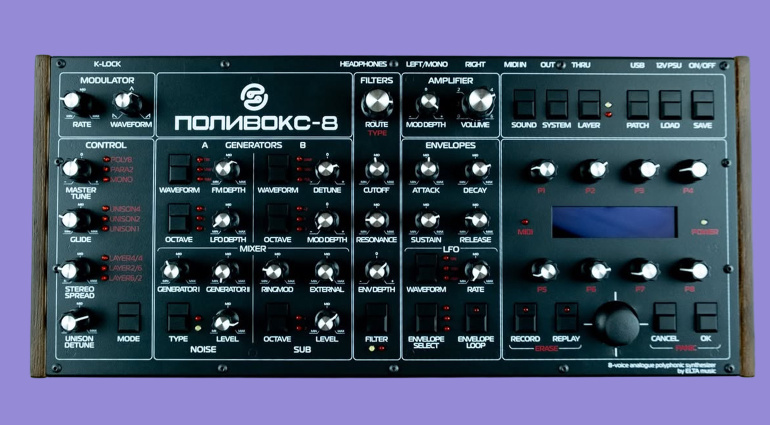
The first prototype photos have emerged, and they reveal a front panel that nods to the original’s military-industrial aesthetic while adding modern touches like an OLED display and a joystick. It’s a look that says, “I have seen the Gulag and I demand a filter sweep.”
What Makes the Polivoks-8 Tick
Under the hood, the Polivoks-8 is anything but a one-trick pony. Each of its eight voices features two fully analog oscillators with FM, sync, and ring modulation, plus a dedicated sub oscillator. Waveforms include the classic trio — sawtooth, pulse, and triangle — along with pulse-width modulation and an analog white noise generator. It’s a solid foundation for everything from screaming leads to deep, evolving pads.
The synth is bi-timbral, meaning you can split or layer two independent sounds across the keyboard. Voice modes include Poly8, Para2, and Mono, with layer options like 4/4, 2/6, and 6/2. That last one is particularly interesting for those who want a thick bass on the lower half and a shimmering pad on the upper. There’s also stereo spread and what appears to be a built-in sequencer, although details on the latter are still hazy.
Preset storage is a welcome addition for those of us who prefer not to spend an entire evening dialing in a patch only to lose it to a power outage. The Polivoks-8 offers 1024 patches — 256 factory and 768 user slots — across eight sound banks. That’s enough to keep even the most prolific patch designer busy until the next Soviet synth revival.
Filter Frenzy: The Soviet Soul Meets the Ladder
If the original Polivoks had a heart, it was its filter — a 12dB/oct lowpass and 6dB/oct bandpass design built around the K140UD12 operational transconductance amplifier (OTA). That filter was noisy, unpredictable, and absolutely magical. The Polivoks-8 keeps that spirit alive with VCF 1, which uses genuine Soviet K140UD12 OTAs, input saturation, and analog FM. It’s the kind of filter that makes you want to play minor chords and stare at a gray sky.
But Elta Music didn’t stop there. VCF 2 is a 24dB/oct ladder filter with resonance drop compensation. This is a more familiar, Moog-style design that offers cleaner, more controlled sweeps. Having both filters — routable in series or parallel — gives the Polivoks-8 a versatility that the original could only dream of. You can start with Soviet grit and then smooth it out with ladder warmth. Or run them in parallel for a wall of sound that would make a Soviet general proud.
Each voice also includes three VCAs: one master VCA and a stereo pair for pan modulation. This opens up spatial effects and dynamic shaping that are rare in analog polysynths at this price point.
Modulation and Controls: Joysticks, LFOs, and Presets
Modulation is where the Polivoks-8 shows its modern side. There are three envelope generators with multiple curve types, pre-wired to VCO, VCF, and VCA, but also re-patchable. That’s a nice touch for those who like to break the rules. The global analog LFO offers a triangle waveform, while eight per-voice digital LFOs provide a wide selection of waveforms, including user-creatable shapes.
Then there’s the joystick. Yes, an actual joystick, mounted on the panel for real-time modulation. You can record joystick movements and save them as modulation sources or even use them as LFO waveforms. It’s a physical, expressive control that invites you to waggle, shove, and caress your way to sonic mayhem. I, for one, plan to use it for everything from filter sweeps to pitch bends, and maybe a bit of coffee-stirring if I’m feeling reckless.
Connectivity is solid: five-pin DIN MIDI in/out/thru, high-speed USB MIDI I/O, a mono input for processing external signals, stereo main output, and a headphone jack. MPE support was mentioned in the initial announcement, though it’s not confirmed in the latest info. We at Noxal will be watching Superbooth like hawks for details.
Market Context and Who It’s For
The Polivoks-8 is entering a crowded field of analog polysynths. Competitors include the Sequential Prophet-5/10, the Oberheim OB-X8, and newer contenders like the UDO Super 6. But none of those have Soviet DNA. The Polivoks-8’s unique selling point is its character — the unapologetic, noisy, filter-driven personality that made the original a cult classic. It’s not a polite synth. It will not sit quietly in a mix. It will demand attention.
At an estimated €2000, it’s positioned as a boutique instrument for those who value personality over polish. It’s for the producer who already has a Prophet and wants something that sounds like it was built in a Cold War missile silo. It’s for the live performer who needs a synth that can cut through a mix with brute force. And it’s for the collector who appreciates the absurdity of owning a piece of Soviet history that can also do polyphonic pads.
No release date has been announced, but Elta Music is showing a prototype at Superbooth. We’ll update you as soon as we know more. In the meantime, I’ll be over here, polishing my Cyrillic font collection and waiting for the pre-order button to turn orange.
Frequently Asked Questions
Is the Polivoks-8 fully analog?
Yes, the oscillators, filters, VCAs, and the global LFO are all analog. The per-voice LFOs, sequencer, and preset storage are digital, but the core signal path is pure analog. This is a hybrid design that respects the original’s soul while adding modern convenience.
Does it support MPE?
MPE support was mentioned in the initial announcement, but the latest information from Elta Music does not confirm it. We are waiting for official word from Superbooth. Given the joystick and per-voice modulation, it would be a natural fit.
How much will it cost and when can I buy one?
The estimated price is around €2000, though this is not yet official. There is no release date; Elta Music is currently showing a prototype at Superbooth. We expect more details — and likely a pre-order window — in the coming months.
I’ll be honest — I’ve already started saving my coffee money for this one. If the Polivoks-8 sounds half as chaotic as the original, it’ll be worth every espresso I skip. Now, if you’ll excuse me, I have a joystick to practice waggling.