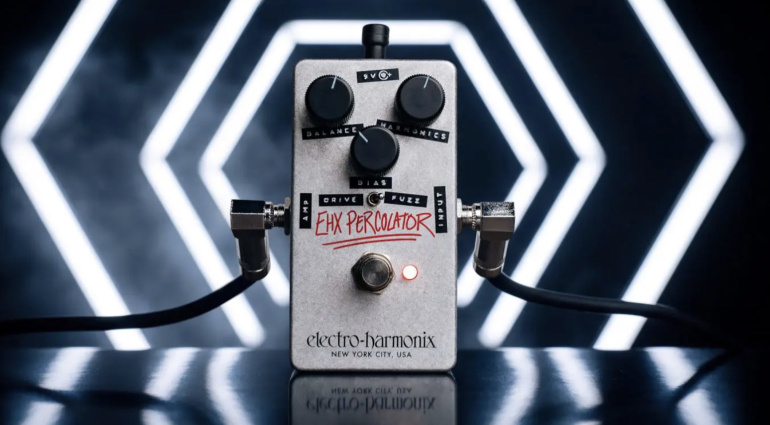
TL;DR: Electro-Harmonix has officially released the EHX Percolator, their affordable ($99) reimagining of the legendary ’70s Harmonic Percolator circuit originally designed by Ed Giese. This new version adds modern controls, a Drive/Fuzz toggle, and momentary footswitch action while preserving the rare silicon/germanium transistor blend that made the original a cult favorite.
- EHX revives the obscure Interfax HP-1 Harmonic Percolator from the 1970s, a circuit famously used by Steve Albini.
- Priced at $99 USD / £86 / €99, making it accessible compared to rare original units or boutique clones.
- Key controls: Harmonics (input gain), Bias (voltage starve), Balance (output volume), plus a Drive/Fuzz toggle switch.
- Internal trim pot adds extra gain and sub-octave rumble for players wanting more destruction.
- Dual-Action Footswitch offers both latching and momentary modes for quick bursts of fuzz.
Reading time: 3 min
Want more synth news before your next coffee break? Join the Noxal newsletter — no spam, just gear worth knowing about.

The return of a cult circuit
There are certain pieces of gear that develop a mythology all their own. The Harmonic Percolator is one of them. Designed in the 1970s by electrical engineer Ed Giese at his Milwaukee repair shop Interfax, the HP-1 was never a commercial smash. It had a tan-and-brown case, two sliders, and a circuit that combined silicon and germanium transistors in a way that was — and still is — genuinely unusual. The result was a fuzz that produced even-order harmonics, giving it a sweet, amp-like distortion that stood apart from the spitting, gated sounds of many contemporaries.
The pedal gained its cult status largely through association with Steve Albini, the late producer and musician whose guitar tone on records like Surfer Rosa and In Utero owed a lot to this box. Original units are now collector’s items, fetching prices that make boutique builders like Skreddy, Blackout Effectors, and others step in to recreate the circuit. Now, Electro-Harmonix has thrown their hat in the ring with a $99 version that promises to make the Percolator available to anyone with a pedalboard and a curiosity about weird fuzz.
What makes the Percolator tick
At its core, the EHX Percolator is a fuzz pedal built around that same hybrid transistor topology. The original Interfax design used a 2N3565 silicon transistor paired with a 2N404 germanium transistor, a combination that created a distinctive harmonic richness. EHX has kept that DNA intact, but they’ve rethought the interface entirely. Gone are the dual sliders. In their place: three knobs and a toggle switch, laid out on a compact black enclosure that could sit comfortably next to any modern pedal.
The Harmonics knob controls input gain. Turn it down and you get a mild overdrive; crank it and you’re in full fuzz territory. The Bias knob is where things get interesting — it adjusts the voltage feeding the circuit, letting you dial in everything from smooth drive to pseudo-octave fuzz to the kind of sputtering, Velcro-like gated tones that make recording engineers giggle. The Balance knob manages overall output, which is useful because the Percolator can get loud.
Modern tweaks and controls
EHX didn’t just copy the original; they added features that make this version more flexible. The Drive/Fuzz toggle switch changes the pedal’s clipping behavior. In Fuzz mode, diodes are engaged for heavy, compressed fuzz. In Drive mode, the diodes are bypassed, turning the pedal into a raw, organic transistor overdrive — crunchy, responsive, and surprisingly dynamic. It’s like getting two pedals in one, which is always a good thing when your pedalboard real estate is precious.
There’s also an internal trim pot that lets you boost the gain and add a heavy sub-octave rumble. This is for players who find the standard fuzz not quite destructive enough. And then there’s the Dual-Action Footswitch: standard latching bypass with momentary functionality. Hold the switch down for temporary bursts of high-gain feedback, release it to return instantly to clean. It’s a small touch, but useful for those moments when you want to punctuate a riff without committing to fuzz for the whole phrase.
Market context and who it’s for
The EHX Percolator enters a market that already has several boutique recreations of this circuit. But at $99, EHX is undercutting most of them by a significant margin. The closest competitor is probably the Danelectro 3699 Fuzz, but that pedal uses an entirely different topology. For players who want the authentic Harmonic Percolator sound without hunting down a vintage unit or paying boutique prices, this is the most direct route.
Who is this pedal for? Guitarists who like fuzz but find Big Muffs too smooth and Fuzz Faces too finicky. It’s for players who want a fuzz that cleans up with the guitar’s volume knob, who appreciate the ability to toggle between overdrive and fuzz, and who aren’t afraid of a pedal that can sound a little unhinged. It’s also for anyone who’s ever read about Steve Albini’s tone and wondered what all the fuss was about. Now you can find out for ninety-nine bucks.
Frequently Asked Questions
Is the EHX Percolator an exact clone of the original Harmonic Percolator?
No, but it stays faithful to the core circuit. EHX has reworked the interface with knobs instead of sliders, added a Drive/Fuzz toggle, and included a momentary footswitch function. The transistor blend (silicon and germanium) remains, preserving the even-order harmonic character that defined the original.
Can the EHX Percolator do both overdrive and fuzz?
Yes. The Drive/Fuzz toggle switch lets you bypass the clipping diodes for a raw transistor overdrive, or engage them for a compressed, aggressive fuzz. Combined with the Harmonics and Bias controls, you can cover a wide range from mild breakup to gated chaos.
Where can I buy the EHX Percolator and how much does it cost?
It is available now at retailers like Thomann, with a current wait time of 2-3 months. Pricing is $96 USD, £86 GBP, or €99 EUR. Check your local dealer for availability.
I’ll be testing this one with my morning espresso — a dark roast from Ethiopia, because some things deserve a little extra character. If the Percolator sounds half as good as that first sip, we’re in for a treat.