TL;DR: Swedish newcomer Apaeron has teased the AFOUR, a compact A4-sized synthesizer with 44 knobs, 27 keys, and four-part multitimbral capability. Details are scarce ahead of Superbooth, but the company’s emphasis on “instant boot time” and a phase control on each oscillator strongly suggests a digital engine, likely virtual analog. No pricing or release date has been announced yet.
- Four-part multitimbral operation, with each voice sporting two oscillators, a filter, two ADSRs, two LFOs, and a mod matrix.
- 44 physical knobs plus a color screen for EQ and system control — no menu-diving required for core synthesis.
- Stereo output with global dirt, drive, delay, reverb, compressor, ducker, and a three-band EQ.
- Onboard arpeggiator and looper, plus three macro knobs for performance tweaks.
- No price or release window; sign up on Apaeron’s website for mailing list updates.
Reading time: 3 min
Want more synth news before your next coffee break? Join the Noxal newsletter — no spam, just gear worth knowing about.

The A4-Sized Mystery Machine
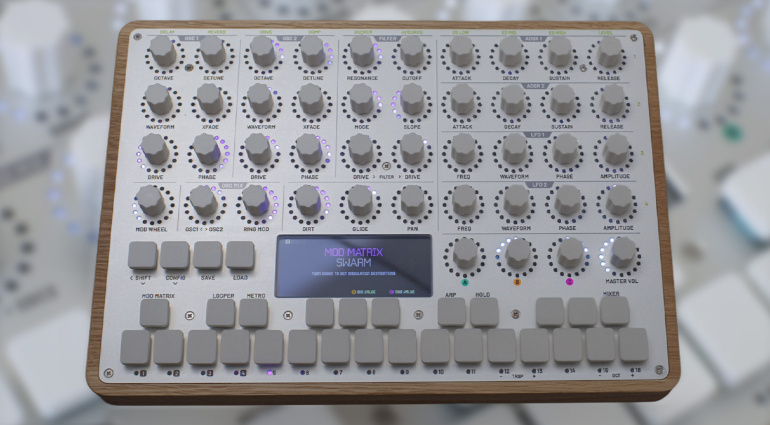
Superbooth is almost here, and with it comes the annual flood of teasers that make synth enthusiasts behave like children on Christmas Eve. This year’s early entry comes from Malmö, Sweden, via a new company called Apaeron. Their debut instrument is the AFOUR, and it’s already causing a stir — largely because nobody outside of the company knows exactly what it is.
The name AFOUR is literal: the synth is A4-sized. That’s roughly 210 x 297 mm of panel space, packed with 44 knobs and 27 velocity-sensitive keys. It’s compact enough to fit on a cluttered desk (the only kind we at Noxal have ever known) but dense enough to suggest serious sonic potential. The design is clean, almost utilitarian, with a color screen tucked into the top right corner. It looks like something you’d want to touch, twist, and probably spill coffee on within the first week.
Analog or Digital? The Bet Is On
Here’s where things get interesting. The AFOUR’s front panel screams analog subtractive synthesis — two oscillators, a filter section with resonance, cutoff, mode, slope, and dual drive knobs. But I’m calling it now: this thing is digital. Why? First, the company explicitly states “instant boot time.” That’s a dead giveaway for a microprocessor running firmware, not pure analog circuitry warming up. Second, each oscillator has a phase control. While phase manipulation is possible in analog, it’s far more common and precise in the digital domain. I’m choosing this hill to die on, and I’ve brought my coffee thermos for the siege.
The AFOUR is also four-part multitimbral. While four-voice analog synths exist, four-part multitimbral analog is rare and expensive. Digital makes this trivial. My bet is on a virtual analog engine, possibly FPGA-based, that can deliver the warmth and grit of analog with the flexibility of digital. The “dirt” knob in the global section and the multiple drive stages (four, by my count) suggest a synth that isn’t afraid to get its hands dirty.
Controls and Connectivity: Knobs for Days
Let’s break down the panel. Two oscillators per voice, each with octave, detune, waveform, xfade, drive, and phase. A mixer with a ring mod pot. A filter with resonance, cutoff, mode, slope, and two drive knobs. That’s four drive stages already — oscillators, filter, and global. The effects section across the top includes delay, reverb, compressor, ducker, and a three-band EQ that’s displayed on that color screen. Stereo output is confirmed via the pan control.
Modulation comes from two ADSR envelopes and two LFOs, each with frequency, waveform, phase, and amplitude controls. There’s a mod matrix, an arpeggiator, a looper, and three macro knobs for real-time performance. The 27 keys are velocity-sensitive, which is a nice touch for a synth this size. MIDI connectivity is present, though the specifics (USB, DIN, or both) remain unconfirmed. For a dirty little box, it’s remarkably well-equipped.
Market Context and Who It’s For
The AFOUR enters a crowded field of compact, performance-oriented synthesizers. It competes with the likes of the Sequential Take 5, the ASM Hydrasynth Explorer, and the Behringer DeepMind 12D. But its Swedish design ethic and emphasis on dirt and drive set it apart. This is a synth for people who want to make sounds that feel alive, slightly broken, and definitely not polite. It’s for the producer who spends more time tweaking than sequencing, who values physical controls over screen menus, and who secretly hopes every patch sounds like a malfunctioning spaceship.
There’s no pricing or availability yet. That’s frustrating, but in a way, it’s also the best part of Superbooth season: the speculation, the detective work, the arguments over whether that phase control is analog or digital. We’ll have to wait until the show to learn more. In the meantime, I’ll be refreshing Apaeron’s website and refilling my mug. Sign up for their mailing list if you’re as intrigued as we are.
Frequently Asked Questions
Is the Apaeron AFOUR analog or digital?
Based on the available information — specifically the “instant boot time” claim and the per-oscillator phase control — we believe the AFOUR is digital, likely virtual analog. The company has not officially confirmed the engine type.
How many voices does the AFOUR have?
The exact voice count hasn’t been disclosed, but the synth is confirmed as four-part multitimbral. Each part appears to have two oscillators, a filter, and its own modulation routing.
When will the AFOUR be released and how much will it cost?
No pricing or release date has been announced. The synth is being teased ahead of Superbooth, so more details are expected at the show. Sign up on the Apaeron website for updates.
I’ll be watching the Superbooth announcements with a cup of black coffee in hand, one eye on the screen and the other on my wallet — because if the AFOUR sounds as good as it looks, my bank account is about to take a hit.