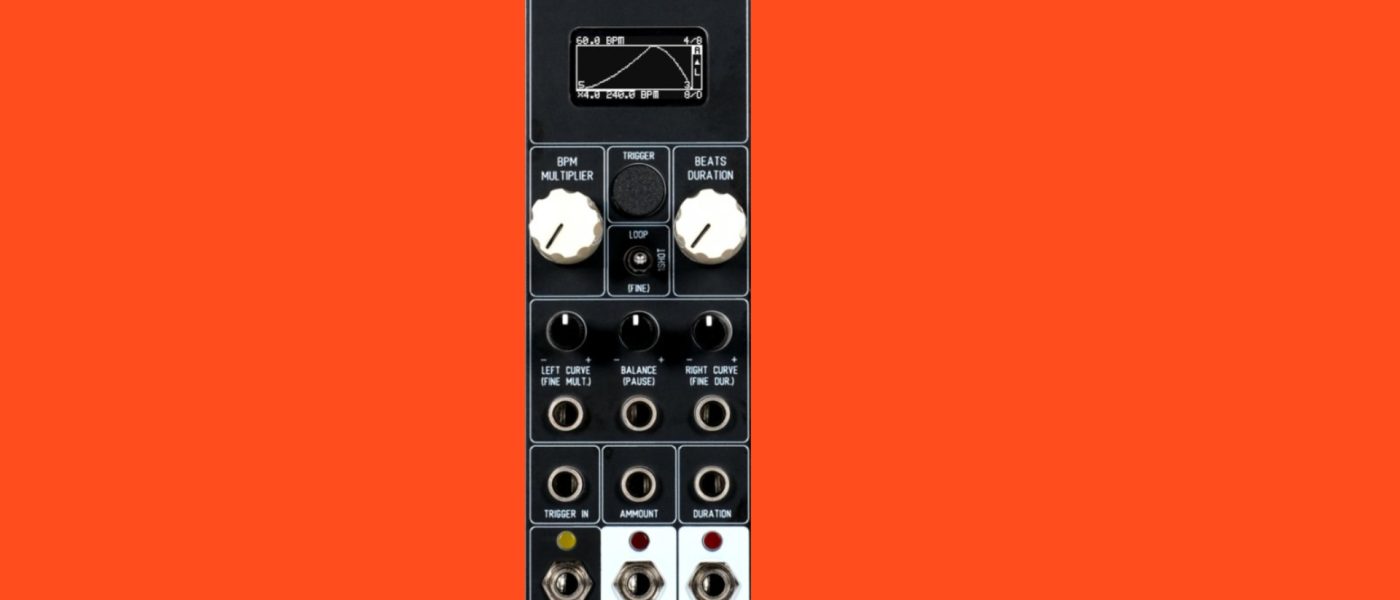
TL;DR: ADDAC System’s new Clock Bender module (8HP, 210€) is a Eurorack utility that warps clock signals by dynamically accelerating or decelerating BPM toward a target over a set number of beats, generating two independent outputs with constantly shifting intervals. It turns rigid sequencers into generative rhythm machines, but its mathematical approach means it’s not for the faint of heart.
- Two independent outputs that dynamically accelerate or decelerate BPM toward a user-defined destination over a specified number of beats.
- Generates metrics where no two intervals are identical, creating everything from simple swing to “beyond free-jazz” patterns.
- Requires only a clock input to start bending, making it a simple but deep addition to any Eurorack setup.
- Priced at 210€, available now from ADDAC System.
- Conceptually challenging — expect a learning curve before the rhythmic magic clicks.
Reading time: 4 min
Want more synth news before your next coffee break? Join the Noxal newsletter — no spam, just gear worth knowing about.

What is Clock Bender?
Let’s talk about the unsung hero of every Eurorack patch: the clock. Without it, your sequencer is just a sad, blinking LED. ADDAC System, the Portuguese wizards known for their quirky utility modules, have decided to give that humble clock a serious attitude adjustment. Enter Clock Bender, an 8HP module that takes your steady clock signal and bends it into something that sounds like it’s been possessed by a jazz drummer on espresso.
At its core, Clock Bender is a clock processor. You feed it a standard clock pulse, and it spits out two independent outputs that are constantly in flux. But this isn’t just simple swing or shuffle — we’re talking about a dynamic acceleration or deceleration toward a target BPM over a specified number of beats. The result? No two intervals between pulses are ever the same. It’s like giving your sequencer a caffeine jolt and watching it lose its mind in the best possible way.
We at Noxal appreciate modules that force us to rethink fundamentals. Clock Bender does exactly that by attacking the very root of rhythm — the steady tick-tock — and turning it into a living, breathing, slightly unhinged entity.
How It Works
The concept is deceptively simple. Patch a clock into the input, set your destination BPM, and define how many beats it takes to get there. The module then generates two outputs that accelerate or decelerate toward that target, creating a constant state of rhythmic flux. The current interval is always shorter or longer than the previous one — there’s no steady state, no settling down. It’s a permanent dance of mathematical tension.
This approach generates unique metrics that, when played against the main clock, create patterns ranging from subtle syncopation to “beyond free-jazz” territory. ADDAC System describes it as “mathematically justified metrics,” which is a fancy way of saying your sequencer will produce rhythms that feel both alien and inevitable. I’ve been playing with this in my own rack, and I’ll admit: it takes a minute to wrap your head around. But once you hear what it does to a simple 16-step sequence, you start to understand the madness.
The module outputs two independent voices, meaning you can have one output accelerating while the other decelerates, or both moving toward different destinations. This opens up polyrhythmic possibilities that would normally require a PhD in music theory — or at least a very patient friend with a drum machine.
Key Specs and Details
Clock Bender is available now for 210€, and it’s a lean 8HP in your rack. That’s a reasonable price for a module that can genuinely transform your rhythmic approach, especially considering how much generative gear costs these days. The interface is straightforward: a clock input, two outputs, and controls for destination BPM and beat count per transition. No menu diving, no hidden submenus — just knobs and jacks.
The module’s power draw is modest, and it’s designed to play nicely with both analog and digital clocks. ADDAC System has a reputation for building solid, no-nonsense hardware, and Clock Bender feels like a natural extension of their philosophy: take a basic function, twist it until it screams, and let the user figure out the rest.
One thing to note: this isn’t a module you’ll master in five minutes. The concept is inherently mathematical, and the demos currently available are sparse. We at Noxal would love to see more video walkthroughs, because hearing this thing in action is the best way to understand its potential. Until then, you’ll need some patience and a willingness to experiment.
Market Context and Who It’s For
In a world of endless oscillators and voice modules, utility modules like Clock Bender are the unsung heroes of Eurorack. They don’t make sounds themselves, but they make everything else sound better — or at least more interesting. With the rise of generative patching and algorithmic sequencing, tools that manipulate clocks are becoming increasingly valuable. Clock Bender sits alongside modules like the PNW or Pamela’s New Workout, but takes a very different, more organic approach.
Who is this for? If you’re the kind of person who spends hours dialing in a single kick drum pattern, this might be too chaotic. But if you crave rhythmic unpredictability — the kind that makes a crowd’s head tilt in confusion before they start dancing — Clock Bender is your new best friend. It’s perfect for experimental techno, ambient glitch, or any genre where rhythm isn’t a steady pulse but a living, breathing organism.
That said, it’s not for everyone. The learning curve is real, and the results can be jarring if you’re not prepared for them. We’d recommend pairing it with a quantizer or a logic module to tame the chaos, or just letting it run wild and seeing what happens. Sometimes the best patches come from letting go of control.
Frequently Asked Questions
Does Clock Bender work with any clock source?
Yes, it accepts standard Eurorack clock signals from any module or external source. Just patch in a clock, set your parameters, and let the bending begin.
Can I use both outputs independently?
Absolutely. The two outputs can be set to different destinations and beat counts, allowing for complex polyrhythms and layered timing variations.
Is Clock Bender difficult to learn?
It has a conceptual learning curve due to its mathematical approach to clock manipulation. We recommend starting with small BPM changes and listening carefully to how the intervals evolve. More demo videos would certainly help, but experimentation is key.
I’m off to patch this into my sequencer and see if I can make a 4/4 beat sound like it’s having an existential crisis. Coffee’s on the desk — don’t touch it.