TL;DR: Expressive E has announced the Osmose CE at Superbooth 2026 — a white “controller edition” of their groundbreaking MPE keyboard, stripping out the internal synth engine for pure MIDI control. It retains the same expressive keybed with per-note gestures, adds deep DAW integration and a new CTRL-E software suite with over 900 presets, and launches at $999/€999 (49-key) and $1199/€1199 (61-key).
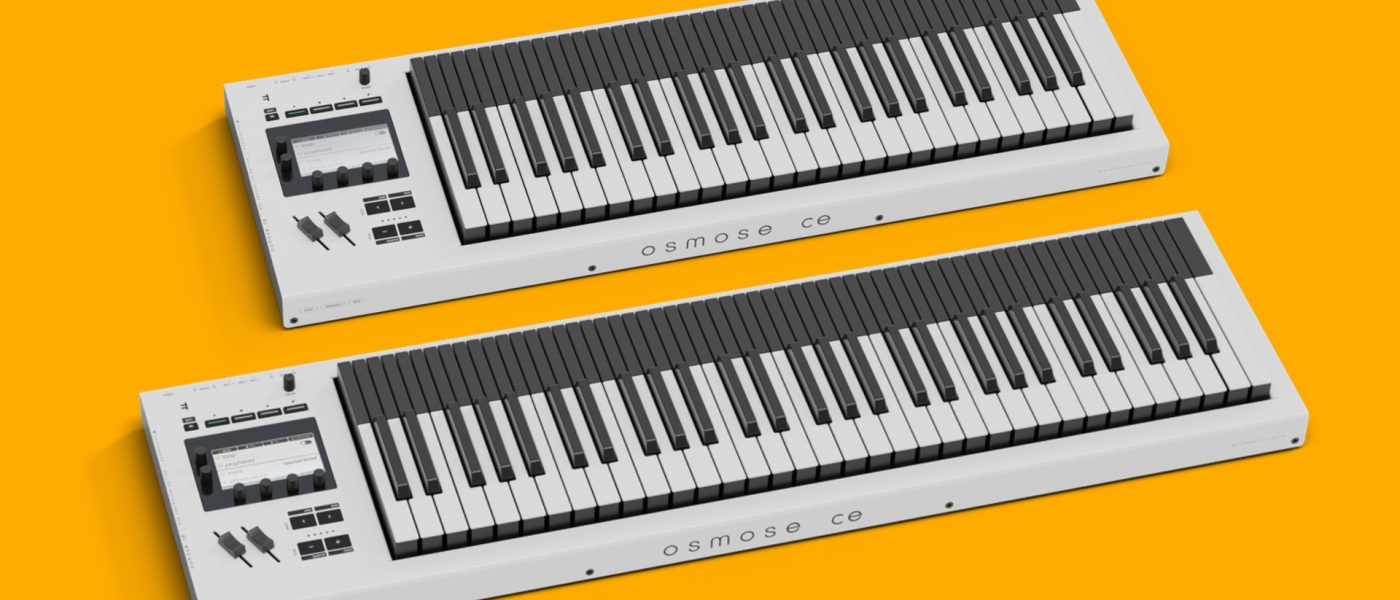
- The Osmose CE is the same innovative keybed as the original Osmose, but without the internal synth engine — a dedicated MPE controller in a white “panda” finish.
- It offers plug-and-play DAW integration with automatic detection for Live 12+, Cubase 15+, Bitwig 5+, and Logic Pro 12+, plus classic transport and mixer controls.
- A new CTRL-E companion software, developed with partners like Synapse Audio, AAS, and Kilohearts, provides over 900 expressive presets with 8 pre-mapped macros each — no manual mapping required.
- Connectivity includes DIN MIDI In/Out/Thru, two USB-C ports (one for power, one for data), and two assignable pedal inputs; no audio outputs since there’s no sound engine.
- Available in 49-key ($999/€999) and 61-key ($1199/€1199) versions, made in Poland — directly challenging controllers from Arturia, Novation, and others.
Reading time: 5 min
Want more synth news before your next coffee break? Join the Noxal newsletter — no spam, just gear worth knowing about.

The Panda Arrives

Let’s face it: when Expressive E first dropped the Osmose, we at Noxal collectively spilled our morning espresso. A keyboard that lets you strum like a guitarist, bend individual notes in a chord, and vibrato like a violinist — all on a familiar piano layout — felt like a leap that shouldn’t have taken this long. The synth engine inside was decent, but the real magic was always the keybed. So why, we wondered, did it take them until Superbooth 2026 to release a controller-only version?
The Osmose CE answers that question with a shrug and a white-and-black paint job. It’s the same expressive keybed, same per-note MPE gestures, same arpeggiator that makes you feel like a wizard. But the engine is gone. Instead of audio outputs, you get DIN MIDI and USB-C. Instead of a black slab, you get what the internet will inevitably call the “panda look.” It’s a logical step — and honestly, one that should have happened before the Expressive Suite software libraries started flooding the market. But better late than never, especially when the price undercuts the original by a significant margin.
What Stays, What Goes
The keybed is unchanged — and that’s the whole point. You still get tap, press & tap, pitch bend, vibrato, shake, strum, and expressive note-off. The 49- and 61-key versions both offer per-note control, and the interface remains identical: seven knobs/encoders, nine buttons, pitch and modulation sliders, and a 4.3-inch color LCD. The workflow is plug-and-play. Connect it to a hardware synth via DIN MIDI, or to a DAW via USB-C, and it automatically detects which DAW you’re using — Live 12+, Cubase 15+, Bitwig 5+, and Logic Pro 12+ are supported at launch.
What’s missing is the sound engine, and with it, the audio outputs. That’s fine. We never bought the Osmose for its presets; we bought it for the way it makes our fingers feel like they’re sculpting sound out of thin air. The CE doubles down on that philosophy. It’s a controller, pure and simple, and it knows it. The only downside? The display is still small, and with limited buttons, you’ll be hugging that shift key like an old friend. But for the expressive power on offer, it’s a small price to pay.
CTRL-E: The Software That Makes It Sing
Expressive E didn’t just strip out the engine and call it a day. They’ve partnered with a who’s who of plugin developers — Synapse Audio, AAS, Kilohearts, GForce, Dawesome, and Vital — to create CTRL-E, a companion software that gives you access to over 900 expressive presets. Each preset comes with eight pre-mapped macros, meaning you can twist knobs on the Osmose CE and get immediate, musical results without diving into parameter mapping hell.
This is where the company’s recent focus on MPE Suites pays off. Those preset libraries, originally designed for software synths, now have a hardware home. The press release quotes Expressive E saying: “Even when the sounds were inspiring, the experience was often held back by complex MPE setups, inconsistent compatibility, and complicated workflows that were too technical to be truly immediate. Osmose CE fixes that.” It’s a bold claim, but after spending time with the original Osmose, I’m inclined to believe them. The CTRL-E software might just be the killer app that convinces keyboardists to finally embrace MPE.
Competition and Context
Let’s be honest: the MIDI controller market is crowded. Arturia’s KeyLab series, Novation’s SL MkIII, Native Instruments’ Komplete Kontrol — they’re all competent, but they’re also fundamentally the same. A keybed, some knobs, a few pads, and a DAW integration that works until it doesn’t. The Osmose CE is different. It’s not trying to be the best all-rounder; it’s trying to be the most expressive keyboard you’ve ever touched.
At $999/€999 for the 49-key version and $1199/€1199 for the 61-key, it’s priced competitively against high-end controllers. But it’s not competing on features — it’s competing on feel. If you’ve ever played a real piano and then switched to a weighted synth action, you know the disappointment. The Osmose CE doesn’t just emulate; it invents. Strumming a chord on a keyboard shouldn’t feel natural, but it does. Vibrato on a single note in a cluster? That’s black magic.
Other manufacturers should be worried. Arturia, Novation, Native Instruments — your next move is being written by a French company that decided the piano key was due for a revolution. The Osmose CE isn’t just a product; it’s a statement. The era of the boring MIDI controller is over.
Specs and Connectivity
Since there’s no synth engine, the back panel is refreshingly simple: DIN MIDI In and Out/Thru, two USB-C ports (one for power delivery at 5V/3.0A, one for MIDI data), two assignable pedal inputs, and a power switch. No audio jacks, no headphone output, no surprises. It’s not bus-powered — the two USB-C ports are a clear giveaway — but that’s a minor inconvenience for a controller that demands stable power for its capacitive sensing.
The build quality is reportedly identical to the original Osmose, which means it’s solid and made in Poland. The white finish is a nice touch, distinguishing it from the black synth version without feeling gimmicky. It’s a controller that looks as good as it plays, and for studio nerds like us, that matters.
Who Is It For?
The Osmose CE is for keyboardists who want to play, not program. It’s for the guitarist who envies a piano player’s chord voicings, or the pianist who dreams of bending notes like a saxophonist. It’s for producers who are tired of mapping MPE parameters and just want to jam. If you already own the original Osmose, there’s no reason to upgrade — unless you want a second keyboard for a different rig or you’re a collector who needs the white variant.
But if you’ve been waiting for an MPE controller that doesn’t require a PhD in MIDI mapping, this is it. The Osmose CE is the most innovative “classical” MIDI keyboard controller to date. Other controllers look like they were designed by committee; this one feels like it was designed by musicians who actually play.
Frequently Asked Questions
Does the Osmose CE work with hardware synths without a computer?
Yes. The Osmose CE has DIN MIDI In and Out/Thru ports, so you can connect it directly to any hardware synth that accepts MIDI. It operates in “external mode” for this purpose, with no computer required.
Can I use it with my existing DAW if it’s not listed at launch?
At launch, automatic DAW detection supports Live 12+, Cubase 15+, Bitwig 5+, and Logic Pro 12+. For other DAWs, you can still use it as a standard MIDI controller via USB-C, but you may need to manually configure MPE settings and won’t get the full DAW integration features like transport control.
Is it possible to power it with an external power supply for standalone use?
Yes. The Osmose CE requires external power via its dedicated USB-C port (5V/3.0A). It is not bus-powered, so you’ll need a power adapter or a powered USB hub for standalone or mobile setups. Two USB-C ports are provided — one for power, one for data — to avoid conflicts.
At Noxal, we believe the best gear makes you forget it’s there — until you need another espresso because you’ve been playing for three hours straight. The Osmose CE does that. Now if only it came with a built-in coffee warmer.