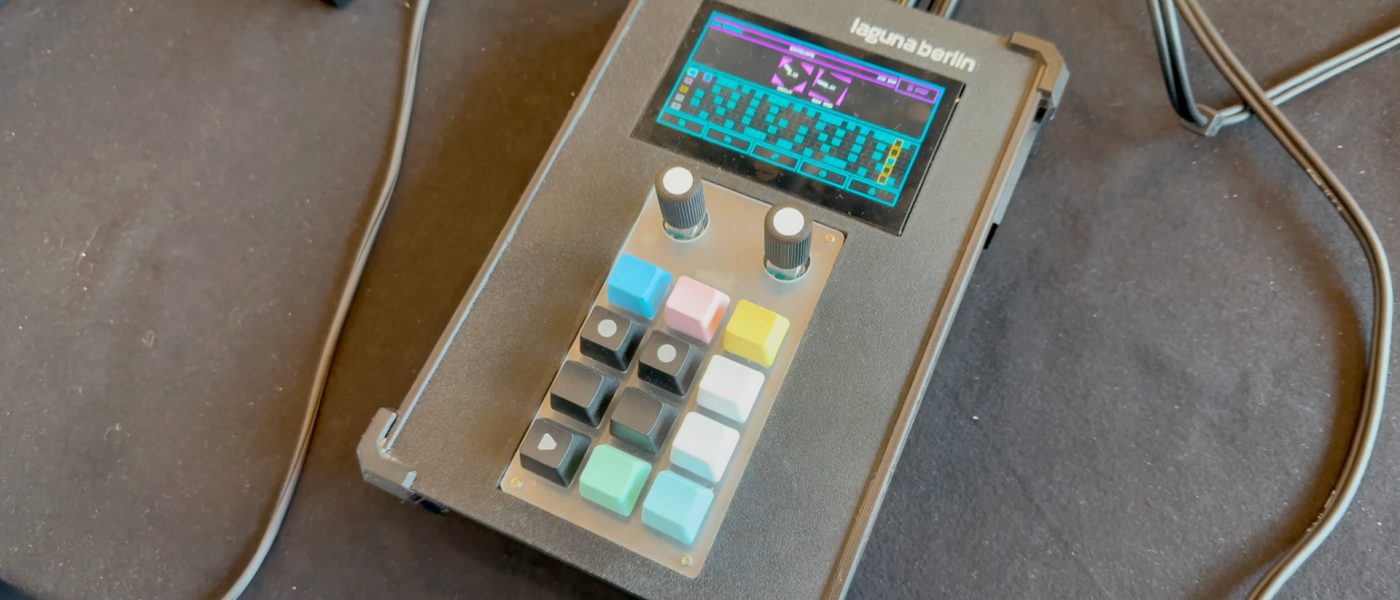
TL;DR: Laguna, a new Berlin-Paris company, has unveiled the Berlin—a prototype 5-track groovebox with 16 all-synthesis sound engines. It’s a brick-shaped minimal interface with a touchscreen, two macro knobs, and 12 clicky buttons, aiming for summer 2026 release at around 360€. We’re intrigued but reserving judgment until we hear it in a quiet room with a decent coffee.
- 16 synthesis engines: Each “groovemachine” uses a different method (FM, chiptune, etc.) and transforms the entire device into a new instrument.
- 5-voice architecture: 3 synth voices and 2 drum voices, with assignable macro controls for live performance.
- 32-step sequencer: Variable pattern lengths, song mode, pattern morphing, and 128 patterns per groovemachine.
- Minimal interface: Touchscreen, two rotary encoders, 12 clicky caps—no menu diving, but the prototype’s look will be refined.
- Pricing and release: Summer 2026, around 360€ (under 400€), stereo output, headphone jack, MIDI in/out.
Reading time: 4 min
Want more synth news before your next coffee break? Join the Noxal newsletter — no spam, just gear worth knowing about.

The Birth of a Brick
SynthFest France 2026 was, as always, a treasure trove of prototypes and passion projects—small companies showing off gear that would never survive the Superbooth hype cycle. Among the noise (literal and metaphorical), a new name appeared: Laguna, a young company split between Berlin and Paris. Their debut, the Berlin, is a groovebox. And when we say “brick,” we mean it with affection.
The prototype we saw looks like a slab of dark matter with a touchscreen and 12 satisfyingly clicky retro-cap buttons. Two macro-style rotary encoders sit on top, and the whole thing is about as minimal as a hardware interface can get. Laguna assures us the final version will be refined aesthetically, but the dimensions are staying. We at Noxal appreciate a company that commits to a shape. It’s honest. It says: “I am a machine. I make beats. Deal with it.”
What really matters, though, is what’s under that brick-like exterior. The Berlin is described as a “digital hyper groovebox,” a phrase that sounds like a marketing intern’s fever dream but turns out to mean something specific: 16 distinct all-synthesis groovemachines, each with its own character. Select one, and the entire device becomes a new instrument. No sample playback here—this is pure synthesis, from chiptune to FM and everything in between.
16 Machines, One Groovebox
Let’s talk about those 16 engines, because that’s the heart of the Berlin. Each “groovemachine” is a self-contained synthesis architecture with its own set of parameters and sonic flavor. You don’t load presets; you load an entire instrument. It’s like having 16 different synths in one box, but you can only play one at a time—unless you’re using the five-voice architecture cleverly.
This is a bold move. Most grooveboxes rely on sample-based drums or a handful of synth engines. Laguna is betting that variety of synthesis methods will keep you exploring. FM for metallic percussion, chiptune for that 8-bit nostalgia, subtractive for bass—each engine transforms the Berlin into a new creative tool. We’re not sure how seamless the switching is, or if it’s instant or requires a reboot, but the concept is genuinely exciting.
The sound at SynthFest was, to be honest, not entirely convincing. But that’s the curse of trade shows: you’re surrounded by 50 other demos, bad room acoustics, and the distant hum of a coffee machine that’s been abused all day. We’ll reserve judgment until final sound demos land. For now, we’re willing to give Laguna the benefit of the doubt.
Voice Architecture and Sequencing
The Berlin offers five voices: three synth voices and two drum voices. This is a classic groovebox layout, but the twist is how parameters are assigned to the two macro encoders and the touchscreen. You can map any engine parameter to the hardware controls for live tweaking. It’s not Elektron-level modulation matrix complexity, but it’s designed for immediacy. No menu diving, they promise. We’ll believe it when we see the final UI.
The sequencer is 32 steps with variable pattern lengths—a welcome feature for anyone tired of rigid 16-step grids. There’s a song mode for arranging patterns into full tracks, and a “pattern morphing” function that sounds suspiciously like a crossfader between pattern states. If it works smoothly, this could be a performance secret weapon. You can store 128 patterns per groovemachine, which is generous for a device with 16 engines.
Connectivity is basic but sufficient: stereo output (two 6.35mm jacks), headphone out, MIDI in/out. No USB host, no CV/gate—this is a self-contained box, not a modular hub. That’s fine. At this price point, you’re paying for the synthesis engines and the sequencer, not a patchbay.
Market Context and Verdict
Priced at around 360€ (under 400€ for sure), the Berlin is entering a crowded field. The Roland MC-101 and MC-707, the Elektron Model:Cycles, the Novation Circuit series—all offer groovebox functionality at similar or higher prices. But none of them have 16 synthesis engines that transform the device. The closest competitor might be the Sonicware Liven series, which also uses all-synthesis engines, but Laguna’s approach feels more ambitious.
Who is this for? Bedroom producers who want a focused, no-sample workflow. Live performers who need a compact box with immediate control. Anyone who’s tired of scrolling through sample packs and wants to actually synthesize their drums and synths. It’s a niche, but a passionate one.
Summer 2026 feels like a long wait, but we’ve seen worse delays in synth world. The prototype is promising, the price is right, and the concept is genuinely fresh. We’ll be watching Laguna closely—and hoping the final version sounds as good as the idea.
Frequently Asked Questions
Can the Laguna Berlin load samples?
No. The Berlin is 100% synthesis-based. There are 16 groovemachines that use various synthesis methods (FM, chiptune, subtractive, etc.), but no sample playback. If you need samples, look elsewhere.
How does the pattern morphing work?
Laguna hasn’t released full details, but the feature allows you to morph between patterns in real time. It’s likely a crossfade or interpolation between sequencer data from two different patterns. We expect more clarity closer to release.
Is the touchscreen required for operation?
Yes, the touchscreen is integral to the interface, alongside the two macro encoders and 12 buttons. Laguna promises no menu diving, so the screen likely handles navigation and parameter display. It’s not a secondary feature—it’s the main visual feedback.
We’ll be waiting for summer 2026 with a fresh pot of pour-over and a healthy skepticism. If the Berlin sounds half as good as its concept, it might just earn a permanent spot on our desk—right next to the mug.