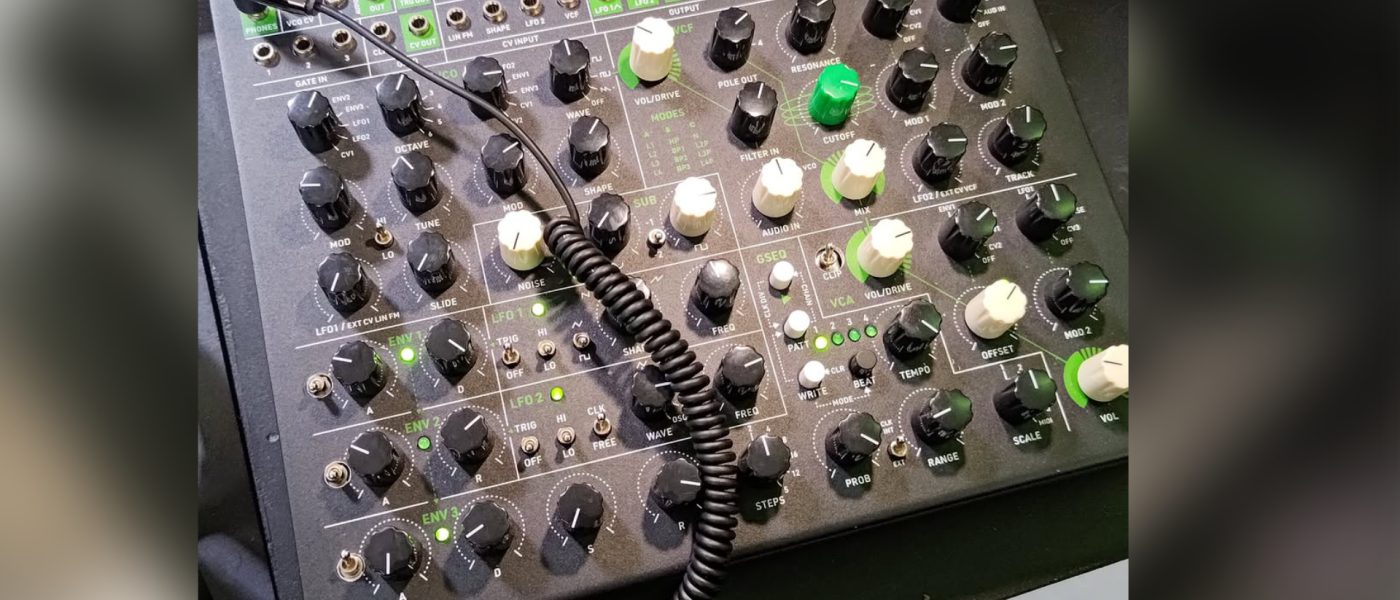
TL;DR: Analog Sweden returns to Superbooth 2026 with the SWEN2, a significant evolution of their 2023 SWENIGISER clone of the rare Orgon Systems Enigiser. The new version adds a second oscillator, dual LFOs, a generative sequencer, and a Eurorack patchbay, transforming it from a faithful recreation into a modern semi-modular monosynth with its own personality.
- Second oscillator (ghost OSC2/noise generator) and sub-oscillator join the original single VCO, with octave selector and fine/coarse tune.
- Filter section upgraded to a 12-mode proto VCF/VCA module with selectable clip drive and auto-calibration.
- Dual multi-wave LFOs with hi/lo modes, clock sync on LFO2, and trigger options replace the basic LFO.
- Built-in generative sequencer with per-step probability, range, and scale control.
- Eurorack-compatible patchbay on top, USB-C power (including power bank), and DIN MIDI input plus headphone output.
Reading time: 4 min
Want more synth news before your next coffee break? Join the Noxal newsletter — no spam, just gear worth knowing about.

From Clone to Evolution

We at Noxal have a soft spot for the weird and wonderful. The original Orgon Systems Enigiser from 1994 was a rave-era cult classic that most synth enthusiasts have only ever seen in grainy YouTube videos. Analog Sweden’s 2023 SWENGISER gave it a second life as a faithful clone, but the SWEN2 takes a different route entirely. This isn’t a museum piece — it’s a reimagining.
The developers describe it as an “evolution,” and they’re not just being polite. While the core circuit remains based on the 1994 original, the SWEN2 adds enough new features that calling it a clone would be misleading. It’s more like a grandchild — one that inherited the strange DNA but went to engineering school and picked up a few tricks along the way.
I’ll admit, I was skeptical when I first read the spec sheet. More oscillators, more modulation, more everything — isn’t that how we lose the character of these oddball machines? But after studying the details, I’m cautiously optimistic. The additions seem thoughtful, not gratuitous.
Oscillator Upgrades and a Second Voice
The original SWENGISER had a single VCO with PWM, FM, and a sawtooth shape bus. That was part of its charm — lean, mean, and slightly unpredictable. The SWEN2 keeps that foundation but adds a second oscillator described as a “ghost OSC2/noise generator,” plus a sub-oscillator tuned one or two octaves down. That’s three sound sources where there used to be one.
There’s also an octave selector and a fine/coarse tune toggle. These are basic features on most modern synths, but their absence on the original was part of its raw character. Now you get the flexibility without losing the grit, assuming the core circuit still behaves like a slightly unhinged friend at 3 AM.
The ghost oscillator label is intriguing. Is it a digital noise source? An analog chaos generator? We’ll have to wait for demos to know for sure, but the potential for evolving textures is promising. The sub-oscillator adds low-end weight, addressing one of the few criticisms of the original design.
Filter and Modulation Deep Dive
The filter section is where the SWEN2 really flexes. It’s now based on Analog Sweden’s 12-mode proto VCF/VCA module, which means you get a staggering range of filter types. Controls include cutoff, resonance, tracking, and volume/drive — and the drive is now selectable, which is a welcome improvement over the fixed saturation of the original.
Both the VCO and VCF sections include auto-calibration/tuning. This is a lifesaver for live use and recording, where the original’s drift could be charming or infuriating depending on the day. The new VCO/VCF source mixer also gives you more control over how the two sections interact.
Modulation gets a serious upgrade too. Three envelopes (AD, AR, ADSR) remain from the original, but now they have new trigger toggles. The LFOs are the real headline: two multi-wave LFOs with frequency control, hi/lo modes, and trigger options. LFO1 has a wave toggle; LFO2 adds clock sync. Compared to the SWENGISER’s single basic LFO, this is like swapping a bicycle for a sports car.
I’ve spent many late nights with a coffee in one hand and a single-LFO monosynth in the other, wishing for just one more modulation source. The SWEN2 seems to understand that pain.
Sequencer, Patchbay, and Connectivity
The biggest surprise is the built-in generative sequencer. Step-based with knob control over probability, range, and scale — this isn’t a simple step sequencer. It’s designed for unpredictable, evolving patterns that feel alive. For a synth whose original claim to fame was chaotic rave stabs, this feels like a natural fit.
The Eurorack-compatible patchbay on top has been redesigned to work without gate converters. It offers CV control over a wide range of parameters, including the modulators. Combined with the sequencer, this makes the SWEN2 a genuine semi-modular instrument. You can patch it into a modular system or use it standalone with the internal modulation.
Connectivity has also been modernized: USB-C MIDI in/out, DIN MIDI input, a dedicated headphone output, and USB-C power that works with power banks. The headphone jack alone is worth celebrating — I can’t count how many times I’ve needed to patch into a mixer just to practice quietly.
Market Context and Who It’s For
At first glance, the SWEN2 occupies a curious space. It’s not a budget monosynth competing with the Behringers of the world, nor is it a high-end boutique like a Make Noise or Moog. It’s a niche instrument for people who love the sound of the original Enigiser but want modern reliability and expanded features.
Who is this for? The rave producer who wants instant grit without menu diving. The modular enthusiast who wants a self-contained voice with patch points. The collector who missed the original but doesn’t want a museum piece. And, if I’m being honest, the person who loves saying “SWEN2” in conversations just to watch people’s faces.
Pricing and availability are still TBA. We’ll be watching Analog Sweden’s announcements like hawks — or more accurately, like synth journalists who’ve had one too many espressos.
Frequently Asked Questions
Is the SWEN2 a clone of the Orgon Systems Enigiser?
No, not exactly. The SWEN2 is an evolution of Analog Sweden’s previous SWENGISER, which was a faithful clone. This new version adds a second oscillator, dual LFOs, a generative sequencer, and many other features that move it beyond cloning into original territory. The core circuit is still based on the Enigiser, but it’s been significantly expanded.
Does the SWEN2 have presets or patch memory?
Based on available information, the SWEN2 does not appear to have preset storage. It is a fully analog instrument with a hands-on interface. You’ll need to recreate sounds manually or use CV patching to save and recall configurations.
Can the SWEN2 be used with a Eurorack modular system?
Yes. The top panel features a Eurorack-compatible patchbay that gives you CV control over many parameters, including modulators. The patchbay has been redesigned to work without gate converters, making it easy to integrate into a modular setup. It can function as a semi-modular voice or be expanded with external modules.
I’m already clearing a spot on my desk, making room between the coffee mug and the soldering iron. Now if only they’d announce the price before my bank account notices I’m shopping again.