TL;DR: Behringer has officially unveiled the JT-2, a paraphonic analog synthesizer module for Eurorack based on a single voice of the Roland Jupiter-8. Priced at an estimated $299, it packages classic Jupiter oscillators and filters into a compact format with MIDI, CV, and an arpeggiator. It’s available for pre-order now, marking a shift from endless teasers to an actual, shippable product.
- The JT-2 is a Eurorack module offering one authentic Jupiter-8 voice, making it a “Jupiter-1” in spirit.
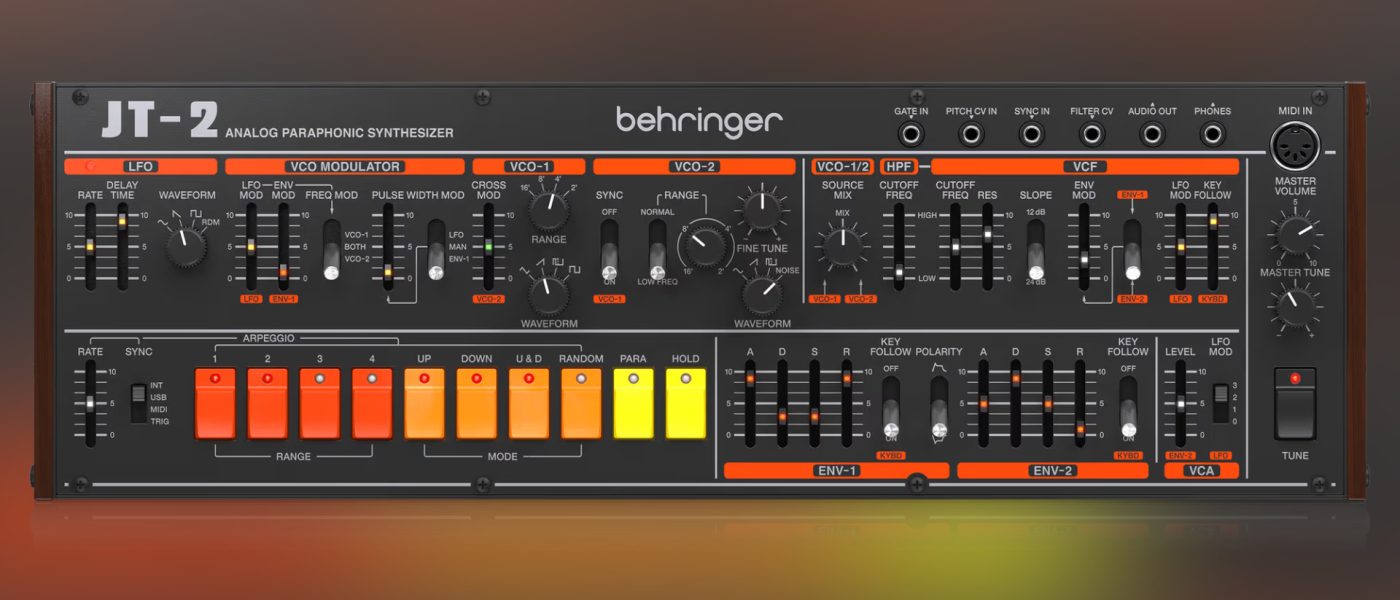
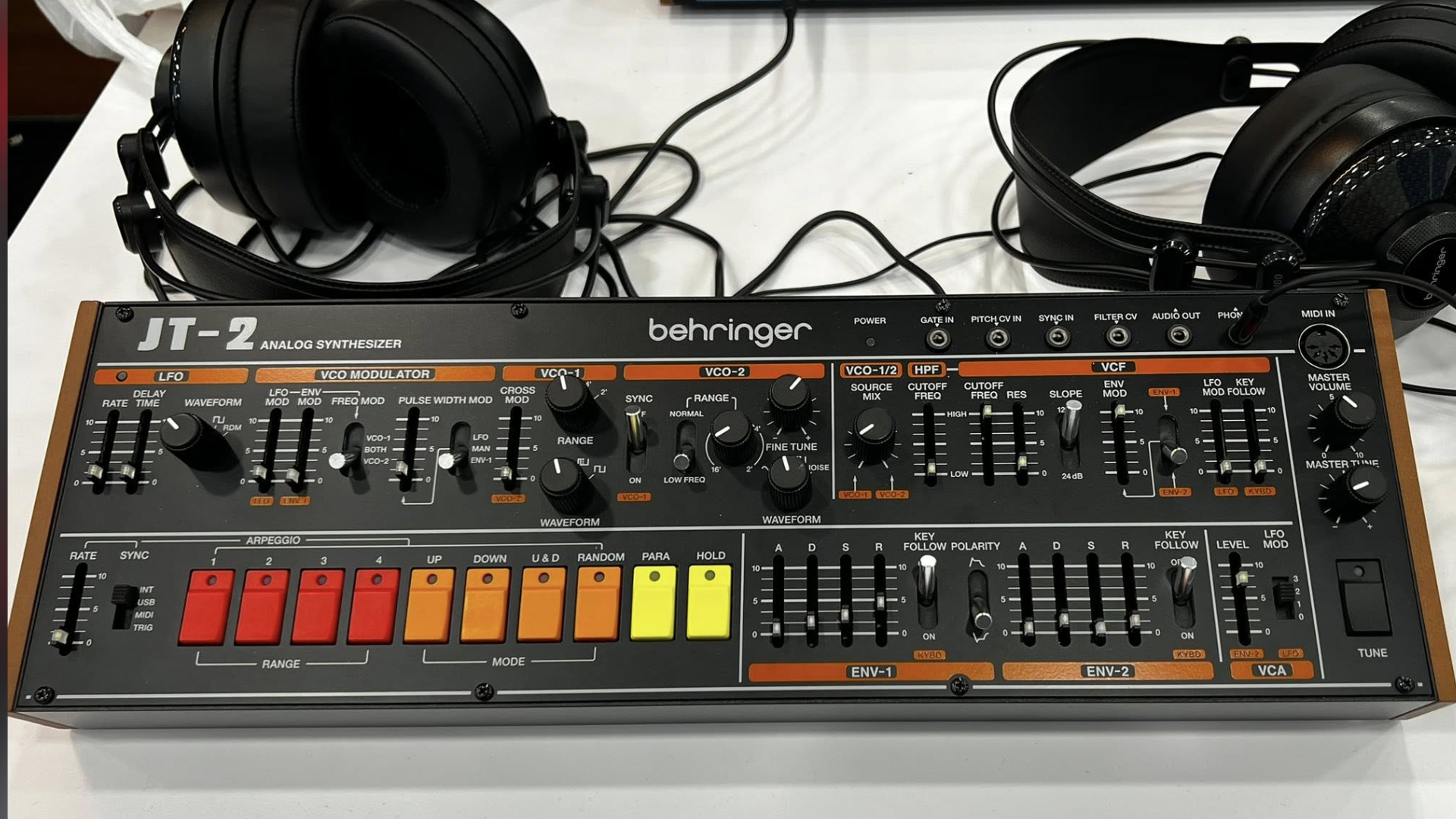
- It features two VCOs with cross-mod and sync, a low/high-pass filter, two envelopes, an LFO, and an autotune function.
- Notable inclusions are a syncable arpeggiator and front-panel MIDI input, alongside essential CV/Gate patch points.
- With an estimated price of $299, it aims to be an affordable entry point into the Jupiter sound architecture.
- This launch follows a period of product teaser “oversaturation” from Behringer, making its concrete pre-order status significant.
Reading time: 4 min
Want more synth news before your next coffee break? Join the Noxal newsletter — no spam, just gear worth knowing about.

The Jupiter Minus Seven
Here at Noxal, we’ve grown accustomed to the rhythmic, almost seasonal, arrival of Behringer teasers. They flutter into our feeds like synthetic leaves, promising everything from proton-based synthesizers to full-scale orchestras in a box. Most vanish into the digital ether, victims of the global chip shortage or what we can only assume is a highly complex, inter-dimensional supply chain. So, when news breaks that a product is not just teased, but finished, showcased at NAMM, and available for pre-order, we perk up. The Behringer JT-2 is that product. It represents a fascinating distillation: taking the legendary, polyphonic architecture of the Roland Jupiter-8 and boiling it down to a single, paraphonic voice in a Eurorack module. It’s not a Bupiter-8. It’s a Jupiter-1. And for a certain breed of synthesist, that might be exactly the point.
The announcement carries the faint, satisfying aroma of a promise kept. Behringer’s social media has been a gallery of vaporware for years, leading to what the source text rightly calls “teaser oversaturation.” The JT-2, therefore, feels like a tactical correction. It’s a tangible, price-tagged object ($189/€189/£159 for pre-order, estimated $299 MSRP) in a sea of rendered images. It suggests that perhaps the gears in Music Tribe City—Behringer’s massive, self-contained factory campus—are finally turning with purpose on something other than guitar pedals and audio interfaces. For the hardware community, a pre-order button is a more compelling argument than a Facebook post.
Specs: Nostalgia in a Box
So, what exactly are you getting in this 42HP slice of Jupiter? The core is an authentic replication of a single Jupiter-8 voice. That means two analog voltage-controlled oscillators (VCOs) with the classic waveforms, plus cross-modulation and hard sync for those brassy, complex leads and sync sweeps we all love. The signal path runs through a filter section offering both low-pass and high-pass modes, presumably based on the iconic IR3109 chip circuit or a faithful reproduction thereof. Modulation duties are handled by two envelopes (likely for filter and amplifier) and one LFO.
Where the JT-2 gets interesting is in its modern concessions. An autotune function is a welcome, practical addition for stabilizing the analog oscillators—a nod to the realities of modern studio workflow. More notably, it includes a syncable arpeggiator, controlled via a row of colored buttons that aesthetically echo the Jupiter-8’s interface. I/O is a mix of classic and contemporary: a front-panel MIDI input for easy DAW integration, a master volume, and master tune knob. For Eurorack integration, it offers essential patch points: Gate In, Pitch CV In, Sync In, and a Filter Out. The rear panel hosts a ¼” audio output, MIDI Thru, and a USB port. It’s a focused, sensible set of features that understands its role as a satellite voice in a larger system.
Paraphony vs. Patience
The elephant in the room, or rather the missing seven voices in the module, is paraphony. The JT-2 is not polyphonic. Its two oscillators share a single filter and amplifier path. This is a significant architectural departure from the original Jupiter-8’s true polyphony and independence. The immediate question from the community, as seen in the source text, is: “But do we need a paraphonic one-voice Jupiter?” The answer depends entirely on what you’re waiting for.
This module exists in the shadow of Behringer’s long-rumored, full-keyboard “Bupiter-8” clone. For those holding out for an affordable, eight-voice behemoth, the JT-2 might feel like a consolation prize. However, for the Eurorack enthusiast or the producer looking for that specific Jupiter brass or string machine layer without committing to a giant keyboard or a software plugin, this is a compelling proposition. It’s a $299 way to inject that specific tonal character into a patch. It’s also, arguably, a more immediate and likely product than the full poly synth, given the complexities and costs involved in manufacturing the latter. The JT-2 is for the pragmatist who wants the sound now, not the dreamer waiting for the full orchestra.
Context and Competition
Positioning the JT-2 in the market is an exercise in understanding Behringer’s niche. At ~$300, it sits comfortably as an “impulse buy” in the world of high-end Eurorack. It’s not competing with a $6,000 Jupiter-8 reissue. It’s competing with other single-voice desktop or module synths like the IK Multimedia UNO Synth Pro (also paraphonic) or Behringer’s own catalog of semi-modulars like the Neutron. Its unique selling proposition is unequivocally the Roland-derived voice architecture.
The commentary from the source text is telling. One user states, “Yes, we do need everything what has authentic sound like original and is cheap.” This encapsulates the Behringer value proposition perfectly. Another ponders replacing a Behringer Model D with it, highlighting how these affordable clones are now competing with each other in users’ studios. The lack of patch memory, noted as a limitation by some, is standard for most analog Eurorack modules—this is a hands-on, performative instrument. The JT-2 isn’t trying to be everything. It’s trying to be one, very specific, famously lush thing. And if it delivers on that promise of “authentic sound,” its place on countless breadboards is virtually assured.
Frequently Asked Questions
Is the Behringer JT-2 truly monophonic?
It’s technically paraphonic. It has two oscillators that can play different notes, but they route through a single filter and amplifier envelope. This means you can play intervals or chords, but the notes will not have independent articulation—the filter and amp will re-trigger based on the last note played. For true polyphony, you’d need multiple JT-2 modules or to wait for the hypothetical full-sized clone.
What are the main differences between this and a real Roland Jupiter-8 voice?
The core oscillator and filter design aim to be authentic. The main differences are the paraphonic architecture (vs. fully independent polyphonic voices), the modern additions (arpeggiator, autotune, MIDI/USB), and the format. It packages the sonic essence into a compact, CV-addressable module, sacrificing the original’s interface scale and true polyphony for integration and price.
When will the JT-2 actually ship?
Behringer has announced it is “ready for pre-order,” which is a step beyond a mere teaser. However, given the company’s history of delays and global supply chain issues, a concrete shipping date is not yet confirmed. The display of a finished unit at NAMM 2026 is a positive sign, but as always with pre-orders, cautious optimism is advised. The estimated retail price is $299 USD.
I’ll believe it’s real when the shipping notification arrives and I have to clear space on the rack. Until then, my coffee remains skeptical, but my credit card is nervously optimistic.