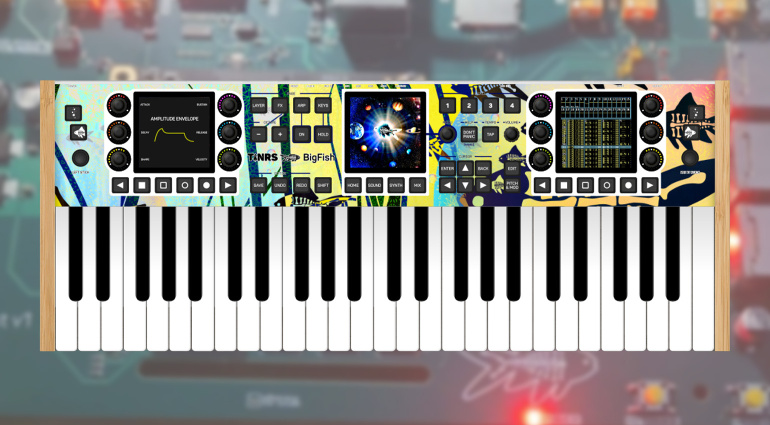
TL;DR: This Is Not Rocket Science (TINRS) has announced the BigFish, a long-in-development digital synthesizer conceived as a spiritual successor to the Clavia Nord Modular. It’s a polyphonic, modular-in-nature synth in a keyboard format with a built-in editor and a unique, custom-built keybed. The instrument is targeting a 2027 release.
- BigFish is a digital, polyphonic synth designed as a modern, standalone successor to the Nord Modular concept, with all editing done on the hardware itself.
- It features “four levels of making,” from playing presets to deep DSP programming, aiming to serve musicians, sound designers, synth architects, and coders.
- A key development hurdle was the creation of the custom “Bink Keybed,” built with Binkhorst Creations, featuring adjustable tension, aftertouch, and full travel sensing.
- The synth’s DNA comes from TINRS’s modular hardware (Fenix) and Stijn’s educational “Blok” software, promising a blend of physical modeling, FM, and complex waveform generation.
- Availability is estimated for Spring 2027, with pricing yet to be announced. More details are expected at Superbooth 2026.
Reading time: 5 min
Want more synth news before your next coffee break? Join the Noxal newsletter — no spam, just gear worth knowing about.

The Nord Modular Dream, Revived
Let’s be honest: for a certain breed of synth nerd, the Clavia Nord Modular wasn’t just an instrument; it was a paradigm. A hardware brain that you programmed with software, offering near-infinite modular flexibility without a single patch cable. Its greatest flaw, of course, was its dependence on that now-ancient software editor. When the OS updates rolled in and the editor broke, a piece of music history began to fossilize. We at Noxal have watched countless companies tip their hats to the concept, but few have dared to walk directly into the light of that particular legacy. Enter This Is Not Rocket Science (TINRS) with the BigFish.
The Dutch company, known for its wonderfully esoteric Fenix modular systems, is making a bold pivot. They’re building a keyboard synthesizer. More specifically, as co-founder Stijn told me last year, they’re building a “Nord Modular follow-up. Modular in a keyboard.” The core promise is intoxicating: 100 Fenixes in a box, but digital, polyphonic, and capable of “gigantic sounds.” The critical evolution? The editor is built directly into the hardware. Stijn explicitly notes this solves the decay problem of the original Nord: “You never need to have an app or anything connected. So it won’t rot away like that system sadly did.” This isn’t just a nostalgic rehash; it’s an attempt to fix the fatal flaw of a legend.
Four Levels of Making: A Synth For Everyone?
TINRS isn’t marketing the BigFish as merely a powerful synth. They’re framing it as an instrument with “four levels of making.” This is either a stroke of genius marketing or a sign of dangerously ambitious scope. Let’s break it down. Level one is “making music”—you play the presets. Fine. Level two is “making sound”—you tweak and design patches. Standard fare for any serious synth. Level three is where it gets spicy: “making synth.” This is the modular playground, where you build new synthesizer architectures “modular style” using the onboard software. Think of it as a hardware-bound Reaktor or VCV Rack.
Then there’s level four: “making DSP.” This is the deep end of the pool, where programmers can ostensibly write or modify the actual synthesis algorithms on the device itself. This layered approach suggests TINRS is aiming for an unprecedented breadth of user, from the performing musician to the academic sound designer and the hardcore DSP coder. I have to wonder if trying to be everything to everyone is a sustainable design philosophy, or if it will result in a brilliant but bewildering instrument. The ambition, however, is undeniably compelling.
The Bink Keybed: A Hardware Hurdle
Here’s a twist I didn’t see coming: one of the primary reasons the BigFish has been “a multi-year project” is the keyboard itself. TINRS decided they couldn’t use an off-the-shelf keybed, so they built their own. In collaboration with Amsterdam’s Binkhorst Creations, they’ve developed the “Bink Keybed.” This tells us two things. First, TINRS is deadly serious about this being a holistic, ground-up instrument, not just a digital brain slapped into a generic controller. Second, they likely had very specific tactile and data requirements that existing keybeds couldn’t meet.
According to the available brochure, the Bink Keybed promises mechanically stable keys, user-adjustable tension, aftertouch, and “full travel sensing” with an easy SDK for integration. They’re also touting sustainable materials. The fact that they plan to offer this keybed to other manufacturers is a fascinating side-project that speaks to its intended quality. For us players, the promise of a customizable, responsive touch surface built specifically for complex synthesis is a huge selling point. It suggests the BigFish is meant to be *played*, not just programmed.
Speculations, DNA, and a Long Wait
What will it actually sound like? The name “BigFish” first appeared in 2017 as a wild Eurorack voice prototype. Descriptions from that era hint at a wildly multi-engine architecture: seven different algorithmic waveshapes, organ-type sounds, chord generation, physical modeling, and FM synthesis. Furthermore, TINRS states the synth uses ideas from the “Blok” system of modular software synths Stijn used in university teaching. The DNA, then, is a fusion of TINRS’s hands-on modular hardware philosophy and years of academic audio design software. The potential is staggering.
Now, the cold splash of reality. The estimated release is Spring 2027. That’s a three-year wait from the time of this announcement. There is no price. We at Noxal have learned to be cautiously optimistic about such distant horizons in the synth world. The good news is that Stijn and Priscilla will be at Superbooth 2026, where we hope to see a functional prototype and get a clearer sense of the roadmap. The BigFish represents a monumental bet for TINRS, “the big project that all other projects have been leading to.” It’s a dream synth, and dreams, as we know, are fragile things. But my coffee is getting cold just thinking about the possibility.
Frequently Asked Questions
Is the BigFish an analog or digital synthesizer?
The BigFish is a digital synthesizer. TINRS describes it as “digital” and “polyphonic,” with its power coming from DSP (Digital Signal Processing) that can model various synthesis techniques, including elements inspired by their analog modular systems.
How is this different from a Nord Modular G2 or using software like Reaktor?
The key differentiator is the fully integrated, standalone hardware editor. Unlike the Nord Modular, which required a computer, or software like Reaktor, which runs on a computer, the BigFish aims to put the entire modular programming environment on the synth itself. It’s designed as a single, self-contained instrument that won’t become obsolete due to computer OS updates.
Will the custom Bink Keybed be available separately?
Yes, according to TINRS and Binkhorst Creations, the Bink Keybed is being developed as a product in its own right and will be available for other instrument manufacturers to license and use in their products.
I’m now going to stare at my Eurorack case and try to imagine condensing it into a keyboard. I’ll need a much stronger coffee.