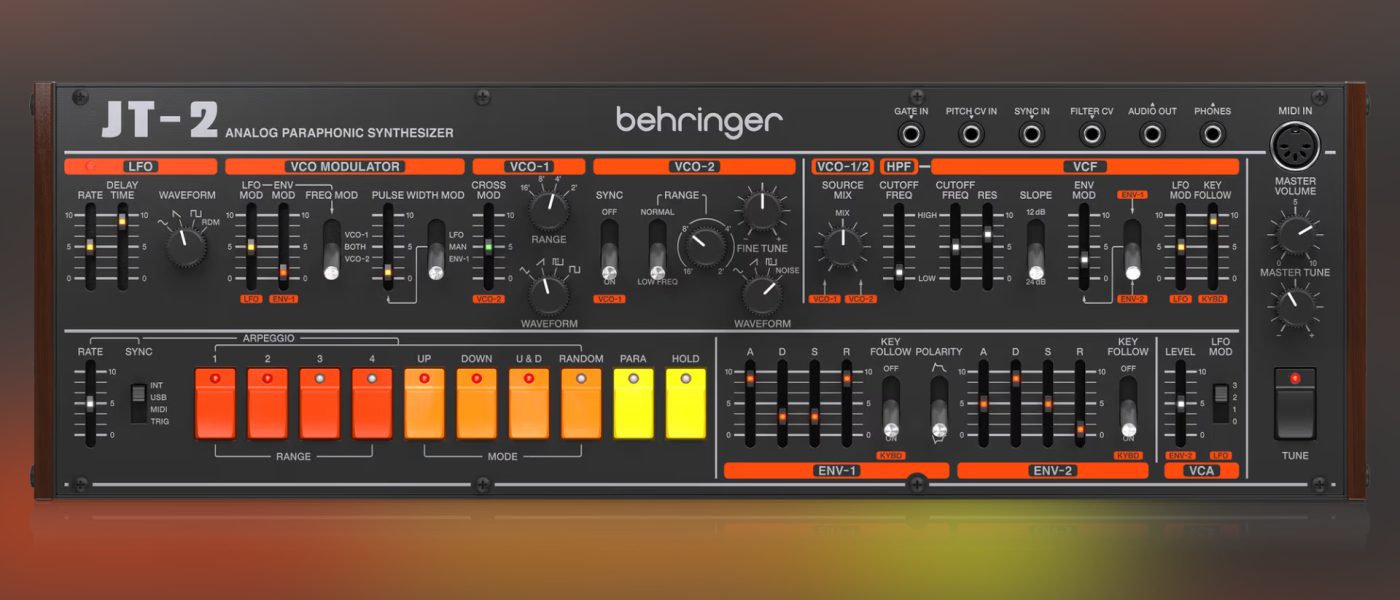
TL;DR: Behringer has released the JT-2, a paraphonic analog synthesizer that extracts a single voice from the legendary Roland Jupiter-8 and stuffs it into a compact Eurorack module. Available now in the EU for €179, it offers dual VCOs, a resonant filter, arpeggiator, and basic CV/gate connectivity — but no patch memory and only paraphonic voice architecture.
- Behringer JT-2 is a paraphonic analog synthesizer based on a single voice of the Roland Jupiter-8, now shipping in the EU at €179 (Thomann).
- Features: 2 VCOs with cross-modulation and sync, low-pass/high-pass filter, two envelopes, LFO, autotune, and a syncable arpeggiator with Jupiter-style colored buttons.
- Eurorack-friendly with patch points: gate in, pitch CV in, sync in, filter out, and a phone socket; rear panel includes 6.3mm audio out, MIDI thru, and USB.
- No patch memory — a potential dealbreaker for some, though Eurorack users typically accept this limitation.
- Behringer is also working on a full keyboard version of the Jupiter-8 (dubbed “Bupiter-8”), which may appeal to those wanting more polyphony.
Reading time: 5 min
Want more synth news before your next coffee break? Join the Noxal newsletter — no spam, just gear worth knowing about.

What Is the Behringer JT-2?
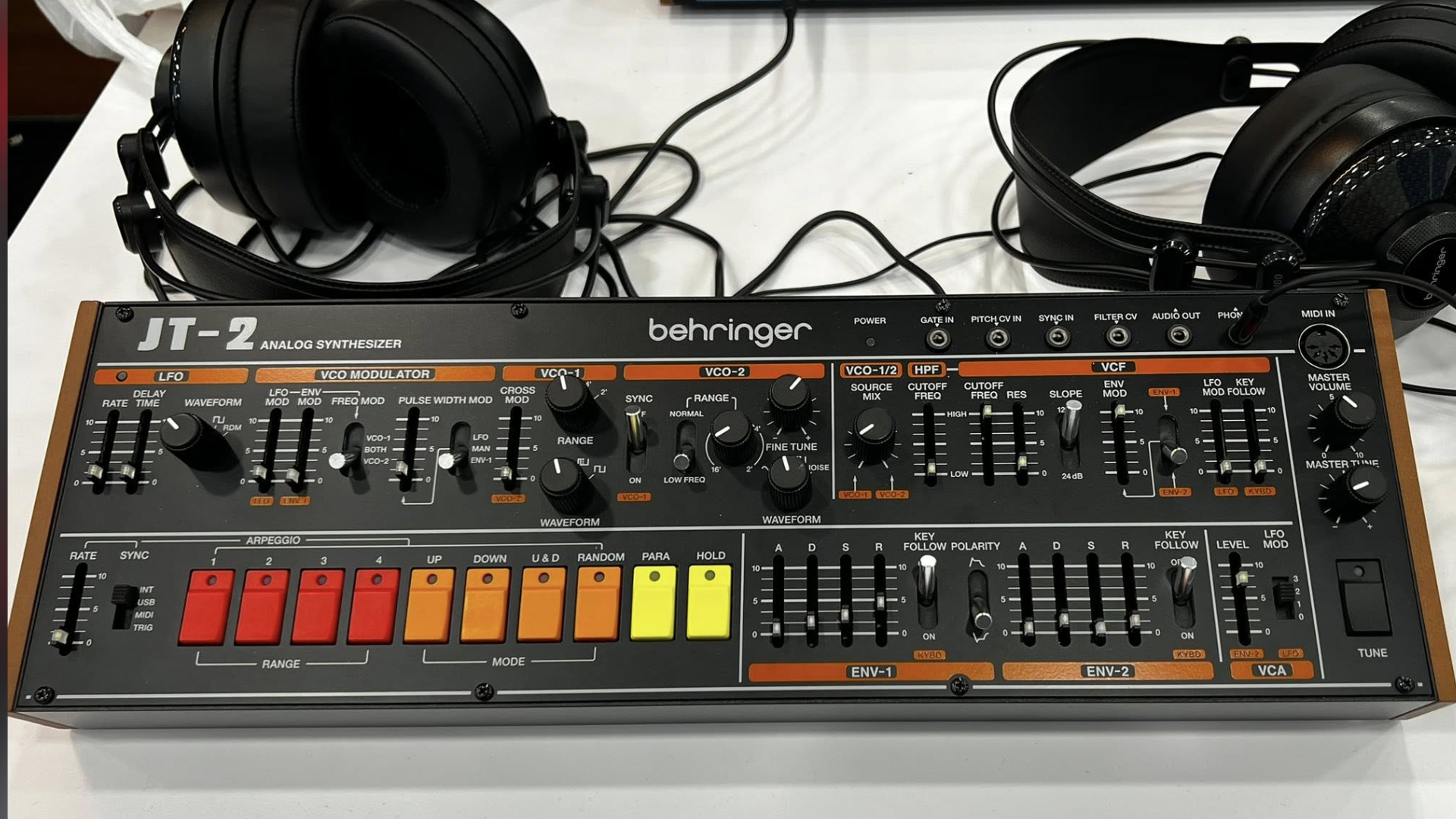
Behringer, the company that has built a reputation on making affordable clones of classic synthesizers, has done it again. The JT-2 is a paraphonic analog synthesizer that takes a single voice from the Roland Jupiter-8 — the 1981 polysynth that still commands four-figure prices on the used market — and squeezes it into a Eurorack module. At €179, it’s less than the price of a decent dinner out for two in most European capitals, and it promises that unmistakable Jupiter-8 tone.
We at Noxal have seen this story before: Behringer announces, teasers fly, chips don’t arrive, and we all wait. But this time, the JT-2 is actually shipping. The first batch landed in the EU via Thomann in mid-April 2026, and it’s available now. That’s refreshingly concrete for a company that has a reputation for vaporware. The unit was shown in final form at NAMM 2026, alongside the JN-80, and it seems the production line is finally humming.
What Makes It Interesting?
Let’s be honest: a single-voice Jupiter-8 is a weird proposition. The original Jupiter-8 is beloved for its lush, polyphonic pads and its ability to split into two separate synths. Taking just one voice feels like ordering a gourmet pizza and only eating the crust. But Behringer has added a twist: paraphony. That means you can play multiple notes, but they all share the same filter and envelope. It’s not true polyphony, but it gives you some chordal flexibility without needing a full voice per note.
The JT-2’s voice core consists of two VCOs with cross-modulation and sync, a resonant low-pass and high-pass filter, two envelopes, and an LFO. There’s also an autotune function — bless you, Behringer, for saving us from tuning drift — and a syncable arpeggiator controlled by those satisfyingly clicky colored Jupiter-style buttons on the front panel. It’s a compact, utilitarian package that screams “I want the Jupiter sound but I live in a Eurorack case and have a day job.”
Key Specs and Connectivity
The JT-2 is built for Eurorack, but it’s also a standalone unit with its own housing. On the front panel, you get: master volume, master tune, MIDI input, and patch points for gate in, pitch CV in, sync in, filter out, and a phone socket. The rear panel offers a 6.3mm audio output, MIDI thru, and USB. It’s a modest selection of patch points — we’d have liked a few more, like an extra CV out or a dedicated envelope output — but for the price, it’s serviceable.
One notable omission: there is no patch memory. That’s standard for Eurorack, where patching is the whole point, but it limits the JT-2’s appeal for those who want to save and recall sounds. You’ll be twisting knobs every time you power it on. Some call that “hands-on.” Others call it “annoying.” We call it a missed opportunity for a synth that could have been a great desktop companion.
Market Context and Who Is It For
At €179, the JT-2 is competing with a crowded field of affordable analog synths. The Korg Volca series, the Arturia MicroFreak, and Behringer’s own Model D and Neutron all sit in similar price brackets. What sets the JT-2 apart is its Jupiter-8 lineage. If you’ve ever wanted that specific sound — the creamy filters, the punchy oscillators — without spending thousands, this might be your ticket.
Who is it for? Eurorack enthusiasts who want a Jupiter flavor in their rack. Producers who want a dedicated monosynth for basslines and leads and don’t mind the lack of patch memory. And collectors who want to say they own a piece of the Jupiter legacy without selling a kidney. It’s not for everyone — if you need polyphony or patch recall, wait for the full keyboard version Behringer is reportedly working on (the “Bupiter-8”). But if you’re okay with paraphony and a bit of knob-twiddling, the JT-2 is a solid, affordable entry point.
The Elephant in the Room: Paraphony and Patch Memory
We can’t ignore the elephant in the room: the JT-2 is paraphonic, not polyphonic. That means you can play multiple notes, but they all go through the same filter and envelope. It’s a compromise that allows Behringer to offer a Jupiter-8 voice at a fraction of the cost, but it fundamentally changes how you interact with the synth. If you’re expecting true polyphonic pads, you’ll be disappointed. If you’re looking for a characterful monosynth that can occasionally play two notes, you’ll be fine.
And then there’s the patch memory situation. Eurorack users are used to this — you patch, you play, you unpatch, you lose the sound. But for a desktop synth that could be used standalone, the lack of patch memory is a significant limitation. We at Noxal would have loved to see at least a few memory slots for saving patches. It’s a feature that would have made the JT-2 a no-brainer for live performers and studio musicians alike. Instead, it’s a bit of a studio toy — fun, but not essential.
Frequently Asked Questions
Is the Behringer JT-2 polyphonic or paraphonic?
The JT-2 is paraphonic. It has a single voice from the Jupiter-8, meaning you can play multiple notes, but they all share the same filter and envelope. It is not true polyphony.
Does the JT-2 have patch memory?
No, the JT-2 does not have patch memory. This is standard for Eurorack modules, but it means you cannot save or recall sounds. You will need to dial in your settings manually each time you power it on.
What is the price and availability of the Behringer JT-2?
The Behringer JT-2 is available now in the EU for €179 at Thomann. Pre-orders in other regions are priced at $189/£159. It is currently shipping, so no more waiting for teasers.
Now if you’ll excuse me, I have to go tune my actual Jupiter-8 — yes, the original — because its oscillators have drifted into a completely different key. At least with the JT-2, autotune is included. Pass the coffee.