TL;DR: Arturia has released a Silver Edition of its AstroLab 61 stage keyboard, priced at €1,589. This comes alongside a major firmware update (v1.4.4) that adds support for Pigments 6 and MiniFreak V3, as well as improved mirroring between Analog Lab Pro and the hardware. It’s a curious colour choice that feels like a throwback to the silver hi-fi era of the 90s.
- New Silver Edition AstroLab 61 available now for €1,589 — a cosmetic refresh only, no hardware changes.
- Firmware v1.4.4 brings Pigments 6 and MiniFreak V3 support, expanding the already massive sound library.
- Effects and keyboard settings now fully mirror between Analog Lab Pro and AstroLab, streamlining stage workflow.
- Bugs squashed: sustain and hold no longer conflict, plus general performance improvements.
- Existing AstroLab owners get all firmware updates for free — no need to buy the silver paint job.
Reading time: 4 min
Want more synth news before your next coffee break? Join the Noxal newsletter — no spam, just gear worth knowing about.

Silver Lining or Silver Lining?
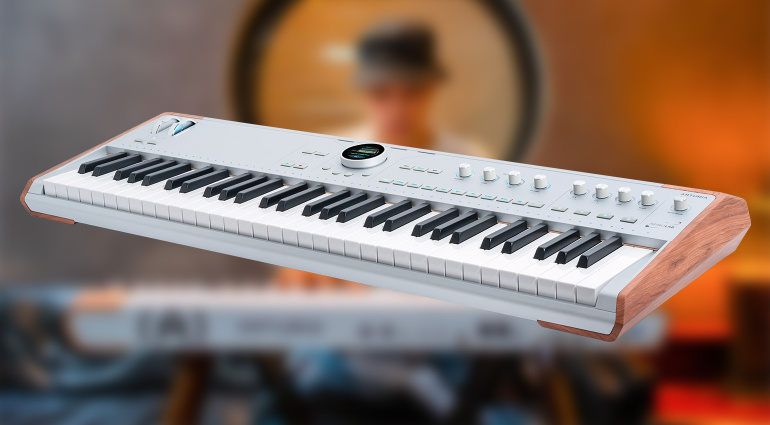
Let’s get the obvious out of the way: the new Silver Edition AstroLab 61 is, well, silver. Arturia has taken the existing 61-key version of their “Analog Pro in a Box” stage keyboard and given it a metallic makeover that screams 1995. I half-expect it to come bundled with a Discman and a pair of Jnco jeans. At Noxal, we have opinions on colour — and this one feels like a marketing team’s nostalgia trip rather than a user-driven choice.
The silver chassis is a bold departure from the original black and blue scheme, and it’s certainly… noticeable. But is it desirable? We’ve seen countless forum threads begging for a black version of the AstroLab, echoing the elegant KeyLab Mk.3 88 with its wooden end cheeks. Instead, Arturia went full retro-futurism. The silver paint is well-executed — it’s a satin finish that catches stage lights nicely — but I can’t shake the feeling that it’s a solution in search of a problem. Still, if you’re a fan of 90s aesthetics or your studio is already a homage to silver Korg Tritons, this might be your jam.
What’s Really New: Firmware 1.4.4
Thankfully, the firmware update that accompanies this launch is far more substantial than a coat of paint. Version 1.4.4 (officially released after a brief, accidental leak) brings Pigments 6 and MiniFreak V3 into the AstroLab fold. For those unfamiliar, Pigments is Arturia’s flagship software synth — a wavetable, granular, and virtual-analog powerhouse. Having it playable from a weighted 61-key bed with proper velocity control is a genuine treat, even if the AstroLab’s front panel remains a preset browser rather than a full programmer.
MiniFreak V3 is perhaps the more exciting addition. The MiniFreak hardware was already one of the most characterful digital synths Arturia has made, and its software replica now lives inside the AstroLab. That means you get all those hybrid oscillator modes, the quirky modulation matrix, and the beloved “Spice” and “Dice” randomisation engines — all accessible via the keyboard’s knob-per-function layout. The update also introduces full mirroring of effects and keyboard settings between Analog Lab Pro and the hardware, which means what you tweak on the computer shows up on the keyboard, and vice versa. No more double-checking settings before a gig.
Who Is This AstroLab Thing For?
At its core, the AstroLab is a stage keyboard that doubles as a hardware controller for Arturia’s vast software ecosystem. It’s not a standalone synth — you need Analog Lab Pro running on a computer or iPad to access its full potential. This makes it a curious beast: it’s not quite a workstation, not quite a controller, but something in between. The target audience is clear: gigging keyboardists who want thousands of sounds at their fingertips without hauling a rack of modules. The addition of Pigments 6 and MiniFreak V3 only sweetens the deal, offering sounds that range from pristine orchestral to gloriously broken digital.
But let’s be honest: if you’re a hardware purist who hates screens and menus, this isn’t for you. The AstroLab lives and breathes in the hybrid space. The 61-key semi-weighted action is decent — not quite as nice as the fully weighted 88-key version, but perfectly serviceable for organ, synth leads, and pads. The build quality feels solid, with metal chassis and smooth encoders. It’s a professional tool, through and through.
The Colour Debate and Market Context
The Silver Edition arrives at a time when Arturia’s design language is anything but predictable. The KeyLab Mk.3 series debuted with bold orange accents that turned heads. The PolyBrute 12 is a monolith of brushed metal and wood. So why silver now? It feels like a calculated move to capture a specific demographic — perhaps the same people who miss silver rack units or who associate the colour with reliability and “professional” gear. I’m not entirely convinced, but I’m also not the one doing market research.
Priced at €1,589, the Silver Edition is exactly the same as the standard black model. No premium for the retro finish. That’s fair, but it also means you’re paying for paint, not performance. If you already own an AstroLab 61, there’s zero reason to upgrade unless you really, really want that silver chassis. The firmware update is free for everyone. So the real question is: does a silver keyboard make you play better? Probably not. But it might make you look cooler while you’re playing — and sometimes, that’s half the battle on stage.
Frequently Asked Questions
Is the Silver Edition AstroLab 61 any different from the standard version?
No. The only difference is the silver paint job. Internals, keybed, firmware, and connectivity are identical. The standard black version remains available at the same price.
Do I need to buy the Silver Edition to get the new firmware?
Absolutely not. Firmware v1.4.4 is a free update for all AstroLab owners. Just update Analog Lab Pro via the Arturia Software Centre, then use the update feature in Analog Lab to push it to the keyboard.
Can I use the AstroLab without a computer?
You can browse and play presets stored on the keyboard, but to load new sounds or access the full V Collection/Pigments library, you need Analog Lab Pro running on a computer or iPad. It’s a hybrid instrument, not a standalone workstation.
We at Noxal will be over here, sipping our third espresso of the morning, wondering if Arturia will ever release a “coffee stain” edition. Until then, at least the silver won’t show the fingerprints.