TL;DR: After three and a half years of teasing and delays, Behringer has finally opened orders for the AKS Mini, a pocket-sized clone of the iconic EMS VCS3/Synthi AKS. Priced at €119, the diminutive synth packs three VCOs, a resonant low-pass filter, a motion sequencer, and a reverb, all powered via USB-C. We at Noxal have learned to temper our enthusiasm for Behringer’s announcements, but this one looks genuinely fun—if you’re willing to wait a few more months for delivery.
- The AKS Mini is available to order now at €119, with deliveries expected in a few months—standard Behringer timeline.
- It features three VCOs (sawtooth and square waves), a resonant analogue low-pass filter, an LFO, a 16-step motion sequencer, and built-in reverb.
- Connectivity includes USB-C power, 5-pin MIDI input, and a 3.5mm TRS sync socket, but there’s no CV/gate—a notable omission for modular users.
- The touch-plate keyboard is mainly for programming the sequencer; for expressive playing, you’ll need an external MIDI controller.
- Behringer first teased this in January 2023; the final design looks nearly identical to those early renders, including the analogue joystick and blue-metallic detune knob.
Reading time: 4 min
Want more synth news before your next coffee break? Join the Noxal newsletter — no spam, just gear worth knowing about.

What is the AKS Mini?
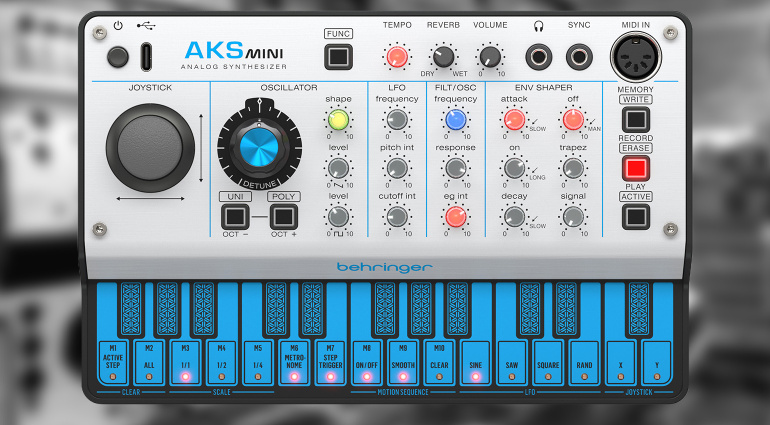
Behringer has been on a cloning spree for years, but the AKS Mini is something a little different. Instead of a full-sized replica of the legendary EMS VCS3 (or its portable sibling, the Synthi AKS), they’ve shrunk everything down into a Volca-sized chassis. The result is a pocketable synth that aims to bottle the wild, unpredictable analogue character of the original in a package that costs less than a night out.
At its heart are three VCOs, each offering sawtooth and square waveforms. There’s a resonant analogue low-pass filter, an LFO, and a built-in reverb—a welcome addition for a synth this size. The control layout is a deliberate homage to the VCS3’s iconic, intimidating matrix panel, but simplified into knobs and a joystick. The standout feature is the large blue-metallic detune knob, which lets you create those rich, detuned oscillator chords that defined so many classic recordings.
The touch-plate keyboard is a direct nod to the Synthi AKS, but let’s be honest: it’s more of a sequencer input than a performance tool. For proper playing, you’ll want to plug in a standard MIDI controller. The 16-step motion sequencer can record parameter changes, which is where the real fun begins—twiddle those knobs live, and the AKS Mini will remember every wobble and filter sweep.
The Long Road to Release
We at Noxal have a policy: we don’t get excited about Behringer announcements until we see a shipping confirmation. The AKS Mini was first shown in January 2023 with a promised summer release and a $99 price tag. Then came the chip shortage, supply chain woes, and the deafening silence of a company that had moved on to a dozen other clone projects. When Behringer teased the final version again in July 2026, I’ll admit I rolled my eyes.
But here we are. Orders are open, the price has crept up slightly to €119 (roughly $125), and the design is virtually unchanged from those early renders. The analogue joystick remains, as does the detune knob. The question is whether Behringer can actually deliver units in a timely manner. If history is any guide, you’ll be waiting a few months after placing your order. But for the price, the wait might just be worth it—especially if you’ve always wanted a VCS3 but couldn’t justify the mortgage-level cost of a vintage unit.
Key Specs and Connectivity
Let’s get technical. The AKS Mini runs on USB-C power—no batteries, no wall wart, just a cable to your laptop or a phone charger. That’s both a blessing and a curse: it keeps the synth slim, but it tethers you to a power source. For a “pocket” synth, I’d have loved a rechargeable battery, but at this price point, compromises are inevitable.
Connectivity includes a 5-pin MIDI input (good for traditionalists) and a 3.5mm TRS sync socket (likely Korg-compatible, given Behringer’s habit of borrowing standards). There’s no CV/gate, which will disappoint modular users hoping to patch the AKS Mini into a Eurorack system. The USB-C port is labeled for power only, so don’t expect MIDI over USB. The reverb is a nice touch—it’s not specified whether it’s analogue or digital, but given the price, I’d bet on a digital algorithm. Still, it’s a reverb on a €119 synth, and that’s a win in my book.
The trapezoid envelope—a VCS3 hallmark—makes an appearance, and it’s as complex as ever. It’s not the most intuitive ADSR, but it rewards experimentation. The 16-step motion sequencer is straightforward: record notes, then overdub parameter changes. It’s not a DAW replacement, but it’s perfect for live jams and happy accidents.
Market Context and Who It’s For
Behringer’s AKS Mini enters a crowded field of pocket synths. Korg’s Volca series dominates the sub-$200 space, with the Volca Keys, FM, and Bass offering similar form factors at similar prices. The AKS Mini’s unique selling point is its direct lineage to the VCS3—a synth that costs thousands on the secondhand market. If you want that squelchy, unstable, psychedelic sound without selling a kidney, this is your best bet.
Who should buy one? Experimental musicians who love unpredictable analogue textures. Producers who want a hands-on, knob-per-function sequencer for sketching ideas away from the computer. And yes, Behringer haters who secretly want to try that VCS3 sound without compromising their principles—just buy it secondhand and pretend you didn’t.
Who should skip it? Anyone expecting a faithful VCS3 clone in terms of patching flexibility. The AKS Mini is a snapshot, not a full replication. If you need CV/gate, modular integration, or a playable keyboard, look elsewhere. Also, if you’re impatient, maybe wait until we actually see units in the wild. We at Noxal will be watching, and we’ll let you know the moment our coffee-stained hands get on one.
Frequently Asked Questions
Does the AKS Mini have CV/gate outputs?
No. The AKS Mini has a 5-pin MIDI input and a 3.5mm TRS sync socket, but no CV/gate jacks. If you want to integrate it with a modular system, you’ll need a MIDI-to-CV converter.
Can I use the touch keyboard to play melodies in real time?
Technically yes, but it’s not designed for expressive playing. The touch-plate keyboard is best suited for programming the sequencer or triggering simple notes. For proper melodic performance, connect an external MIDI keyboard.
When will the AKS Mini actually ship?
Behringer says orders are open now, but based on their track record, expect a delay of 2–4 months. We recommend ordering only if you’re comfortable waiting—or if you enjoy the thrill of tracking a shipping number that doesn’t move for weeks.
I’ll be honest: I’ve already pre-ordered one, and I’m planning a coffee-fueled live stream the moment it arrives. If the AKS Mini sounds even half as good as the original VCS3, it’ll be worth the wait—and the caffeine crash.