TL;DR: OXI Instruments has dropped the biggest firmware update yet for the E16 MIDI controller, version 1.0.0, which completely overhauls the built-in looper with tempo-synced modes, adds a desktop configuration app, and introduces Lua scripting. The €409 16-knob controller—already beloved for its morphable snapshots and 12-layer grouping—just became a much more serious tool for live looping and DAW integration.
- The Looper now offers three modes: original No Sync, new Free Sync (auto-quantized loop capture), and Fixed Sync (count-in with locked loop lengths).
- A desktop OXI App finally lets you configure, back up, and share presets, scenes, and pages without menu-diving on the hardware.
- Lua scripting support opens the door for user-customized behaviors and deeper integration with specific synths and DAWs.
- The E16 remains available in standard (smooth encoders) and limited edition Detended (clicky knobs) versions, both at €409 including VAT.
- This update is free and available now via the OXI App—no hardware revision required.
Reading time: 5 min
Want more synth news before your next coffee break? Join the Noxal newsletter — no spam, just gear worth knowing about.

What’s New in the E16 v1.0.0 Update
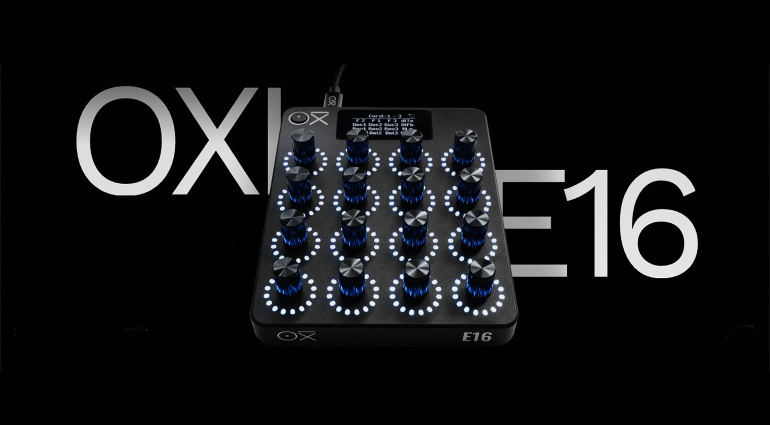
OXI Instruments has a habit of making good gear better after it ships. The ONE MKII sequencer got regular feature drops, and now the E16 MIDI controller is following the same playbook. Version 1.0.0 is what OXI is calling “the biggest update yet,” and for once the marketing copy isn’t hyperbole. We’re looking at a fundamental rework of the looper engine, the introduction of a desktop companion app, Lua scripting, SysEx communication, and a cleaner overall interface.
The update is free, available now, and applies to both the standard E16 and the limited edition Detended version. If you already own one, you’re getting a new controller for the price of a download. If you don’t, this might be the moment to reconsider that blank space on your desk.
The Looper Rebuild: From Toy to Tool
The original E16 looper was functional but limited. It recorded MIDI CC data and played it back in a loop, but without any tempo awareness. You could make some interesting drone textures or chaotic parameter sweeps, but syncing it with a DAW or hardware sequencer required manual start-stop finesse. Version 1.0.0 changes that entirely by introducing two new sync modes alongside the original “No Sync” behavior.
Free Sync is the most interesting addition. You record freely—no count-in, no rigid bar constraints—and the looper automatically snaps your loop to the nearest beat or bar based on quantization settings. This is brilliant for capturing spontaneous gestures without breaking your flow. Fixed Sync, meanwhile, gives you a count-in and forces you to record within predetermined loop lengths. It’s less forgiving but more predictable, which is exactly what you want when building structured arrangements.
The new looper effectively turns the E16 into a performance instrument rather than just a control surface. You can now layer looping MIDI phrases, morph between them with snapshots, and sync everything to your master clock. For live electronic music, that’s a serious upgrade.
Why the Desktop App Matters
We at Noxal have a complicated relationship with desktop configuration apps. Some are essential (see: Elektron’s Overbridge), some are afterthoughts that gather dust. The OXI App falls into the former category. It lets you configure presets, scenes, pages, and backups from your computer, then push them to the hardware. Considering the E16 has 12 pages with 16 controls each, that’s a lot of parameter mapping to do without a screen larger than the built-in OLED.
The app also unlocks Lua scripting, which is where things get properly interesting. Lua is a lightweight scripting language that’s already used in gear like the Organelle and the Norns. For the E16, it means you can write custom behaviors: conditional mappings, DAW-specific integrations, even generative MIDI patterns. OXI hasn’t released a scripting API document yet, but the potential is obvious. If you’re the type of person who enjoys writing custom Python scripts for your MIDI router, you’ll feel right at home.
SysEx communication is another welcome addition. It opens up deeper integration with hardware synths that support SysEx parameter changes—think older Roland gear, Yamaha DX-series, or boutique modular controllers. The E16 is no longer just a CC box; it’s a proper bidirectional control surface.
Who Should Buy the OXI E16 in 2026
The E16 was already a clever controller when it leaked in September 2025. With 16 endless encoders, LED rings, dual MIDI outs, Bluetooth, and two virtual USB ports, it covered a lot of ground. The Detended limited edition added clicky encoders for tactile feedback, which we suspect will become the more coveted version once stock runs out.
At €409, it sits in an interesting price bracket. It’s more expensive than a used Faderfox UC4 but cheaper than a fully loaded MIDI Fighter. What you’re paying for is the software ecosystem: the snapshot morphing, the grouping macros, the scripting, and now the synced looper. If you’re a live performer or a studio tinkerer who wants to control multiple synths and effects without menu-diving, the E16 is a strong contender. If you just need a few knobs for Ableton macros, you can spend less and get less.
The biggest competition is probably the new Arturia MiniLab 3 or the Novation Launch Control XL, but neither offers 16 encoders with per-knob LED feedback, snapshot morphing, or Lua scripting. The E16 is a niche tool, but it’s a very well-executed one.
Frequently Asked Questions
Does the OXI E16 work as a standalone MIDI looper without a computer?
Yes. The looper runs on the hardware itself and can be synced to an external MIDI clock from your DAW or hardware sequencer. You don’t need the desktop app running for the looper to function—just power and a MIDI connection.
Is the Lua scripting available now, or is it coming later?
Lua scripting support is included in the v1.0.0 firmware update, but OXI has not yet published a full scripting API reference. Early adopters can experiment, but expect the documentation to arrive in a follow-up release within the next few weeks.
Can I use the Detended (clicky) encoders for the looper functions?
Absolutely. The limited edition Detended version uses tactile encoders with physical detents, which many musicians prefer for step-based parameter changes. The looper modes work identically on both versions—the only difference is the feel of the knobs.
I’ll be honest: I spent more time than I’d like to admit just looping pitch bend messages into a Korg Minilogue while sipping a third espresso. The E16 made it feel productive. That’s the mark of good firmware.