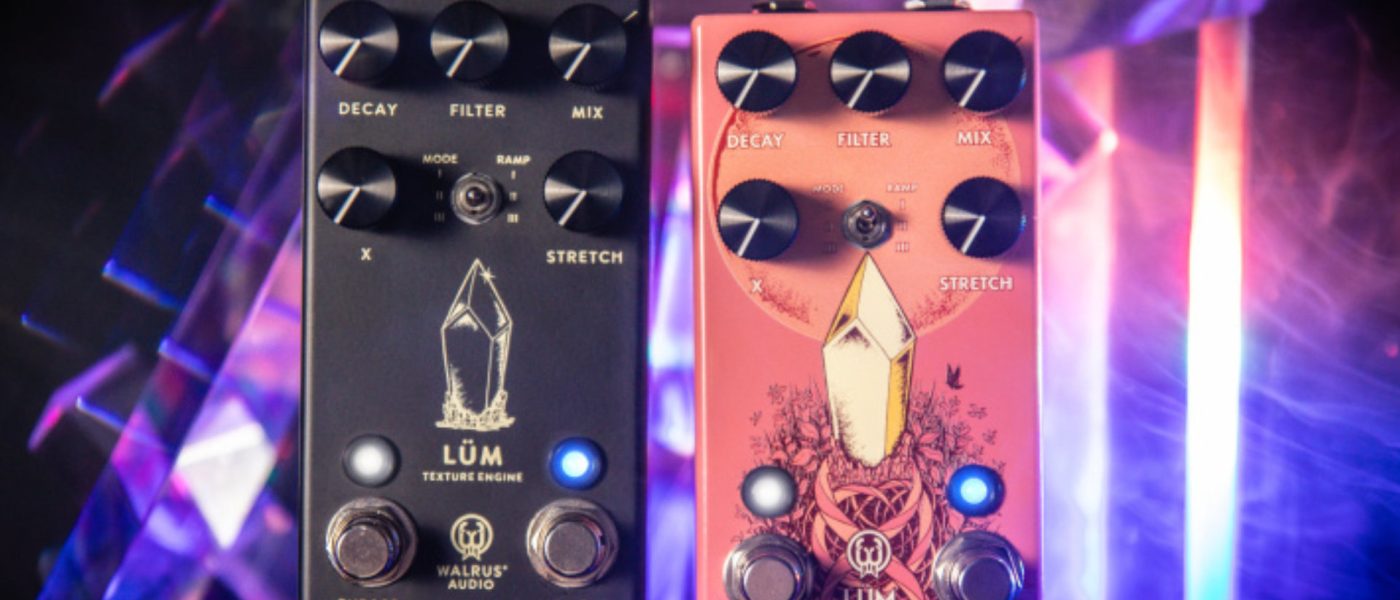
TL;DR: Walrus Audio has brought back the Lüm granular textural reverb pedal as a regular production model after overwhelming demand following its limited-edition run. It combines elements from the Slö, Lore, and Fable pedals into a single unit, now available in black and guava gloss finishes for $279.99.
- Lüm merges granular synthesis and reverb from three previous Walrus Audio pedals (Slö, Lore, Fable) into one pedal.
- It features three distinct modes: Grain Cloud, Grain Verb, and Forward-Reverse Verb with independent controls.
- Momentary automation, ramp function with adjustable glide times (10ms–5000ms), and three onboard presets with smooth crossfading.
- Now a regular product in two colors (black and guava gloss) after a limited-edition release that sold out.
- Priced at $279.99/€299 and available now.
Reading time: 4 min
Want more synth news before your next coffee break? Join the Noxal newsletter — no spam, just gear worth knowing about.

What is the Lüm Pedal?

Walrus Audio has a habit of creating beautiful, textural reverbs that sound like they were designed by someone who spends weekends watching clouds drift by. The Lüm is their latest attempt to bottle that aesthetic, and this time it’s sticking around. Originally released last September as a limited-edition experiment, the pedal combined the DNA of three beloved Walrus pedals: the Slö, Lore, and Fable. It sold out quickly, and after enough pleading from the synth-and-guitar community, Walrus has brought it back as a regular production model.
If you missed the first run, don’t worry. The Lüm now comes in two new colors: black (for the minimalists) and guava gloss (for those who want their pedalboard to look like a tropical fruit). The core concept remains the same: take your audio signal, fracture it into tiny “grains,” and wrap those grains in different washes of reverb. The result is sporadic, atmospheric textures that can turn a simple chord into an evolving soundscape. At $279.99, it sits comfortably in the premium pedal range, but given what it offers, it’s a reasonable ask for anyone who wants serious granular power without diving into Eurorack.
The Three Modes in Detail
The Lüm offers three distinct modes, each drawing from a different Walrus pedal lineage. Mode 1 is Grain Cloud, which gives you dual granular taps powered by a feedback delay line. The X knob controls grain size—essentially how frequently you hear the “glitches” that make granular synthesis so addictive. It’s like listening to a glacier calve in slow motion.
Mode 2 is Grain Verb, which combines dual granular taps with a reverb algorithm tank. Walrus describes it as “grains taking a bath in reverb,” and I can’t think of a more accurate description. Again, the X knob adjusts grain size, but here the reverb adds a lush, spacious quality that makes the glitches feel less like errors and more like intentional art.
Mode 3 is the Forward-Reverse Verb, lifted directly from the Lore pedal. It runs a forward reverb algorithm into a reverse reverb algorithm, creating that classic “ghost in the machine” effect. The Stretch knob controls the rhythmic interaction between the two reverbs, while X controls the reverse reverb decay. I’ve spent hours with the Lore pedal coaxing out horror-movie textures, and the Lüm captures that same unsettling beauty. Each mode also includes a tweakable filter, decay, and dry/wet mix, so you’re not locked into anything.
Key Specs and Features
Beyond the three modes, the Lüm has a few tricks that elevate it above a simple three-in-one pedal. The Stretch engine globally shifts the sample rate from 0.5x to 2x speed, which dramatically alters the behavior of the granular and reverb engines. Dial it down for slow, murky textures or crank it up for chaotic, pitch-shifted glitches.
Then there’s the momentary control—a feature I wish more pedals had. Hold down the Moment switch, and you can automate any one of the five knobs. It turns the pedal into an expressive performance tool without requiring you to be a contortionist. The ramp function adds an adjustable glide between 10ms, 1000ms, and 5000ms, giving you smooth transitions or abrupt shifts depending on your mood. Two bypass modes (trails or instant cut) let you decide how the effect decays when you switch it off.
Presets are stored onboard in three slots (red, green, blue), and here’s the clever part: switching presets doesn’t cut the effect abruptly. Instead, it crossfades smoothly to the next one. This is a small detail, but in a live or studio setting, it can be used creatively—imagine morphing from a subtle shimmer to a full-blown granular explosion without a hard edit. It’s the kind of thoughtful design that separates Walrus from the pack.
Market Context and Who It’s For
Granular synthesis is having a moment. Just yesterday, we reported on the Dobbo granular pedal from Butterfly Effects, and now Walrus drops the Lüm. The competition is heating up, but the Lüm has a distinct advantage: it’s not trying to be everything. It focuses on reverb-centric granular textures, which is exactly what most guitarists and synth players want when they reach for an ambient pedal.
Who is this for? If you already own a Slö, Lore, or Fable, you might not need the Lüm—though having all three in one box with presets and momentary control is tempting. If you’re new to Walrus or want a single pedal that covers the ground of three, this is a no-brainer. It’s also ideal for anyone who finds Eurorack granular modules too complex or expensive. The Lüm gives you that same fractured, unpredictable sound in a compact, stompbox format that works with synths, guitars, or even drum machines.
At $279.99, it’s not cheap, but it’s less than buying two of the three pedals separately. And given Walrus’s build quality and the fact that it’s now a regular product (no limited-edition FOMO), you can take your time deciding. But don’t wait too long—good gear has a way of disappearing.
Frequently Asked Questions
Can the Lüm be used with synthesizers?
Absolutely. While it’s marketed as a guitar pedal, the Lüm works perfectly with any line-level instrument, including synthesizers. Just be mindful of the mono input and output—if you need stereo, look elsewhere, but for creating atmospheric textures, it’s fantastic.
How does it compare to the Slö, Lore, and Fable individually?
The Lüm takes the core algorithms from each pedal and combines them into one unit. You lose some of the extended features of the individual pedals (like the Slö’s extra modulation options), but you gain the ability to switch between all three modes, save presets, and use the momentary automation. It’s a trade-off, but a worthwhile one if you want versatility over depth.
Can I use the Lüm with MIDI for preset recall?
No, the Lüm does not support MIDI. Presets are stored onboard and selected via the footswitch. If you need MIDI-controlled preset switching, you’ll have to look at Walrus’s MAKO series or other manufacturers. For live use, the three onboard presets with crossfading should cover most needs.
Now if you’ll excuse me, I need to go make another pour-over and figure out how to fit the Lüm onto a pedalboard that’s already full of reverb pedals. There’s always room for one more.