TL;DR: Frap Tools has released firmware v1.10 for its Magnolia synthesizer, adding full MIDI CC control over every parameter, MIDI over USB, user-definable velocity and aftertouch curves, and 200 additional patch slots. The update transforms an already innovative West Coast-inspired FM synth into a more flexible and deeply controllable instrument for both studio and stage.
- Full bidirectional MIDI CC implementation now covers every parameter — no more menu-diving for external control.
- MIDI over USB joins traditional DIN ports, making integration with modern setups seamless.
- 11 user-definable velocity and aftertouch curves allow tailored response for different playing styles.
- 200 extra user patch slots bring the total to a generous number for live sets and sound design sessions.
- Independently configurable LED brightness for each colour — because sometimes you need your synth to match your mood lighting.
Reading time: 5 min
Want more synth news before your next coffee break? Join the Noxal newsletter — no spam, just gear worth knowing about.

What is the Frap Tools Magnolia?
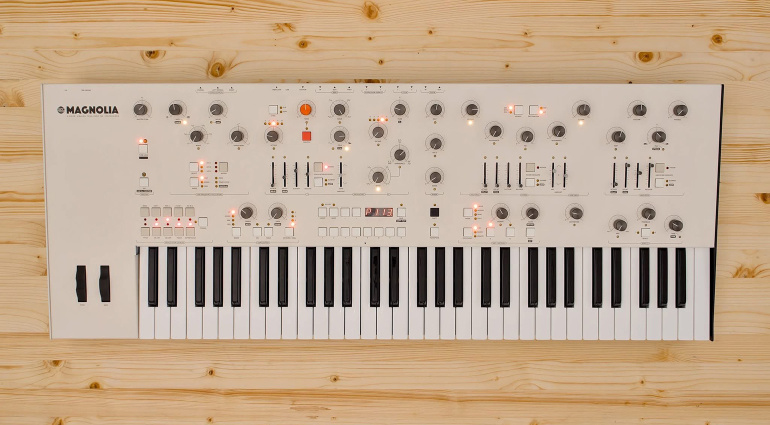
Let’s rewind to Superbooth 25. Before the first beer was poured, Frap Tools — known for their modular wizardry — dropped a bombshell: an 8-voice analog polyphonic synth with through-zero FM and a keyboard. The Magnolia wasn’t just another subtractive box. It was a love letter to West Coast synthesis, wrapped in a striking UI with machined-aluminium knobs and ARP-esque sliders.
At its heart, the Magnolia pairs two oscillators per voice: one “West Coast” oscillator with FM, wavefolding, and flip sync, and one “East Coast” oscillator with PWM. Two filters (high and low pass) can be frequency-modulated. Mod routing is refreshingly simple — press a source button, turn a knob. No micro menus. The 4-character screen suggests a menu-less philosophy that we at Noxal deeply respect.
When it launched at $4,199, the synth world took notice. It wasn’t cheap, but it was original. And originality, dear reader, is worth every penny in a market flooded with reissues.
Firmware 1.10: The Big New Features
Frap Tools has just released firmware v1.10, and while the changelog looks modest on paper, the impact is substantial. First, the synth now supports full bidirectional MIDI CC control over every parameter. That’s not a typo — every parameter. No more wondering if that obscure modulation destination can be tweaked via your DAW. It can.
MIDI over USB has also been added, alongside traditional DIN ports. This means you can connect directly to a computer or modern controller without a MIDI interface. Eleven user-definable velocity and aftertouch curves let you dial in exactly how the synth responds to your touch — from feather-light to hammer-fisted. And for those of us who care about aesthetics, the LEDs on the front panel now have independently configurable brightness for each colour. You’re welcome, Instagram.
Two hundred additional user patch slots bring the total memory to a healthy number, and bug fixes address issues with parameter retention after Static Display use and incorrect MIDI note playback. Updates are handled via a small executable on a connected computer. There are whispers of a future computer utility and librarian, but for now, the manual process works.
Why Full MIDI CC Matters
Let’s be honest: many synths claim “full MIDI CC” and then deliver a subset of parameters. Frap Tools has gone the other way. Every knob, slider, and modulation source can be addressed via MIDI. For studio producers using hardware sequencers or DAW automation, this is a game-changer. You can now record complex parameter sweeps, automate filter FM depth, or control wavefolding from your favourite controller.
Bidirectional CC means the synth also transmits its current parameter values back. This matters for patch recall and for visual feedback on controllers with motorised faders. It’s a small detail that separates pro-level gear from the rest. We at Noxal have seen too many synths that only send CCs one way. Frap Tools got it right.
The velocity and aftertouch curves are another thoughtful addition. Polyphonic aftertouch is rare enough, but having 11 curves to shape its response is a luxury. Pianists, organists, and drum machine enthusiasts can all find a curve that feels natural. It’s the kind of deep customisation that turns a good synth into a personal instrument.
Who Is the Magnolia For?
The Magnolia is not for everyone. At over $4,000, it sits firmly in the boutique tier. But if you make experimental electronic music, ambient, film scores, or anything that benefits from complex, evolving textures, this synth rewards exploration. The through-zero FM, wavefolding, and dual-filter architecture produce sounds that standard subtractive synths cannot touch.
It’s also for the modular refugee who wants a keyboard interface but refuses to compromise on West Coast techniques. Frap Tools has essentially packaged a Buchla-inspired voice architecture into a playable, polyphonic instrument. If you’ve ever drooled over a Make Noise Shared System but wished it had keys and polyphony, the Magnolia is your synth.
Finally, it’s for the collector who values originality. In a market where many new synths are variations on a 1970s theme, the Magnolia is genuinely new. It sounds unlike anything else. And with firmware 1.10, it’s now also deeply controllable. That’s a rare combination.
Frequently Asked Questions
Does the Magnolia support USB MIDI for both control and data transfer?
Yes. Firmware 1.10 adds MIDI over USB, allowing direct connection to computers and modern controllers. This complements the existing DIN MIDI ports. Firmware updates are also performed via USB using a small executable from Frap Tools’ website.
Can I control the Magnolia’s wavefolding and FM parameters via MIDI CC?
Absolutely. The update introduces full bidirectional MIDI CC control over every parameter, including wavefolding, FM depth, filter modulation, and more. You can automate and record parameter changes from any MIDI controller or DAW.
How many user patches can the Magnolia store after the update?
The firmware adds 200 additional user patch slots, bringing the total to a generous number. Combined with the new MIDI CC implementation, this makes the Magnolia far more practical for live performance and studio recall.
Now if you’ll excuse me, I need to figure out which of my 11 velocity curves makes me sound like I actually practiced that arpeggio. Coffee first, then curves.