TL;DR: French synth repair shop Miltone has opened pre-orders for the 4EXP, a hand-built, through-hole clone of the Oberheim Four Voice. At €9,990 (aluminum) or €11,990 (Tolex), it’s a no-compromise replica that uses reverse-engineered vintage components and ball-bearing knobs. First 50 units ship late 2026.
- Authentic through-hole replica of the Oberheim Four Voice, built from reverse-engineered original circuits and vintage components.
- Available in aluminum (€9,990) or Tolex (€11,990) chassis, with beige or black SEM modules; no keyboard included.
- Pre-orders open for first batch of 50 units, with a €1,500 refundable deposit; deliveries expected late 2026.
- Supports CV/Gate only for now, with MIDI integration in development.
- Includes printed service manual with full schematics, part lists, and calibration procedures—designed to be repairable for life.
Reading time: 4 min
Want more synth news before your next coffee break? Join the Noxal newsletter — no spam, just gear worth knowing about.

What Is the Miltone 4EXP?

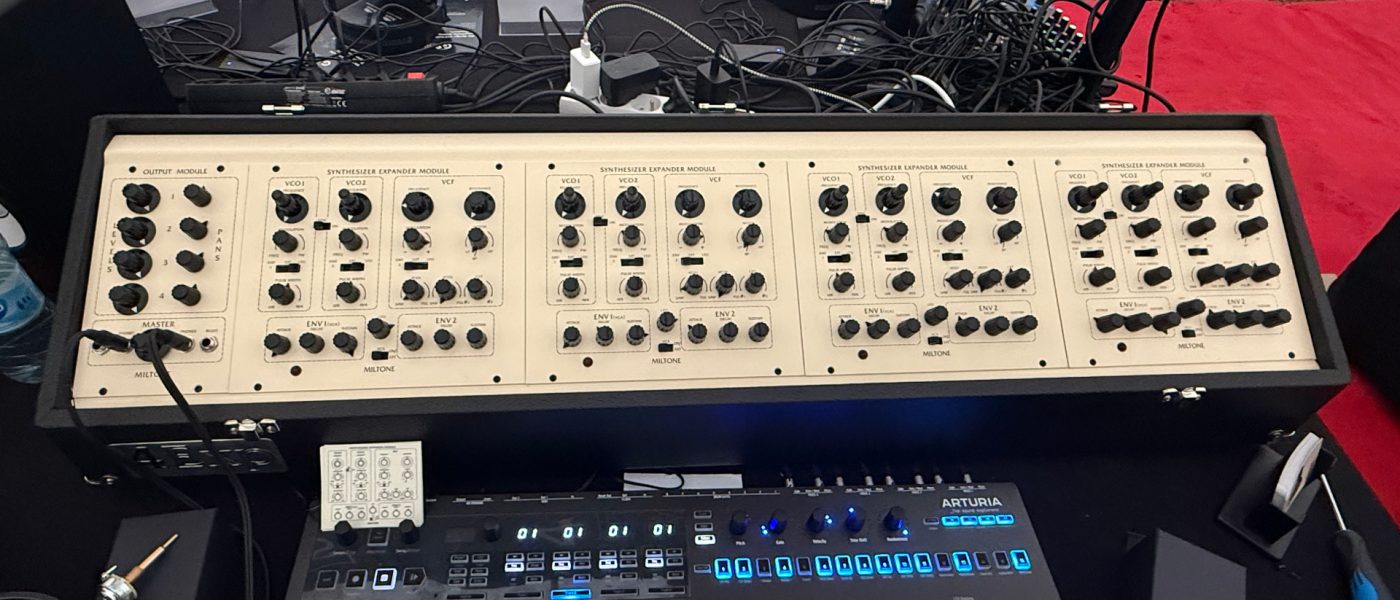
At Superbooth 2026, a familiar face among the modular chaos emerged from the Parisian repair bench of Miltone (known to vintage synth hoarders as Vintage Synths & Co). The 4EXP is not a reissue, not a Behringer-style cost-cutting exercise, and certainly not a quick cash grab. It is a meticulously hand-built replica of the Oberheim Four Voice synthesizer, designed to be indistinguishable from the original in sound, feel, and repairability.
Unlike NRSynth’s Quatuor, which debuted at SynthFest France 2026 with a keyboard, the 4EXP is an expander module—no keys, no arpeggiator, no sequencer. It’s a raw, four-voice SEM beast that communicates only via CV/Gate for now, though MIDI is in the pipeline. The result is a synth that feels less like a product and more like a time capsule from 1976, built with the obsessive precision of someone who has spent decades fixing the real thing.
I’ll be honest: when I first saw the price tag—€9,990 for aluminum, €11,990 for Tolex—I choked on my espresso. But then I remembered that a real Oberheim Four Voice can fetch €30,000 to €50,000 on a good day, assuming you can find one that hasn’t been desoldered into a smoking ruin by a well-meaning hobbyist. Suddenly, the math shifts from “absurd” to “niche but defensible.”
Build Quality and Authenticity
What separates the 4EXP from other clones—and I’m looking at you, Behringer—is the sheer lunacy of its fidelity. Miltone didn’t just copy the schematic and call it a day. They reverse-engineered the original potentiometers, including the ball-bearing mechanism that gives those Oberheim knobs their signature tactile feedback. They spent months sourcing vintage components where possible, and where that failed, they found modern equivalents that match the original’s electrical and sonic characteristics.
Every SEM voice is built using through-hole technology, just like the original. No surface-mount shortcuts, no cost-optimized layouts. The result is a synth that can be repaired with a soldering iron and a steady hand, and the included service manual (with full schematics, part lists, and calibration notes) practically begs you to open it up. As Miltone puts it, the 4EXP is designed to “last a lifetime and be easily serviceable.” It can also be used to expand an existing Oberheim Four Voice into an Eight Voice—a feature that will make vintage collectors weep with joy.
The interface is nearly identical to the original, save for the “Miltone” branding replacing “Oberheim.” You get the same knobs, the same switches, the same layout that made the Four Voice a legend. It’s like ordering a bespoke suit from a tailor who insists on using the same thread as the original Savile Row house—except the suit costs as much as a used car.
Key Specifications and Design Choices
Per voice, the 4EXP offers the classic Oberheim SEM architecture: a single VCO with sawtooth and pulse waveforms, a 4-pole low-pass filter, an ADSR envelope, and a VCA. No arpeggiator, no sequencer, no digital nonsense. It’s a brute-force analog voice that demands external sequencing or a keyboard controller to breathe life. Currently, CV/Gate is your only option, though MIDI is “under development” and should arrive before your first grandchild goes to college.
The chassis options are where things get interesting. The aluminum version (€9,990) is a sleek, industrial slab that will look at home in any modular rack. The Tolex version (€11,990) is covered in the same textured vinyl as vintage guitar amps—a choice that screams “I want my synth to look like it survived a 1970s arena tour.” Both versions are available with beige or black SEM modules, and each unit is individually numbered. The build-to-order model means you’re not getting a mass-produced widget; you’re getting a hand-calibrated instrument that took months to assemble.
Let’s talk about the elephant in the room: the price. €9,990 is not pocket change. But consider that a single original SEM module can cost €2,000–€3,000 on the used market, and a full Four Voice is a unicorn. The 4EXP is effectively four new-old-stock SEMs with a control section and a chassis, built by people who have spent decades repairing the originals. Is it worth it? If you have to ask, you’re probably not the target audience.
Market Context and Who It’s For
The 4EXP enters a crowded field of Oberheim clones. There’s the NRSynth Quatuor, the Shear Electronics OB-X, and the ever-present Behringer rumors. But Miltone’s approach is unique: they aren’t trying to make a more affordable alternative; they’re making a perfect replica for people who can’t find—or can’t afford—the real thing. This is the synth for collectors who want to expand their vintage Four Voice to an Eight Voice, or for studios that need a reliable, repairable workhorse that sounds exactly like the original.
Who is this for? Certainly not the bedroom producer on a budget. But for the professional studio with deep pockets, or the vintage synth enthusiast who has already exhausted the used market, the 4EXP is a compelling proposition. You get the sound, the feel, and the serviceability of an original, with the added benefit of a warranty and a support team that actually knows how to fix these things.
I’ve spent enough time in repair shops to appreciate the value of a synth that doesn’t require a second mortgage to maintain. The 4EXP is that synth. It’s absurdly expensive, but it’s also absurdly authentic. And in a world of cheap clones and disposable gear, that kind of commitment deserves a nod—even if it’s a nod from behind a coffee-stained desk while I calculate how many months of rent this would cost.
Frequently Asked Questions
Is the Miltone 4EXP a direct clone of the Oberheim Four Voice?
Yes, it is a component-for-component replica using through-hole technology and reverse-engineered parts, including the original ball-bearing potentiometers. The only branding difference is the “Miltone” name instead of “Oberheim.”
Can I play the 4EXP with a standard MIDI keyboard?
Currently, the 4EXP only accepts CV/Gate input. MIDI support is in development and expected to be added via a future update or hardware expansion, but no release date has been confirmed.
How does the 4EXP compare to the NRSynth Quatuor?
The NRSynth Quatuor includes a keyboard and is slightly more affordable, but the 4EXP offers a more authentic circuit replication using vintage components and through-hole technology. The 4EXP is also designed to be repairable and expandable into an Eight Voice system.
I’ll be honest—I’m typing this with a half-empty mug of cold brew and a deep sense of envy for anyone who can justify a €10,000 synth. But if you’re going to spend that much, at least you’ll get a synth that sounds like 1976 and can be fixed with a soldering iron and a good espresso.