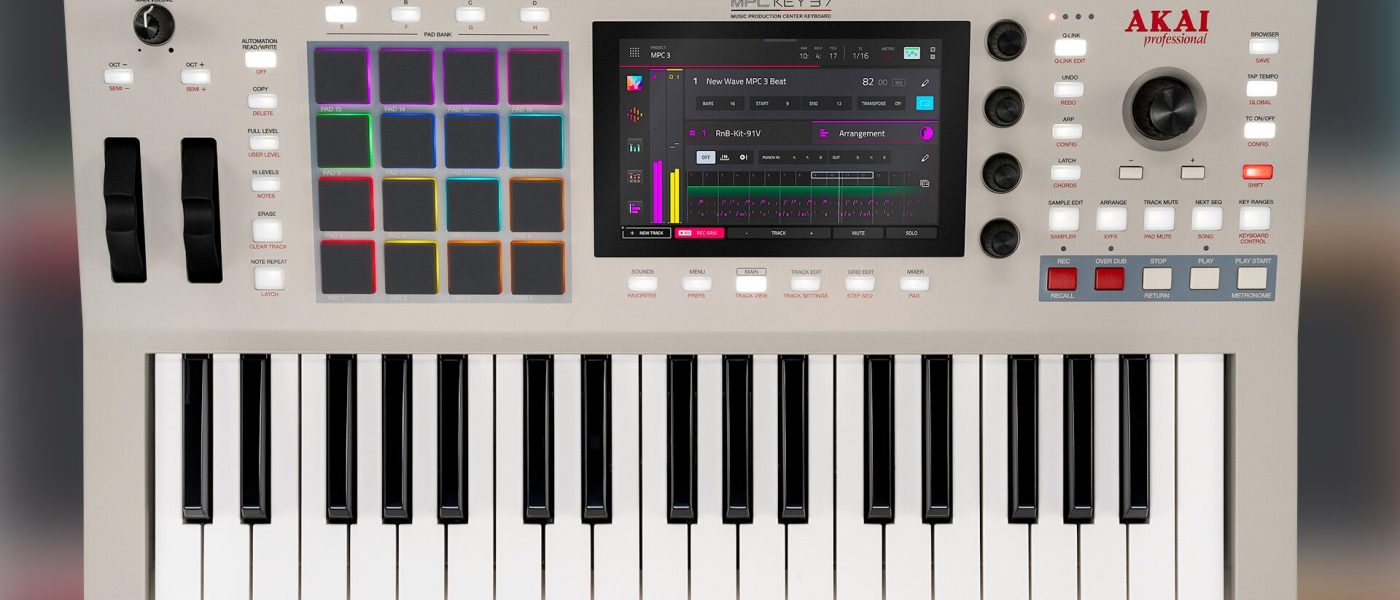
TL;DR: Akai has quietly dropped the MPC Key 37 G2, a second-generation keyboard workstation that finally addresses the original’s biggest complaint: being underpowered. It packs an 8-core processor, 4GB of RAM, and 64GB of storage, plus a new cream-white colorway that ditches the divisive red. At $999, it’s the standalone keyboard groove box the original should have been from day one.
- 8-core CPU and 4GB RAM — quadruple the processing power of the 2020-era MPC One+ internals that held back the original.
- 64GB internal storage (up from 16GB) supports up to 32 simultaneous plugin instruments and 16 stereo audio tracks in standalone mode.
- USB-C port enables 24×24 multi-channel audio streaming, 32 MIDI I/O channels, and direct sampling from phones or tablets.
- Cream-white color replaces the notorious red finish, hearkening back to the iconic late-’80s MPC aesthetic.
- Ships with MPC 3.9, Native Instruments Analog Dreams MPC edition, 13 instrument plugins, and six curated expansion packs.
Reading time: 4 min
Want more synth news before your next coffee break? Join the Noxal newsletter — no spam, just gear worth knowing about.

What is the MPC Key 37 G2?

Let’s be honest: when Akai dropped the original MPC Key 37 in that shade of red that screamed “look at me, I’m in a music video from 2004,” we at Noxal were cautiously optimistic. A keyboard MPC with 37 synth-action keys, aftertouch, and that touchscreen workflow? Yes, please. But then we saw the specs — the same 2020-era CPU and 2GB RAM from the MPC One+ — and we sighed into our third espresso of the morning. It was underpowered before it even hit the shelves.
The MPC Key 37 G2 is Akai’s mea culpa. It keeps the same chassis, the same keybed, the same 16 pads, and that lovely 7-inch multitouch display. But the interior has been gutted and rebuilt. The new cream-white color — inspired by the original MPCs from the late ’80s, not the red that made it look like a prop from a sci-fi B-movie — is a welcome change. It’s less conspicuous, more professional, and honestly, it just looks better in a studio next to a cup of black coffee.
This isn’t a redesign. It’s a rethinking of what a keyboard MPC should be. And if you ask me, it’s about damn time.
The Power Problem, Fixed
The original MPC Key 37 used the same CPU/RAM combo as the MPC One+, which was already showing its age when it launched in 2020. That meant loading times that tested your patience, project limitations that cramped your creativity, and a ceiling on how many plugins you could run before the whole thing started gasping like a marathon runner at mile 20. The G2 fixes that with an 8-core processor and 4GB of RAM — literally four times the memory of the predecessor.
What does that mean in practical terms? Faster load times, obviously. But more importantly, it means you can run up to 32 simultaneous plugin instruments and 16 stereo audio tracks in standalone mode. That’s not just a spec sheet flex; that’s the difference between “I’ll finish this in the DAW” and “I’ll finish this on the couch, on the train, or in my hotel room.” The internal storage has also jumped from 16GB to 64GB, giving you room for all those expansion packs you’ve been hoarding.
We at Noxal are not easily impressed by numbers on a page. But when we heard that the G2 can handle full professional productions entirely standalone, we felt a little flutter. The kind you get when you realize your favorite groove box has finally grown up.
Key Specs and Connectivity
The back panel looks familiar: main stereo output and input, eight CV/gate outputs, MIDI I/O, and so on. But there’s a new USB-C port that changes everything. It enables 24×24 multi-channel audio streaming, expanded to 32 MIDI I/O channels, and full host and device support over a single cable. Translation? You can now sample directly from your phone, tablet, or any external device via USB-C. No more hunting for adapters or fumbling with audio cables while your coffee goes cold.
Wi-Fi (2.4 GHz and 5 GHz, 802.11ac) and Bluetooth 5 are also built in. That means wireless file transfers, Ableton Live Control Mode, and seamless Ableton project import/export. The G2 is designed to bridge the gap between hardware creation and DAW finishing — a bridge that, frankly, many of us have been trying to build with duct tape and sheer willpower for years.
The 37-key synth-action keybed with velocity and aftertouch remains unchanged, which is fine. It’s not the best keybed in the world — it’s not going to replace your weighted controller — but it’s perfectly adequate for jamming out basslines, chords, and lead parts. The pitch and mod wheels on the left are where they should be, and the 16 MPC pads are as responsive as ever. If it ain’t broke, don’t fix it.
Software and Content
Out of the box, the MPC Key 37 G2 ships with MPC 3.9, which includes a full linear arranger, expanded arrangement workflows, integrated synthesis, and deeper DAW interoperability. There’s also an optional Pro Pack that unlocks Pro Stems Algorithm, Super Warp Time-Stretch, Clip Matrix, and pro-level plugin effects. But the real news is the included content.
Akai has partnered with Native Instruments to include the Analog Dreams MPC edition at launch — a premium collection of analog-inspired cinematic sounds. On top of that, you get 13 instrument plugins, six curated expansion packs (Acoustic Tools, Classic Drum Machines, Apollo Retro Kits, Marco Polo Lo-Fi Book, Gemini Future Classic Synths, and Orion Future Classic Workstations), and over 20GB of production-ready content. That’s enough to keep you busy for weeks, maybe months, depending on how much sleep you’re willing to sacrifice.
We at Noxal appreciate a company that gives you a complete palette from the moment you power on. No subscription, no “starter pack” that leaves you wanting more. Just a solid, professional tool with enough sounds to make your first track — and your hundredth.
Market Context and Who It’s For
At $999/£849/€999, the MPC Key 37 G2 sits in a curious spot. It’s more expensive than the MPC One G2 (which also got the same CPU/RAM upgrade), but you’re paying for that keyboard and the integrated workflow. It’s cheaper than the MPC Key 61, which offers more keys but the same processing power. For the producer who wants a standalone keyboard workstation that doesn’t require a laptop — and doesn’t want to mortgage their studio to afford it — this is a compelling option.
Who is this for? The beatmaker who’s outgrown their groove box and wants a keyboard. The producer who’s tired of staring at a DAW screen and wants to get back to hands-on creation. The live performer who needs a self-contained rig that can handle everything from pads to leads to full arrangements. It’s also for anyone who, like me, has been waiting for a keyboard MPC that doesn’t feel like it’s running on borrowed time.
Is it perfect? No. The synth-action keybed won’t please everyone, the lack of aftertouch polyphony might frustrate some, and the cream-white color will get dirty if you eat Cheetos while producing (please don’t). But it’s finally the instrument it should have been from the start. And at this price, it’s hard to argue with the value.
Frequently Asked Questions
Does the MPC Key 37 G2 work as a USB audio interface?
Yes. The new USB-C port supports 24×24 multi-channel audio streaming and 32 MIDI I/O channels, allowing it to function as a full audio interface for your computer or mobile device. You can sample directly from phones, tablets, and external gear over a single USB-C cable.
Can I use the MPC Key 37 G2 without a computer?
Absolutely. That’s the whole point. It runs MPC 3.9 in standalone mode, supports up to 32 plugins and 16 stereo audio tracks, and includes over 20GB of content out of the box. No computer required — just plug in power, headphones, and you’re making music.
Is the MPC Key 37 G2 compatible with the original MPC Key 37 expansions and projects?
Yes, it should be fully backward compatible. The G2 runs the same MPC operating system and supports all existing MPC expansions, plugin instruments, and projects. The additional processing power and RAM simply give you more headroom to run them all simultaneously.
We at Noxal will be testing the G2 with a fresh pot of pour-over and a deadline looming — because nothing says “professional review” like a caffeine-fueled all-nighter with a groove box that finally has the guts to keep up.