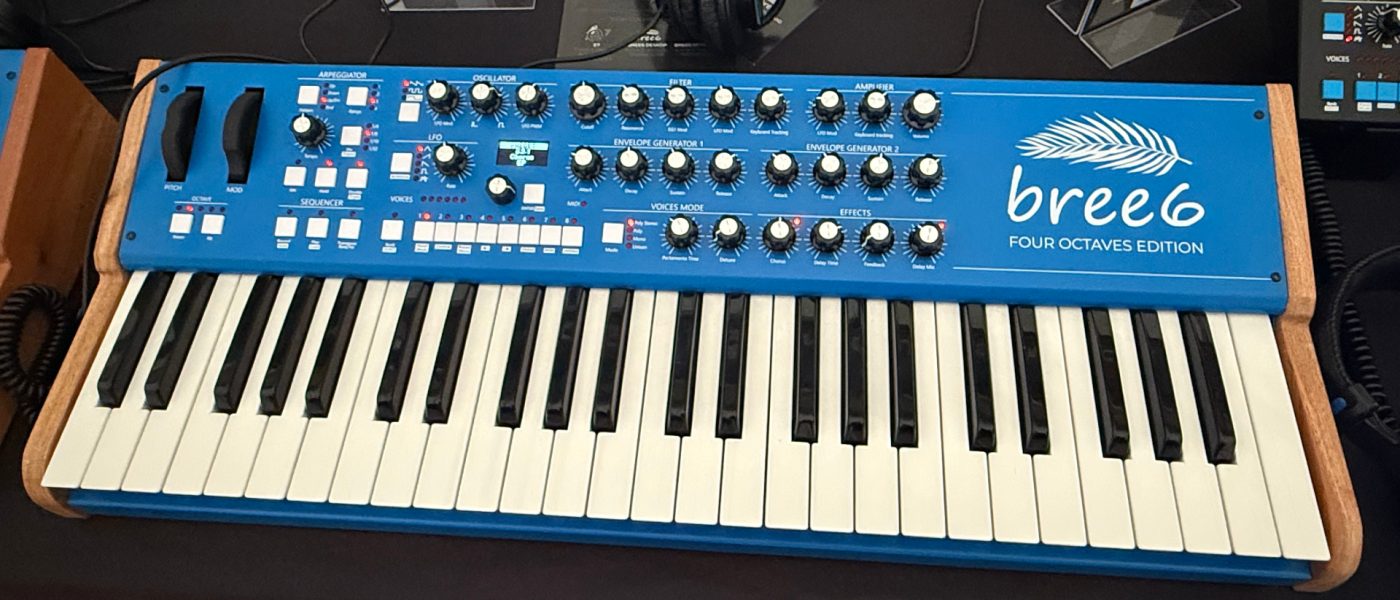
TL;DR: GS-Music has answered the call for a larger keyboard on its bree6 analog polysynth, launching a Four Octaves Edition at Superbooth 2026. Same 6-voice analog architecture, same knob-per-function interface, but now with four octaves of velocity- and aftertouch-sensitive keys. No price or release date yet, but the desktop and three-octave versions set expectations.
- Four octaves (49 keys) instead of three, with velocity and aftertouch, addressing community demand.
- Identical analog signal path: single VCO per voice, 24dB/oct ladder filter, two ADSRs, one LFO, plus 32-bit FX.
- 512 patch locations, arpeggiator, and sequencer; same hands-on interface as the three-octave version.
- Announced at Superbooth 2026; price and availability still TBA.
Reading time: 3 min
Want more synth news before your next coffee break? Join the Noxal newsletter — no spam, just gear worth knowing about.

What is the bree6 Four Octaves Edition?
We at Noxal have a soft spot for developers who actually listen. Guido Salaya of GS-Music is one of those rare beings. After releasing the bree6 as a desktop module and then a three-octave keyboard, he heard the feedback: “We want more keys.” So now, ahead of Superbooth 2026, we get the Four Octaves Edition.
This isn’t a new synth. It’s the same bree6 under the hood—six voices of analog polyphony, a single VCO per voice, a 24dB/oct lowpass ladder filter, two ADSR envelopes, one multi-wave LFO, and a 32-bit multi-FX processor with delay and chorus. The only change is the keyboard: four octaves (49 keys) with velocity and aftertouch, replacing the three-octave (37-key) version.
I’ll be honest, the three-octave keyboard felt cramped for a polysynth aimed at vintage lovers. Four octaves is the sweet spot—enough for two-handed playing without turning your studio desk into a battleship.
Why bother with four octaves?
Let’s be real: three octaves is fine for monosynths and bass lines. But for a polyphonic synth that wants to do pads, chords, and leads, you need room to spread your fingers. The original bree6 keyboard felt like a compromise—compact, but limiting. Guido clearly heard the grumbling on forums and at trade shows.
This update is a direct response to user demand. It’s not a new revision, not a “Mk II” with extra features. It’s just… more keys. And that’s okay. Sometimes the best update is giving people what they asked for. No menu-diving, no hidden menus—just a larger canvas for the same great sound engine.
We at Noxal appreciate that GS-Music didn’t inflate the price with gimmicks. It’s still the same hands-on experience: a front panel full of knobs and buttons, no screen to stare at, just you and the synth. The new edition keeps the arpeggiator and sequencer for those who like to build patterns without a computer.
Specs and sound
If you missed the desktop or three-octave version, here’s the rundown. The bree6 is a 6-voice analog polyphonic synth with a single VCO per voice—no crazy wavetables, no multi-oscillator wobble. It’s a classic architecture: VCO into 24dB/oct ladder filter, two ADSRs for shaping, one LFO for modulation. The filter is the star here—it’s that creamy, resonant ladder type that makes analog fans weep.
The 32-bit multi-FX processor adds delay and chorus, which are decent but not groundbreaking. The arpeggiator is more interesting: multiple modes let you create rhythmic patterns that evolve. The sequencer is straightforward, good for sketching ideas. And with 512 patch locations, you can save everything without fear.
I’ve spent time with the desktop version, and its sound is warm, slightly dark, with a vintage vibe. It’s not a brute-force synth like a Prophet-10; it’s more polite, more focused on classic tones. The single VCO per voice means it won’t have the thickness of a two-oscillator design, but it punches above its weight for leads and pads.
Market context and who it’s for
GS-Music operates in a crowded space. The analog polysynth market is hot—Sequential has the Take 5 and Trigon-6, Behringer is flooding with budget clones, and boutique builders like UDO and Dreadbox are pushing boundaries. The bree6 sits in the middle: not cheap, not ultra-premium. It’s for the player who values hands-on control and vintage tone over feature bloat.
Who is this for? Musicians who want a compact poly with a proper keyboard. If you were eyeing the three-octave version but felt limited, this is your ticket. It’s also for studio players who don’t want to wrestle with a 61-key behemoth but need more than a toy keyboard. And for fans of Argentine engineering—Guido’s work is solid, and his responsiveness to feedback is rare in this industry.
Price and availability are TBA, but expect it to be slightly more than the three-octave version. If the desktop module ($999-ish) is any guide, the four-octave version should land around $1,200–1,400. We’ll update when GS-Music announces.
Frequently Asked Questions
Does the bree6 Four Octaves Edition have any new features besides the keyboard?
No. It’s the exact same analog engine, FX, arpeggiator, and sequencer as the three-octave and desktop versions. The only change is the larger keyboard with velocity and aftertouch.
When will it be available and how much does it cost?
GS-Music announced it at Superbooth 2026, but price and release date are still TBA. We estimate $1,200–1,400 based on the desktop module’s pricing.
Is the bree6 worth it compared to the Sequential Take 5 or Trigon-6?
It depends. The bree6 has a single VCO per voice and a simpler feature set, but its hands-on interface and vintage ladder filter are unique. The Take 5 offers more modulation and effects; the Trigon-6 has a dual VCO option. The bree6 is for those who value direct control and classic tone over complexity.
We at Noxal will be brewing a double espresso and waiting for GS-Music to drop the price. Until then, our bank accounts are safe—and our three-octave bree6 still plays. Barely.