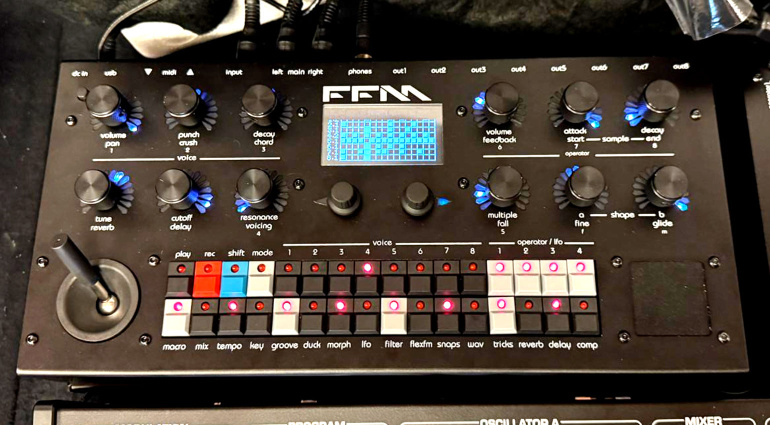
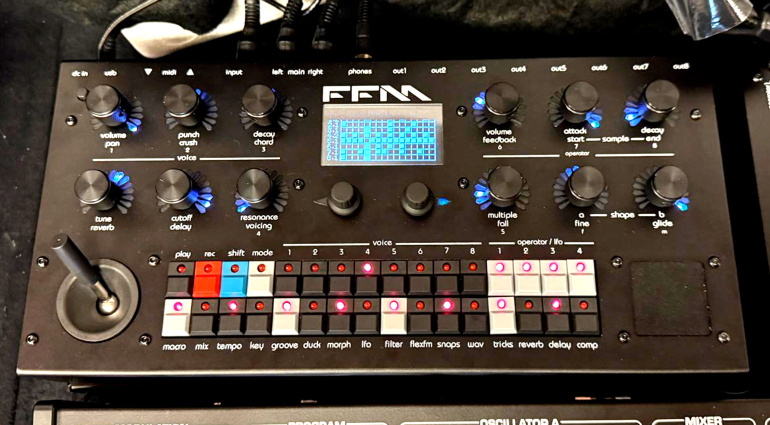
TL;DR: At Superbooth 26, Twisted Electrons unveiled FLEXfm, a hybrid groovebox that marries an eight-voice, four-operator FM engine with analog multi-mode filters and a built-in sampler. A joystick lets you morph between patterns or algorithms in real-time, while 12 LED-ring encoders and a velocity-sensitive trigger pad put performance front and centre — no price or release date yet, but this is the most ambitious box from the French mavericks to date.
- Eight voices of FM synthesis with four operators and 32 editable algorithms, each routed through an analog multi-mode filter.
- Built-in sampler with audio input for recording, USB sample import, and resampling — a first for Twisted Electrons’ FM grooveboxes.
- Joystick enables seamless morphing between four patterns or four algorithms, plus user-recordable LFO waveforms.
- Sequencer packs polyphonic chaining, step division (up to eight sub-steps), operator masking per step, probability engine, and mix scene snapshots.
- Individual outputs for each voice, stereo out, and a velocity-sensitive trigger pad for rolls and ghost notes.
Reading time: 3 min
Want more synth news before your next coffee break? Join the Noxal newsletter — no spam, just gear worth knowing about.
The French Connection: Twisted Electrons Does It Again

Twisted Electrons has long been the quiet overachiever of the groovebox world. While everyone else was chasing virtual analog or sample-based workflows, the French outfit doubled down on FM synthesis — first with the MEGAfm series, then with the TWISTfm and the percussion-focused Blast Beats. Their machines have always felt like they were designed by people who actually use them, not by marketing committees. The FLEXfm, unveiled at Superbooth 26, is the logical next step: a hybrid that stuffs FM, sampling, and analog filters into a compact desktop box. And yes, there’s a joystick. We’ll get to that.
At Noxal, we’ve spent enough late nights twisting operators and wrestling with menus to know that FM synthesis can be both rewarding and infuriating. The FLEXfm looks to tip the balance toward the former, with a control surface that puts 12 LED-ring encoders and a velocity-sensitive trigger pad front and center. No menu-diving for the core stuff. That alone is worth a raised eyebrow — and a second pour of coffee.
FM Meets Analog Heat: A Synth Brain’s Dream
The FM engine here is no half-baked add-on. We’re talking eight voices, each with four operators and 32 algorithms. That’s a lot of harmonic real estate. Each operator is highly editable — envelope, ratio, level, the works — so you can go from glassy DX7-style bells to gnarled, inharmonic textures that sound like a dying modem having a bad trip. But the real kicker is the analog multi-mode filter per voice. This isn’t a digital emulation; it’s the same kind of character circuit found in the TWISTfm, which means you get that warm, slightly unpredictable analog grit that digital filters often sand away.
Combine this with four LFOs per voice (yes, four) and the ability to record your own LFO waveforms using the joystick, and you’ve got a modulation matrix that could keep even the most jaded studio hermit busy for weeks. The joystick also lets you morph between four algorithms or four patterns in real-time, which is the kind of hands-on control that makes live sets feel alive rather than pre-programmed. I can already imagine the happy accidents — a filter sweep here, an algorithm change there, and suddenly your beat has grown a pair of ears.
The Joystick and the Sequencer: Performance Tools That Matter
Let’s talk about that joystick. It’s not just a gimmick — it’s a performance interface that lets you bend, warp, and morph your sound in real-time. You can assign it to filter cutoff, algorithm selection, pattern morphing, even custom LFO recording. For a groovebox that’s already packed with knobs, the joystick adds a dimension of expression that’s hard to replicate with standard encoders. It’s the kind of feature that makes you want to actually perform rather than just press play and twiddle.
The sequencer is equally well-thought-out. Polyphonic chaining means you can build complex arrangements across patterns. Step division goes down to eight sub-steps, which is great for those ratcheting, glitchy hi-hat patterns. Operator masking lets you toggle individual operators on or off per step — think of it as FM patch variation without needing a separate pattern. There’s a probability engine for random accents, snapshot save/recall for mix scenes, and the trigger pad is velocity-sensitive, so rolls and ghost notes feel natural. If you’ve ever tried to program a convincing flam on a standard step sequencer, you’ll appreciate this.
Sampling and Connectivity: More Than Just a Synth Engine
Here’s where FLEXfm breaks new ground for Twisted Electrons: built-in sampling. You can import samples via USB or record your own through the audio input. Resampling is supported, so you can layer FM sounds with sampled textures, run them through the analog filters, and then resample the result. It’s a closed-loop creative system that blurs the line between synthesis and sampling. For a company that’s historically been pure FM, this is a big deal.
Connectivity is generous. Stereo output, audio input for sampling, and — wait for it — individual outputs for each of the eight voices. That’s a level of routing flexibility usually reserved for high-end modular setups or flagship workstations. You can send each voice to a separate channel on your mixer, apply external effects, or pan them across the stereo field. For live performers and studio rats alike, this is a godsend. No more wrestling with internal effects that sound like wet cardboard.
Market Context and Who It’s For
The groovebox market is crowded — Elektron’s Digitakt and Digitone, the Roland MC-series, the Polyend Tracker, and various others all vie for your desk space and your wallet. But FLEXfm carves out a unique niche by combining FM synthesis, analog filters, and sampling in a compact form factor with a performance-oriented interface. It’s not trying to be everything to everyone; it’s trying to be a powerful, hands-on tool for people who love FM but want more character than a cold digital engine can provide.
Who is this for? Producers who crave the complexity of FM but don’t want to stare at a computer screen. Live performers who need instant access to sound-shaping controls. Sound designers who want to layer FM textures with sampled material. And anyone who’s ever felt that their groovebox was holding them back from real-time experimentation. Twisted Electrons hasn’t announced pricing or availability yet, but if the FLEXfm lands anywhere near the price of the TWISTfm (around €500), it could be a serious contender for best groovebox of the year. We’ll update you as soon as we know more — and after we’ve had a chance to put it through its paces with a fresh pot of coffee and a deadline looming.
Frequently Asked Questions
What is the Twisted Electrons FLEXfm?
The FLEXfm is a hybrid groovebox that combines an eight-voice, four-operator FM synthesis engine with analog multi-mode filters and a built-in sampler. It features a joystick for real-time morphing, 12 LED-ring encoders, and a velocity-sensitive trigger pad, all housed in a compact desktop format.
Does the FLEXfm have individual outputs?
Yes, it offers individual outputs for each of the eight voices, plus a stereo output. This allows you to route each voice to separate mixer channels, apply external effects, or create complex panning setups — a rare feature at this price point.
When will the FLEXfm be available and how much will it cost?
Pricing and release date have not been announced yet. We’ll update this article as soon as Twisted Electrons provides more information. For now, you can see it in person at booth O396 at Superbooth 26.
We at Noxal will be refreshing the Twisted Electrons product page with the same nervous energy we reserve for the last sip of a morning espresso. If this groovebox sounds as good on paper as it does in our heads, we might need to start a support group for our bank accounts.