TL;DR: Tasty Chips has announced the GR-2, a new portable granular synth that borrows heavily from the flagship GR-MEGA’s firmware and engine but costs €849 — roughly $1000 less. It packs four engines, 128 grains per voice, a 7-inch touch screen, and built-in effects, making high-end granular synthesis more accessible without sacrificing the company’s signature sound.
- The GR-2 runs the same firmware as the GR-MEGA, meaning patches are cross-compatible between the two units.
- It offers four engines (granular, sampler, tape, and spectral with Paulstretch), 128 grains per voice, and up to 4000 grains system-wide.
- Connectivity includes stereo inputs/outputs, DIN MIDI, two USB-A 3.0 ports, and USB-C for DAW integration (8 in/10 out).
- Effects suite includes chorus, compressor, two delays, two distortions, flanger, 5-band parametric EQ, reducer, two reverbs, ring mod, and vibrato.
- Preorder is live via Kickstarter until May 27, 2026, with early bird tiers sold out; general price is €849.
Reading time: 3 min
Want more synth news before your next coffee break? Join the Noxal newsletter — no spam, just gear worth knowing about.

What Is the Tasty Chips GR-2?
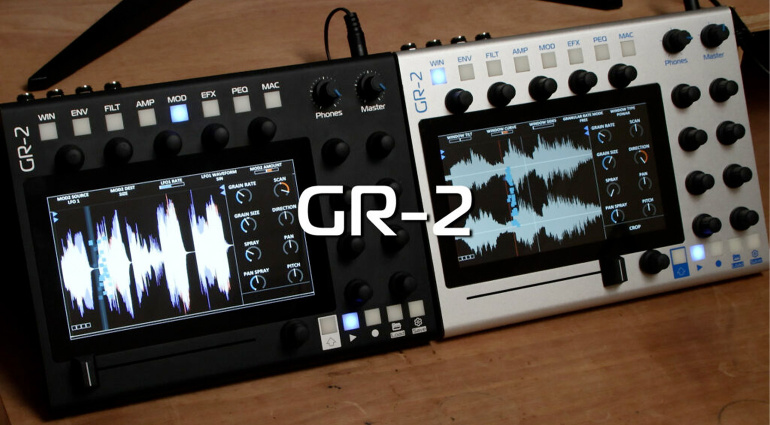
We at Noxal have a soft spot for granular synthesis done right. It’s a rabbit hole that can either yield lush, evolving textures or a headache-inducing menu dive. Tasty Chips, bless them, have been refining the experience since the GR-1 launched back in 2017. Now they’re back with the GR-2, a portable granular sampler that essentially repackages the GR-MEGA’s brain into a more affordable, smaller chassis.
The headline here is not just the price — €849, which is roughly $1000 less than the MEGA — but the promise that the GR-2 runs the same firmware. That means patches you build on the big brother can load directly onto the little one. That’s not just convenience; it’s a statement of intent. Tasty Chips isn’t cutting corners on the core sound engine; they’re cutting them on the physical interface and, presumably, the build materials.
Engines and Architecture: MEGA Lite
Inside the GR-2, you get four engines: granular, sampler, tape, and spectral. The spectral engine is based on Paulstretch, which is a nice touch for anyone who wants to time-stretch samples into ambient oblivion. Each voice can handle up to 128 grains, and the system supports up to 4000 grains total across all voices. That’s a lot of microscopic sound particles floating around in there.
Polyphony is rated at 16 voices per layer, with four layers available. That’s fewer than the MEGA’s 32 voices per layer, but still enough to build complex, stacked textures. The effects section is generous: chorus, compressor, two delays, two distortion models, a flanger, a five-band parametric EQ, a reducer, two reverb algorithms, a ring modulator, and vibrato. If you can’t find a sound in that chain, you’re not trying hard enough.
One of the most practical upgrades from the GR-1 is the addition of stereo samples and built-in audio inputs. The original GR-1 was mono-only, which was a limitation for anyone wanting to process stereo sources or build wider soundscapes. The GR-2 fixes that without fanfare, and we appreciate the quiet competence.
Control Surface and Connectivity
Let’s talk about the interface, because this is where the GR-2 diverges most from its siblings. There’s a 7-inch touch screen that serves as the primary navigation tool. Tasty Chips claims reduced menu diving — with most settings one level deep — and the Quick Access menu buttons across the top let you jump to the most common parameters. You can also make any setting full screen with a gesture, which is a nice touch for live tweaking.
The physical controls have shifted from potentiometers to encoders for most parameters. Tasty Chips says this is intentional: encoders are better for modulated parameters because they don’t have a fixed physical position. The only potentiometers left are for hard controls like master volume. The absence of vertical faders — a hallmark of the GR-MEGA — is notable, but the top-side encoders are meant to compensate. As they put it, “It’s not possible to change two LFOs at the same time, but you do have four LFOs and more options in the Quick Access pages.”
Connectivity is solid for a portable unit. You get DIN MIDI in and out/thru, two USB-A 3.0 ports, and USB-C for DAW connection with eight channels in and ten out. Audio-wise, there are stereo inputs and outputs, plus a headphone output with its own volume knob. That’s enough to integrate into most setups without needing a breakout box.
Pricing and Market Context
The GR-2 is currently available for preorder via Kickstarter at €849. Early bird tiers are already gone, which suggests demand is real. The campaign runs until May 27, 2026, and Tasty Chips will be showing it off at Superbooth. For context, the GR-1 originally launched at a similar price point, so the GR-2 undercuts it slightly while offering more features. The GR-MEGA, meanwhile, sits at around €1849.
At this price, the GR-2 competes with other hardware granular options like the 1010music Nanobox (for the truly portable crowd) or used modules from Make Noise and Instruo. But none of those offer the same integration of four engines, touch-screen navigation, and cross-compatibility with a flagship instrument. It’s a sweet spot for anyone who wants serious granular synthesis without selling a kidney.
Who Is It For?
This is for the producer who has been eyeing the GR-MEGA but can’t justify the cost. It’s for the GR-1 owner who wants stereo inputs, more polyphony, and a better effects section. It’s for the live performer who needs a compact unit that can still deliver complex, evolving textures without a laptop. And it’s for the curious sound designer who wants to explore granular synthesis without the steep learning curve of modular or the limitations of software.
We at Noxal appreciate when a company listens to user feedback — the GR-2 is clearly the result of years of community input. The addition of stereo, improved effects, and easier menu navigation are all things GR-1 users have been asking for. If the firmware truly matches the MEGA’s capabilities, this could be the most cost-effective gateway to high-end hardware granular synthesis on the market right now.
Frequently Asked Questions
Can the GR-2 load patches from the GR-MEGA?
Yes. Tasty Chips states that both units run the same firmware, so patches are cross-compatible. This is a major selling point for anyone who might upgrade later or wants to share sounds between the two.
Does the GR-2 have built-in audio inputs for sampling?
Yes, the GR-2 includes stereo audio inputs, a feature that was absent from the original GR-1. This allows you to sample external sources directly into the unit, making it more versatile for live and studio use.
How does the GR-2 compare to the GR-1 in terms of polyphony?
The GR-2 offers 16 voices of polyphony per layer across four layers, for a total of 64 voices. The GR-1 had fewer voices per layer, so this is a significant upgrade. The GR-MEGA still leads with 32 voices per layer, but the GR-2 is no slouch.
I’ll be honest: I preordered one before finishing this article. Now I just need to find a coffee mug big enough to hold my excitement — and my caffeine — while I wait for the shipping confirmation.