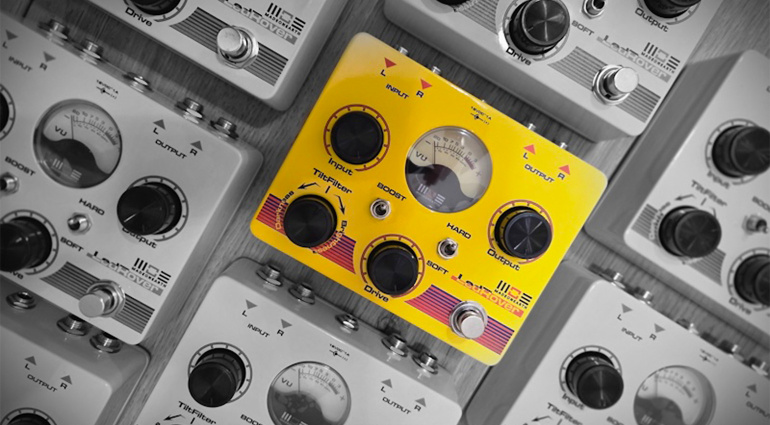
TL;DR: MadeOnEarth, creator of the revered Analog Chorus 60, has unveiled the LedRover — a 100% analog diode distortion pedal built specifically for synthesizers and drum machines. It features two distinct distortion modes, a custom tilt filter with a steep 15dB/octave slope, and a 10X boost switch for extreme saturation.
- Analog diode distortion with two modes (Hard and Soft) optimized for synths and drum machines, not guitars
- Custom tilt filter with unusual 15dB/octave slope for pre-distortion shaping
- 10X Boost button drives op-amp saturation into the filter
- Dual-mode VU meter monitors wet and dry signals
- Expected pricing around €500, with availability targeted for early July
Reading time: 4 min
Want more synth news before your next coffee break? Join the Noxal newsletter — no spam, just gear worth knowing about.

What Is the LedRover?
We at Noxal have a soft spot for pedals that refuse to be polite. The LedRover from MadeOnEarth is exactly that kind of beast. It is a 100% analog distortion pedal, but before you roll your eyes thinking “not another overdrive for the pedalboard,” know this: it was designed from the ground up for synthesizers and drum machines. That means no mid-scooped guitar voicings, no impedance mismatches, and no loss of low-end heft.
Designer Isak Eliyahu — the same wizard who brought us the component-accurate Analog Chorus 60 (a Juno-60 chorus in a stompbox) — started this project with a singular goal: find the ultimate distortion to pair with a TB-303. What emerged is a diode-based distortion circuit that, in the demo videos, absolutely decimates a Moog DFAM in the most musical way possible. I am not supposed to editorialize here, but I have listened to the demos three times now, and my coffee has gone cold from being neglected. That is a high compliment.
How It Works: The Diode Revelation
Rather than copying a standard guitar distortion circuit, Eliyahu went looking for something more interesting. He found inspiration in what he describes as “a famous filter resonance design that uses diodes in the feedback loop, which creates a round sound with a distortion tone that can be aggressive while remaining musical.” The source does not name names, but we are 90% sure that is the KORG MS-20 filter architecture. That filter’s diodes in the feedback path are legendary for that snarling, organic breakup when resonance is cranked.
Based on this, the LedRover offers two distinct diode distortion modes labeled Hard and Soft. The exact diode types and placements differ between the two, and both were calibrated by running actual synthesizers and drum machines through them — not guitars. That matters. A guitar’s harmonic content sits in a different range than a sawtooth wave from a 303 or a kick drum from an 808, and most distortion pedals designed for guitar will turn your synth into a muddy mess. The LedRover apparently does not.
Tilt Filter and Boost Controls
Beyond the distortion itself, the LedRover packs a custom-designed tilt filter. Most tilt filters in the pedal world are simple 6dB/octave affairs — you turn one knob to shift the balance between bass and treble. MadeOnEarth went further: the tilt filter here uses a 15dB/octave slope for both low and high frequency ranges. That is steeper than standard, and it means the filter is more aggressive at carving out frequencies before they hit the distortion circuit. The result, according to the designer, is that the signal hits the distortion “with high saturation” and emphasizes frequencies that are pleasant to the ear.
Then there is the 10X Boost button. It is labeled as a way to “drive the signal hard with op-amp saturation into the filter,” and while it is ostensibly for boosting weak signals from passive gear, there is nothing stopping you from slamming a hot synth signal into it. That is exactly the kind of “abuse the controls” philosophy we appreciate. The pedal also features dedicated input and output level dials, buffered bypass, and — this is a nice touch — a dual-mode physical VU meter that can monitor wet or dry signals. It is a stompbox format in a custom aluminum box with UV printing and bespoke potentiometers. It looks like it belongs in a studio, not on a pedalboard.
Pricing, Availability, and Context
MadeOnEarth is showing the LedRover at Superbooth this week. No official price has been announced yet, but given that the Analog Chorus 60 sells for €500, we expect the LedRover to land in that same ballpark. A YouTube comment from the designer indicates a target release of early July. That is soon. For comparison, the boutique distortion pedal market for synths is not exactly crowded — most players are either using guitar pedals and hoping for the best, or spending serious money on Eurorack distortion modules. A dedicated stompbox at this level of design is rare.
We should note that this article contains advertising links that help fund the site, but the price for you remains the same. We do not take commissions lightly, and we would not link to anything we would not buy ourselves. The LedRover looks like it might earn that trust.
Who Is This For?
This pedal is for anyone who has ever plugged a 303, DFAM, or even a simple square wave into a distortion pedal and felt disappointed. It is for the producer who wants to retain the character of their synth while adding dirt that does not turn into white noise. It is for people who understand that pre-distortion filtering is more important than the distortion itself. It is also for collectors of boutique gear who appreciate a well-designed enclosure with a VU meter that actually does something.
If you are a guitarist, you might still enjoy this pedal, but that is not what it was built for. The steep tilt filter and diode voicing are optimized for electronic instruments. Do not expect it to clean up with your guitar’s volume knob. Expect it to make your SH-101 growl like a wounded animal.
Frequently Asked Questions
What is the difference between the Hard and Soft distortion modes?
The two modes use different diode placements and types. Hard mode is more aggressive and saturated, while Soft mode retains more of the original signal’s character with a rounder, less clipped distortion. Both are designed to stay musical even at extreme settings.
Does the LedRover work with guitar?
Technically yes, but it is optimized for synthesizers and drum machines. The tilt filter’s 15dB/octave slope and diode voicing are calibrated for the harmonic content of electronic instruments. Guitarists may find it lacks the standard midrange voicing they are used to.
Is the VU meter just for show?
No. The dual-mode VU meter can monitor either the wet or dry signal, which is genuinely useful for setting input and output levels to avoid unwanted clipping or to match bypass levels. It is a practical tool, not just a glowing decoration.
Now if you will excuse me, my coffee has gone cold from watching those demos on repeat. I am going to make another pour-over and pretend I do not already have a distortion pedal problem. The LedRover is not helping.