TL;DR: Neutral Labs has announced Queen Elmyra, an eight-voice drone synthesizer with 24 oscillators, 96 patch points, and a pair of real vacuum tubes for analog saturation. It’s now available on Kickstarter at €1,500 for early birds, with shipping expected in October 2026.
- Eight voices, each with three digital wavetable oscillators (up to 24 total) in quantized, microtonal, or chord modes.
- Two analog multi-mode filters that can be linked for stereo operation, plus stereo digital effects (delay, reverb, chorus, phaser, etc.).
- Two real vacuum tubes provide analog saturation and distortion, visible through a window on the front panel.
- 96 patch points for CV control over every parameter, including voice-to-voice modulation and independent voice outputs.
- Kickstarter pricing starts at €1,500 (early bird) or €1,600 regular; ships October 2026.
Reading time: 4 min
Want more synth news before your next coffee break? Join the Noxal newsletter — no spam, just gear worth knowing about.

The Queen Ascends
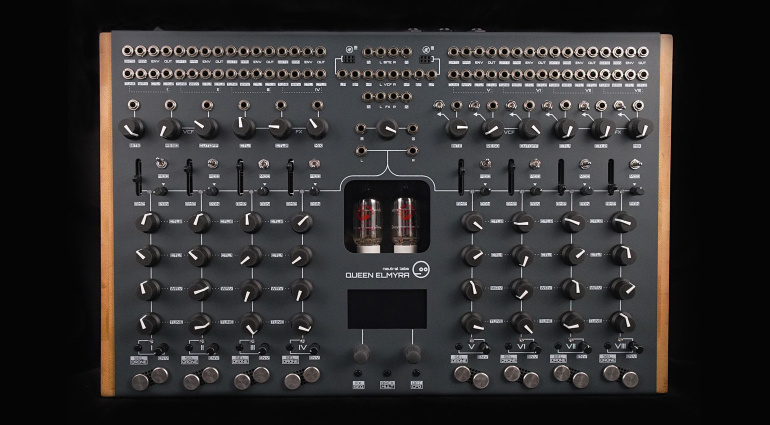
Neutral Labs has never been one for subtlety. Their original Elmyra was a compact, touch-plate-driven drone synth that channeled the chaotic spirit of Soma Laboratory’s Lyra-8 while carving its own niche. Now, they’ve unleashed Queen Elmyra, a synthesizer that looks like it was designed by a mad scientist with a budget and a vendetta against silence. With eight voices, 24 oscillators, 96 patch points, and two real vacuum tubes, this thing isn’t just a drone synth—it’s a throne.
At first glance, Queen Elmyra is intimidating. The panel is a dense jungle of jacks, knobs, and touch plates, with a glowing window in the center that houses a pair of tubes like the eyes of a mechanical deity. But beneath the imposing exterior lies a surprisingly flexible instrument. Each of the eight voices is built around three digital wavetable oscillators, capable of operating in quantized, microtonal, or chord modes. That’s 24 oscillators total, all controlled via capacitive touch plates that respond to finger pressure and position.
The digital oscillators are no slouch either. They offer wavetable synthesis with a wide range of waveforms, and the chord mode lets you stack intervals for instant harmonic density. This isn’t a synth you program with a screen; it’s a performance instrument where every gesture shapes the sound. The tubes add an analog warmth that digital oscillators often lack, saturating the signal before it hits the filters and effects.
What Makes Her Royal
The heart of Queen Elmyra is its signal path. After the oscillators, the signal passes through one of two analog multi-mode filters, which can be linked for stereo operation. These filters are based on classic designs but with a modern twist—they’re clean, resonant, and capable of everything from gentle low-pass sweeps to screaming band-pass screeches. The ability to route each voice through either filter independently opens up complex stereo fields that are rare in the drone world.
Then there are the effects. Each voice has two effect slots, which can be filled with a digital suite including delay, reverb, chorus, phaser, filter, and distortion. These are stereo effects, and they’re lush. The reverb, in particular, can stretch a simple sine wave into an infinite cathedral of sound. Combined with the tube saturation, the effect chain is capable of producing drones that feel both massive and intimate.
But the real star is the patch bay. With 96 patch points, you can modulate every single parameter—oscillator pitch, filter cutoff, effect depth, even the sequencer. This is where Queen Elmyra transforms from a drone machine into a modular ecosystem. Want one voice to control the filter of another? Just patch it. Want to use a voice as a modulation source? Done. The sequencer per voice adds rhythmic potential, allowing for evolving patterns that drift in and out of sync.
Patching and Connectivity
Queen Elmyra doesn’t just talk to itself—it talks to your whole studio. There’s MIDI In and Out, clock in and out, and a reset input for the sequencers. But the individual voice outputs are the killer feature. Each voice has its own jack, meaning you can send them to separate mixer channels, process them differently, or even use the voices as independent monophonic synths. This is a game-changer for live performance and recording, where you might want to treat each voice as its own instrument.
The balanced stereo output is clean and robust, but the headphone jack is a welcome addition for late-night sessions when your neighbors don’t appreciate 24 oscillators of microtonal drone at 3 AM. The touch plates are responsive and intuitive, though I’ll admit they take some getting used to—especially if you’re accustomed to physical keys or knobs. But once you’ve spent an hour coaxing evolving textures from them, the learning curve feels like a small price to pay.
One notable omission: no USB connectivity. This is a purely analog/CV-controlled machine, so you’ll need a MIDI interface or a separate USB-to-CV converter if you want to sequence it from a DAW. That’s fine by us—we at Noxal prefer our gear to be as hands-on as possible.
Market Context and Value
At €1,500 for early birds (€1,600 regular), Queen Elmyra sits firmly in the high-end drone synth territory. That’s more than the Make Noise Strega or the Soma Lyra-8, but you’re getting eight voices, 24 oscillators, and real tubes. Compare it to a Eurorack system with similar capabilities, and you’re looking at €3,000 or more. Neutral Labs has essentially packed a full modular voice into a standalone unit, and the price reflects that efficiency.
There’s also the Kickstarter factor. Neutral Labs has a solid track record with the original Elmyra and the Elmyra 2, but crowdfunding always carries risk. The October 2026 shipping date is a long wait—nearly two years from now. We’ve seen delays happen (looking at you, countless synth Kickstarters), so backers should be prepared for potential timeline shifts. That said, the company has been transparent about their production plans, and the early bird pricing is generous enough to warrant the risk for dedicated drone enthusiasts.
In terms of competition, the Lyra-8 remains the spiritual predecessor, but Queen Elmyra outpaces it in almost every spec. The Soma Lyra-8 has 8 voices but analog oscillators and no patch bay. Queen Elmyra offers digital wavetables, CV control, and tubes. The two are complementary, not directly competing. If you already have a Lyra, Queen Elmyra could be its evil twin.
Who Is This For?
This synth is for the drone warlord who needs more than just a few notes. It’s for the modular enthusiast who wants a self-contained system that doesn’t require a wall of modules. It’s for the ambient producer who dreams of stereo fields that feel infinite. And it’s for the curious tinkerer who isn’t afraid of 96 patch points and a two-year wait.
If you’re looking for a straightforward, menu-driven synth, this isn’t it. Queen Elmyra demands engagement. You will spend hours patching, tweaking, and listening. The touch plates require practice, and the sheer number of options can be overwhelming at first. But once you find your flow, the rewards are immense. This is a synth that rewards exploration and punishes predictability.
We at Noxal are cautiously optimistic. The specs are breathtaking, the design is audacious, and the price is fair for what’s offered. But crowdfunding is a beast, and the wait is long. If you can afford to back it and forget it, Queen Elmyra might just be the queen your drone rig deserves.
Frequently Asked Questions
What is the difference between Queen Elmyra and the original Elmyra?
The original Elmyra was a compact, 4-voice drone synth with analog oscillators and a simpler touch-plate interface. Queen Elmyra expands to 8 voices, each with three digital wavetable oscillators (24 total), adds analog tubes for saturation, includes 96 patch points for full CV control, and offers stereo effects and individual voice outputs. It’s a significant upgrade in every dimension.
Can I use Queen Elmyra without patching?
Yes, the synth comes with a default internal routing that allows you to play it without any patch cables. However, the patch bay is where the magic happens. If you never patch, you’re missing out on its modular capabilities. The 96 patch points are optional but highly encouraged for full exploration.
When will Queen Elmyra ship, and is the Kickstarter risky?
Neutral Labs plans to ship in October 2026. As with any Kickstarter, there is risk of delays or cancellation. However, Neutral Labs has a history of delivering on previous projects (Elmyra, Elmyra 2), and the campaign appears well-planned. The early bird price of €1,500 offers good value if you’re willing to wait.
I’ll be pouring a second cup of coffee while staring at the Kickstarter page, calculating how many patches I can map before the caffeine kicks in. Long live the queen—and long live the drone.